
Letters to a Friend, Written to Mrs. Ezra S. Carr, 1866-1879
John Muir
THE CLASSIC COLLECTION · 1914
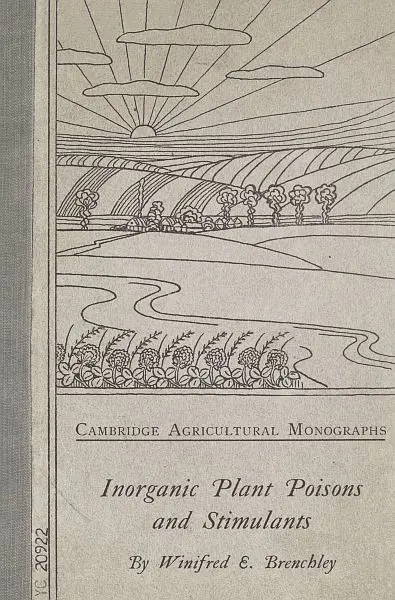
"Inorganic Plant Poisons and Stimulants" by Winifred Elsie Brenchley is a scientific publication written in the early 20th century. The work investigates the effects of various inorganic substances, specifically focusing on their toxic and stimulating actions on plant growth and development. It aims to provide a comprehensive analysis and correlation of existing research related to these substances, delving into their applicability in agricultural practices. The opening of the work begins with a preface outlining the significant changes in agricultural practices over the previous century, highlighting the use of artificial fertilizers and the conflicting evidence surrounding inorganic substances as potential plant nutrients. Brenchley sets the stage for further exploration by discussing the historical context of plant nutrition and the classification of substances based on their effects on plant growth. In particular, she emphasizes the complexity of understanding how certain inorganic compounds can exhibit both toxic and beneficial effects, depending on their concentrations and combinations with other nutrients, thereby inviting future investigation into the nuanced interactions between plants and these chemicals.
Introduction adapted from the source catalogue; source summaries may be automatically generated.
Free to read · English · 41,390 words · No account needed
MAKE TIME FOR A GOOD BOOK
On by default. Untick to stop anonymous reading totals. Each page counts after 10 seconds in view. How this works.
Anonymous counting is on unless you have switched it off.
DUNNINGTON, F. P. Manganese in the Ash of Wheat. Proc. Amer. Chem. Soc. II, 141. (1878) 79
EHRENBERG, P. Wirkungen des Zinks bei Vegetationversuchen. Chem. Zeit. XXXII, 937. (1908) 43
EWERT, Dr. Der wechselseitige Einfluss des Lichtes und der Kupferkalkbrühen auf den Stoffwechsel der Pflanze. Landw. Jahrb. XXXIV, 233–310. (1905) 31
FEILITZEN, H. von. Kann man auf dem freien Felde einen günstigen stimulierenden Einfluss auf die Entwickelung der Kulturpflanzen durch kleine Mengen Mangansalze wahrnehmen? Journ. Landw. LV, 289–92. (1907) 87
FITCH, R. The action of insoluble substances in modifying the effect of deleterious agents upon the fungi. Ann. Mycologici, IV, 313–22. (1906) 23
FLICHE et GRANDEAU. Ann. Chim. Phys. 354. (1874) 71
FRANK, B. und KRÜGER, F. Ueber den Reiz, welchen die Behandlung mit Kupfer auf die Kartoffelpflanze hervorbringt. Ber. Deut. bot. Gesell. XII, 8–11. (1894) 30
FREYTAG, M. Ueber den Einfluss des Zinkoxyds und seiner Verbindungen auf die Vegetation. Mitth. König. landw. Akad. Poppelsdorf, 82–99. (1868) 37, 38, 42, 43
FREYTAG, M. Die schädlichen Bestandteile des Hüttenrauchs der Kupfer-, Blei-, und Zinc-hütten und ihre Beseitigung. Landw. Jahrb. II, 315–57. (1882) --
FUKUTOME, T. On the influence of manganese salts on Flax. Bull. Coll. Agric. Tokyo, VI, No. 2, 137–8. (1904) 88
GAUTIER, A. et CLAUSMANN, P. Origines alimentaires de l’arsenic normal chez l’homme. Compt. rend. CXXXIX, 101–8. (1904) 51
GIRARD, A. Sur l’accumulation dans le sol des composés cuivriques employés pour combattre les maladies parasitaires des plantes. Compt. rend. CXX, 1147–52. (1895) --
GORUP-BESANEZ, E. von. Ueber das Verhalten der vegetirenden Pflanze und der Ackererde gegen Metallgifte. Ann. Chem. Pharm. CXXVII, 243–56. (1863) 25, 41, 58
GOSIO, B. Einwirking von Microphyten auf feste Arsenverbindung. Mitt. aus den Lab. sci. della Direzione di Sanità. Abst. in Ber. Deut. chem. Ges. XXV, Vol. III, 346. (1892) 63
GOSIO, B. Zur Frage, wodurch die Giftigkeit arsenhaltiger Tapeten bedingt wird. Ber. Deut. chem. Gesell. XXX, Bd. 1, 1024–6. (1897) 63
GOSIO, B. Weitere Untersuchungen über die Biologie und den Chemismus von Arsenschimmelpilzen. Il Policlinico, X. (1900). Abs. in Bot. Centr. LXXXVII, 131–3. (1901) 63
GÖSSL, J. Ueber das Vorkommen des Mangans in der Pflanze und über seinen Einfluss auf Schimmelpilze. Beih. Bot. Centr. XVIII, 1, 119–32. (1905) 80
GUERIN, G. Sur un composé organique, riche en manganèse, retiré du tissu ligneux. Compt. rend. CXXV, 311–2. (1897) 79
GUSTAVSON, G. Chemische Rolle der Mineralsalze in der organischen Natur. Mitt. Landw. Forstwirthsch. Akad. Petrowskoë-Rasumowskoë. Heft 3, 1–15. Moskau. (1881.) Abst. in Just, Bot. Jahresber. I, 38. (1882) 45
GUTHRIE, F. B. and COHEN, L. Note on the occurrence of manganese in soil and its effect on grass. Agric. Gaz. New South Wales, XXI, 219–22. (1910) 83
GUTHRIE, F. B. and HELMS, R. Pot experiments to determine the limits of endurance of different farm crops to certain injurious substances. Part 1. Wheat. Ag. Gaz. N.S.W. XIV, 114–20. (1903) 60
GUTHRIE, F. B. and HELMS, R. Ibid. Part 2. Maize. Ag. Gaz. N.S.W. XV, 29–32. (1904) 60
GUTHRIE, F. B. and HELMS, R. Ibid. Part 3. Barley and Rice. Part 4. Rye. Ag. Gaz. N.S.W. XVI, 853–60. (1905) 60
Your reading position is saved on this browser. Take it to another device with a library code. Reading pages adapt to text, rather than matching a printed edition.
BEHIND THE BOOK
This eBook is for the use of anyone anywhere in the United States and most other parts of the world at no cost and with almost no restrictions whatsoever. You may copy it, give it away or re-use it under the terms of the Project Gutenberg License included with this eBook or online at www.gutenberg.org. If you are not located in the United States, you will have to check the laws of the country where you are located before using this eBook. Read the source licence.
The original source file, including credits and licence, is retained by this library. Request an original-format copy at no charge. Please include the book title and Project Gutenberg identifier #48008.
KEEP YOUR CURIOSITY GOING
John Muir

Asa Gray
Asa Gray

Florence Nightingale
Elizabeth Robins Pennell
Denison Olmsted