
Letters to a Friend, Written to Mrs. Ezra S. Carr, 1866-1879
John Muir
THE CLASSIC COLLECTION · 1914
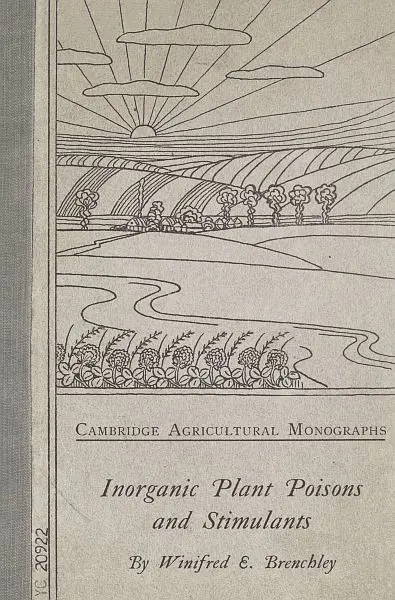
"Inorganic Plant Poisons and Stimulants" by Winifred Elsie Brenchley is a scientific publication written in the early 20th century. The work investigates the effects of various inorganic substances, specifically focusing on their toxic and stimulating actions on plant growth and development. It aims to provide a comprehensive analysis and correlation of existing research related to these substances, delving into their applicability in agricultural practices. The opening of the work begins with a preface outlining the significant changes in agricultural practices over the previous century, highlighting the use of artificial fertilizers and the conflicting evidence surrounding inorganic substances as potential plant nutrients. Brenchley sets the stage for further exploration by discussing the historical context of plant nutrition and the classification of substances based on their effects on plant growth. In particular, she emphasizes the complexity of understanding how certain inorganic compounds can exhibit both toxic and beneficial effects, depending on their concentrations and combinations with other nutrients, thereby inviting future investigation into the nuanced interactions between plants and these chemicals.
Introduction adapted from the source catalogue; source summaries may be automatically generated.
Free to read · English · 41,390 words · No account needed
MAKE TIME FOR A GOOD BOOK
On by default. Untick to stop anonymous reading totals. Each page counts after 10 seconds in view. How this works.
Anonymous counting is on unless you have switched it off.
Thus it is evident that it is exceedingly difficult sharply to characterise either toxic or stimulant action. In neither case is the reaction simple--many factors may come into play and many processes are concerned, while the effect of a so-called poison may vary in respect of each of the functions and processes concerned. If the poison is presented in great strength the toxic action is dominant, and probably affects many functions in the same sense, so that the action is, so to speak, cumulative. Lower down in the scale of concentration differentiation of action may set in, and while some processes may still be hindered, others may be stimulated. If the two actions balance one another an apparent indifference may be manifested, so that it seems that such strengths of the poison have no effect on growth, either harmful or beneficial. At still lower concentrations, with certain plants and certain poisons, the stimulative action overpowers the toxic effect, so that in some respect or other improvement occurs in growth.
It is quite conceivable, however, that some poisons are truly indifferent in weak concentrations, as no stimulation makes itself evident under any circumstances. In these cases one is inclined to suspect that the action is somewhat more simple, in that the toxic effects gradually diminish until no poisonous action is manifest at very weak concentrations, and as no stimulation is present to bring the growth above the normal with these very weak concentrations the plant is similar to those grown without any addition of the poison.
The modus operandi of these stimulative agents is not yet fully understood. Perhaps at the present time two main theories hold the field: (1) that they act as catalytic agents, being valueless on their own account, but valuable in that they aid in the procuring of essential food substances; (2) that the stimulants themselves are of integral value for nutrition. The French school, with Bertrand at the head, hold strongly to the catalytic theory, maintaining that manganese and boron compounds are able to increase growth if they are present in small quantities, as they act as “carriers” whereby the various functions of the plant are expedited by the increased facility with which the essential nutritive elements are supplied. The manganese in laccase, for instance, is held to be an oxygen carrier, whereby the oxygen is first absorbed and then released for the benefit of the plant, the manganese being regarded as essential for the functioning of the enzyme. But, if these elements are essential, this theory seems to stop short of the truth. If certain functions are dependent for their very occurrence upon the presence of even minute traces of any element, then surely that element is as essentially a nutrient element, as vital to the well-being of the plant as is such an element as carbon or nitrogen or phosphorus, even though the latter occurs in far greater quantity. It is necessary that one should free one’s mind from the idea that the quantity of an element present in a plant is an index of its value to the plant. Naturally enough, in the early days of plant physiology, the most abundant elements first engaged the attention of investigators, and they were divided into essential and non-essential, ten elements being classed in the former category. More recent work is beginning to show that other elements are constantly present in plants, but in such small quantities that the older and cruder methods of analysis failed to reveal them, so that until lately they have been completely overlooked in work on plant nutrition. Even yet we do not know which of these other elements are essential and which are merely accidental. While we do know that the ten essential elements (C, H, O, N, S, P, K, Mg, Fe, Ca) are necessary for the well-being of all plants, it is conceivable that these other substances which only occur in very small quantities may be more individual in their action, and that while a trace of a certain element may be absolutely essential to one plant, that same element may be quite indifferent for another species. If one takes a broad outlook, the two theories seem to be in reality only parts of one, the “nutrition” theory carrying matters a little farther than the “catalytic” idea, broadening its scope and extending its application.
Your reading position is saved on this browser. Take it to another device with a library code. Reading pages adapt to text, rather than matching a printed edition.
BEHIND THE BOOK
This eBook is for the use of anyone anywhere in the United States and most other parts of the world at no cost and with almost no restrictions whatsoever. You may copy it, give it away or re-use it under the terms of the Project Gutenberg License included with this eBook or online at www.gutenberg.org. If you are not located in the United States, you will have to check the laws of the country where you are located before using this eBook. Read the source licence.
The original source file, including credits and licence, is retained by this library. Request an original-format copy at no charge. Please include the book title and Project Gutenberg identifier #48008.
KEEP YOUR CURIOSITY GOING
John Muir

Asa Gray
Asa Gray

Florence Nightingale
Elizabeth Robins Pennell
Denison Olmsted