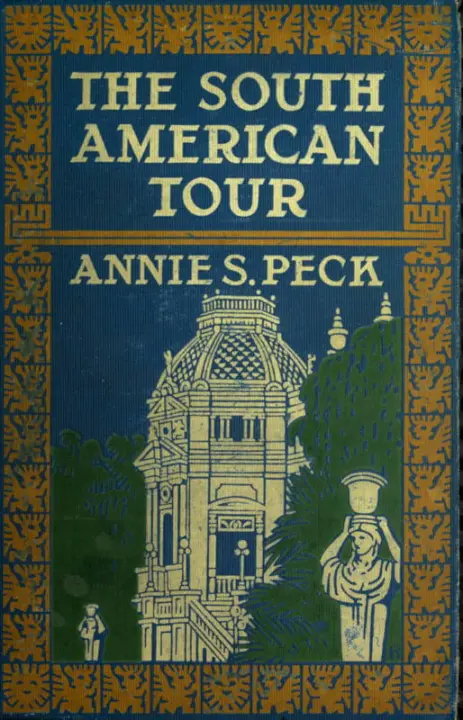
The South American Tour
Annie S. (Annie Smith) Peck
THE CLASSIC COLLECTION · 1922
"Industrial and Commercial South America" by Annie S. Peck is a comprehensive guidebook written in the early 20th century. The work focuses on the geographical, economic, and social aspects of South America, aiming to promote trade and understanding between the continent and the United States. Peck utilizes various authoritative sources, including governmental publications and insights from company officials, to document South America's industrial activities, resources, and potential for commercial relations. At the start of the book, Peck discusses the motivation behind creating this work, emphasizing the need for Americans to gain a deeper understanding of South America and its peoples, particularly in light of increasing commercial relationships. The introduction touches on the historical context of U.S. foreign trade and the importance of cultivating friendly relations with South American countries. The narrative then transitions into an examination of the continent's physical characteristics—its climate, geology, and geography—as a basis for understanding the diverse nations and their industrial potential. The opening suggests that pursuing closer ties with South America could lead to mutual benefits in trade and cultural exchange.
Introduction adapted from the source catalogue; source summaries may be automatically generated.
Free to read · English · 144,769 words · No account needed
MAKE TIME FOR A GOOD BOOK
On by default. Untick to stop anonymous reading totals. Each page counts after 10 seconds in view. How this works.
Anonymous counting is on unless you have switched it off.
=Boyacá=, west and north, except for the Casanare Province, is a Department chiefly in the tierra fria of the East Cordillera. The population is mostly Indian and mestizo, the agriculture is mainly of temperate character: wheat, barley, maize, alfalfa, potatoes. Mining is actively carried on: gold, silver, copper, iron, quicksilver, marble, have been denounced, and 157 emerald claims. Asphalt is worked; there are salt works at Chita, an old Indian town, population 11,000.
Tunja, the capital, is called a fine old city with three public
libraries.
=Santander del Norte=, north of Santander, is also traversed by the East Cordillera. The mean temperatures vary greatly: 46° on several paramos, and 81° in the valleys of the Catatumbo and Zulia. Gold, silver, copper, lead, coal are mined. Rio de Oro, tributary to the Catatumbo, has rich auriferous deposits, and what is now of greater importance, it passes through a district rich in petroleum. The varied crops are the chief source of wealth: wheat and potatoes, coffee and cacao.
Cúcuta, the capital, altitude 1000 feet, with a temperature of 84°, is an important commercial city.
=Santander=, written also with Sur, south of Santander del Norte and of Magdalena, has Boyacá on the east and south; Antioquia and Bolívar are across the Magdalena River on the west. Similar to Santander del Norte, it has more low plains. Gold, silver, copper, talc, asphalt are found.
Bucaramanga, the capital, has a mean temperature ranging from 64° to
84°.
=Cundinamarca=, south of Boyacá, has Meta on the east, Tolima and Huila south, and Tolima west. Less than one-half of the population is white; about one-third is on the high plateau, the rest on the slopes or in the Magdalena Valley, or on the Orinoco watershed. The scattered population is in 110 municipalities. Agriculture is most important, the land near Bogotá being especially well cultivated. In the city many factories are operated and a variety of trades followed. Mines are widely distributed: iron, gold, silver, copper, lead, coal, jasper, etc.
Bogotá is the capital of the Department as well as of the country.
=Huila=, south of Cundinamarca and Tolima, has Meta and Caquetá east, Cauca south, and Cauca and Tolima west. Half of Huila is Government land, forest and mountain. Cattle raising is well developed. Wheat, maize, rice, coffee, sugar, tobacco, are cultivated on a large scale. There are four quartz mines, and gold placers receive attention.
Neiva, the capital, is practically at the head of steam navigation on the Magdalena River. With an altitude of about 1500 feet it has an even temperature approximating 80°.
Your reading position is saved on this browser. Take it to another device with a library code. Reading pages adapt to text, rather than matching a printed edition.
Annie S. (Annie Smith) Peck
BEHIND THE BOOK
This eBook is for the use of anyone anywhere in the United States and most other parts of the world at no cost and with almost no restrictions whatsoever. You may copy it, give it away or re-use it under the terms of the Project Gutenberg License included with this eBook or online at www.gutenberg.org. If you are not located in the United States, you will have to check the laws of the country where you are located before using this eBook. Read the source licence.
The original source file, including credits and licence, is retained by this library. Request an original-format copy at no charge. Please include the book title and Project Gutenberg identifier #72488.
KEEP YOUR CURIOSITY GOING
Wilfrid Scawen Blunt
Wilfrid Scawen Blunt

E. W. (Edgar Watson) Howe
Cécile Tormay

Moritz Busch
John L. Ransom