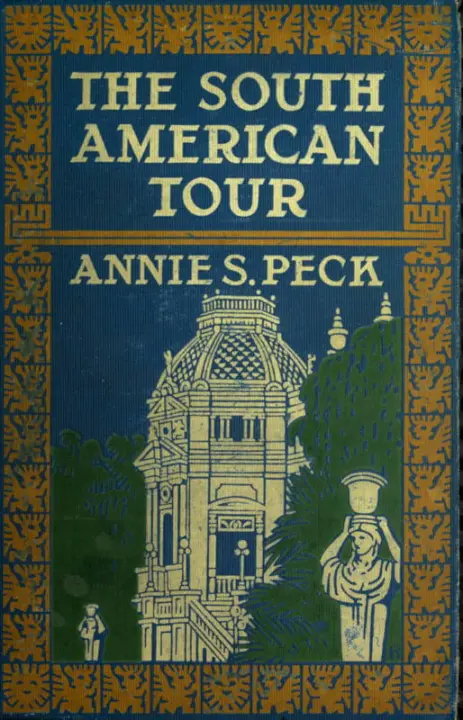
The South American Tour
Annie S. (Annie Smith) Peck
THE CLASSIC COLLECTION · 1922
"Industrial and Commercial South America" by Annie S. Peck is a comprehensive guidebook written in the early 20th century. The work focuses on the geographical, economic, and social aspects of South America, aiming to promote trade and understanding between the continent and the United States. Peck utilizes various authoritative sources, including governmental publications and insights from company officials, to document South America's industrial activities, resources, and potential for commercial relations. At the start of the book, Peck discusses the motivation behind creating this work, emphasizing the need for Americans to gain a deeper understanding of South America and its peoples, particularly in light of increasing commercial relationships. The introduction touches on the historical context of U.S. foreign trade and the importance of cultivating friendly relations with South American countries. The narrative then transitions into an examination of the continent's physical characteristics—its climate, geology, and geography—as a basis for understanding the diverse nations and their industrial potential. The opening suggests that pursuing closer ties with South America could lead to mutual benefits in trade and cultural exchange.
Introduction adapted from the source catalogue; source summaries may be automatically generated.
Free to read · English · 144,769 words · No account needed
MAKE TIME FOR A GOOD BOOK
On by default. Untick to stop anonymous reading totals. Each page counts after 10 seconds in view. How this works.
Anonymous counting is on unless you have switched it off.
---------------------+---------+----------+---------------+----------+--------- DEPARTMENTS | AREA, |POPULATION| CAPITALS |POPULATION|ALTITUDE |in square| | | | in |miles | | | | feet ---------------------+---------+----------+---------------+----------+--------- Coastal Divisions | | | | | Tumbes (Province) | 2,000 | 8,000 | Tumbes | 3,000 | Piura | 17,000 | 155,000 | Piura | 15,000 | 167 Lambayeque | 4,600 | 93,000 | Chiclayo | 5,000 | 82 Libertad | 10,000 | 188,000 | Trujillo | 15,000 | 203 Ancash | 16,500 | 317,000 | Huarás | 12,000 | 9,928 Lima | 13,000 | 250,000 | Lima | 175,000 | 450 Callao (Province) | 15 | 35,000 | Callao | 35,000 | 6 Ica | 8,700 | 68,200 | Ica | 10,000 | 1,312 Arequipa | 22,000 | 172,000 | Arequipa | 50,000 | 7,550 Moquegua (Province) | 1,255 | 32,000 | Moquegua | 5,000 | 4,034 | | | | | Sierra Departments | | | | | Cajamarca | 125,000 | 333,000 | Cajamarca | 12,000 | 9,230 Huánuco | 14,000 | 110,000 | Huánuco | 6,000 | 6,270 Junín | 23,000 | 305,000 | Cerro de Pasco| 15,000 | 14,300 Huancavelica | 9,000 | 167,000 | Huancavelica | 8,000 | 12,400 Ayacucho | 18,000 | 227,000 | Ayacucho | 20,000 | 9,200 Apurimac | 8,100 | 133,000 | Abancay | 6,500 | 7,854 Cuzco | 90,000 | 300,000 | Cuzco | 30,000 | 11,445 Puno | 28,000 | 270,000 | Puno | 13,000 | 12,600 | | | | | Montaña Departments| | | | | Amazonas | 14,000 | 53,000 | Chachapoyas | 4,500 | 7,635 San Martín | 30,000 | 33,000 | Moyabamba | 5,000 | 2,900 Loreto | 172,000 | 120,000 | Iquitos | 18,000 | 356 Madre de Dios | 25,500 | 16,000 | Maldonado | 500 | 836 ---------------------+---------+----------+---------------+----------+---------
As previously stated, the population is largely an estimate, but probably approaches 6,000,000. From the above approximate figures it is evident that it is very unevenly distributed, as it is in fact in all of the Republics. There are three principal classes aside from the wild or uncivilized Indians of the montaña: the whites, the real governing class, chiefly of Spanish origin, some with a slight admixture of Indian blood; the mestizos, more nearly half and half, white and Indian, largely the artisan and tradesman class; the Indians, most numerous in the sierra, much as in Inca days, but probably poorer in mental and physical condition and in creature comforts than in the earlier period. The population of the montaña in the lower forest section beyond the mountains is wild Indian except for a very small percentage of white and Indian gold diggers or rubber gatherers. Even now, in spite of exploration for several centuries, there are probably thousands who have never seen a white man. The entire number of montaña Indians is estimated (it can only be a guess) at perhaps 300,000. Of the rest the proportion is very uncertain, but one writer gives it as Indians 50 per cent, mestizos 35, whites 11 per cent, the rest negroes, zambos, and Asiatics.
Your reading position is saved on this browser. Take it to another device with a library code. Reading pages adapt to text, rather than matching a printed edition.
Annie S. (Annie Smith) Peck
BEHIND THE BOOK
This eBook is for the use of anyone anywhere in the United States and most other parts of the world at no cost and with almost no restrictions whatsoever. You may copy it, give it away or re-use it under the terms of the Project Gutenberg License included with this eBook or online at www.gutenberg.org. If you are not located in the United States, you will have to check the laws of the country where you are located before using this eBook. Read the source licence.
The original source file, including credits and licence, is retained by this library. Request an original-format copy at no charge. Please include the book title and Project Gutenberg identifier #72488.
KEEP YOUR CURIOSITY GOING
Wilfrid Scawen Blunt
Wilfrid Scawen Blunt

E. W. (Edgar Watson) Howe
Cécile Tormay

Moritz Busch
John L. Ransom