THE CLASSIC COLLECTION✦My diaries, being a personal narrative of events 1888-1914, Part 2 (1900-1914)CLASSIC FREE BOOKS
My diaries, being a personal narrative of events 1888-1914, Part 2 (1900-1914)
Wilfrid Scawen Blunt
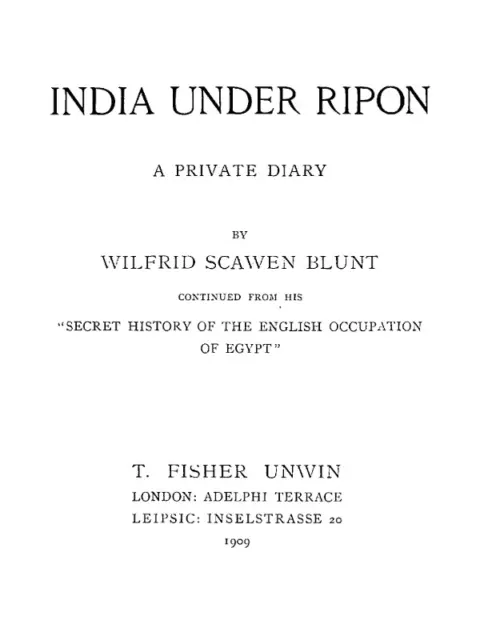
THE CLASSIC COLLECTION · 1909
"India under Ripon: A Private Diary" by Wilfrid Scawen Blunt is a historical account written in the early 20th century. The work provides insights into the socio-political climate of India during Lord Ripon's tenure as Viceroy in the late 19th century, exploring themes of governance, reform, and the burgeoning movement towards Indian self-assertion. Blunt's personal observations serve to illuminate a critical period in Indian history, marked by unrest and the quest for rights and equality among native populations. At the start of the diary, Blunt sets the stage for his journey through India, outlining his intentions to engage directly with the people and understand their perspectives on British rule. He reflects on the significant political changes occurring during Lord Ripon's administration, noting the tensions stemming from the oppressive policies of previous administrations and the hardship faced by the Indian populace, especially during famines. The narrative introduces the reader to the intricacies of Indian society, including the divisions between various communities and the impact of British rule on local governance and economic conditions, all of which are pivotal to understanding the historical dynamics of resistance and reform.
Introduction adapted from the source catalogue; source summaries may be automatically generated.
Free to read · English · 105,687 words · No account needed
MAKE TIME FOR A GOOD BOOK
On by default. Untick to stop anonymous reading totals. Each page counts after 10 seconds in view. How this works.
Anonymous counting is on unless you have switched it off.
“Then we went to the Exhibition, where we met old Siva Prasad, and had a long conversation with him. Though he begins by the proposition that he entirely approves the administrative system of the British Government, in practice he complains of nearly everything which other people complain of. He says they don’t understand the people’s wants, that they overtax them, and are perpetually raising the assessment. He holds land under them, and says it is impossible so much as to dig a well without the rent being raised. Reduced to its simplicity his argument is purely an historical one--namely, that India was worse off in the matter of peace and order before they came. ‘For the sake of this,’ he said, ‘let them strip us to the skin. So long as body and soul hold together, and we have a rag to our loins, we will be thankful, only we would ask some permanence in their revenue demands--fifty per cent., eighty per cent., ninety per cent. if they will--but not always an increase for every improvement we make.’ He then described the action of the assessment officers, just as others have done. Yet, for his English views and anti-National attitude, he has been burnt in effigy in his native town. This speaks volumes as to the ‘loyalty’ of the Hindus. He had written to the Maharajah, who will entertain us at Benares.
“The meeting of the Anjuman i Islam was a great success. All present, some two hundred, were in strictly native dress, with the single exception of Abd-el-Latif’s son. The proceedings began with what seemed a very able lecture or sermon in Hindustani, delivered by Ferid-ed-Din, a man of the old stamp, but full of intellectual vigour. He explained, it would seem, his ideas of the wants and needs of Mohammedans in the matter of education, and described my views of reform as contained in the ‘Future of Islam,’ from which he made quotations, and mentioned the fact of Anne’s knowledge of Arabic as an example for all Mohammedans to follow. (We were both there.) And he also mentioned the university scheme. All this was very well received. Then Abd-el-Latif spoke, attacking Seyd Ahmed and his school, and then I, too, made my discourse, Abd-el-Latif translating it sentence by sentence, as I went on. It is rather difficult to be eloquent under such circumstances, but after the first I got on well. I told them how I had travelled up the country from the south, and how at Madura I had heard the Mohammedans complain that they had no one to teach them English, and no one to teach them their religion. I likened their position to that of the Catholics in England, and told them what efforts had been made by these in the way of founding colleges on a religious basis, and a university. I next described the ideas the Nationalists had entertained at Cairo of reforming and extending the university education of the Azhar, and I urged them, now that circumstances in Egypt had interrupted this great idea, to take it up in India. I believed a great opportunity was offered them thus of assuming the intellectual leadership of Islam. I then explained in detail my plan that a university on a religious basis should be founded in some city where living was cheap, and which should be sufficiently central to serve the wants of all India. I did not mention Hyderabad, as the idea ought to come from the Nizam himself. I urged on the Princes present (for there were representatives of every reigning Mohammedan house) to come forward and endow professorships, and poorer men scholarships. It would be an act of religion, not only an act of philanthropy, and so would gain them merit in this world and the next; and by connecting their names with the endowment they would perpetuate themselves in the memory of good men. I then stated my intention of myself founding such an endowment, a professorship of religious history, and lastly thanked them for the welcome they had given us. When I had landed in India I did not know whether the Mohammedans there would understand the sincerity of my sympathy, but the result had surpassed all my expectations. I begged them to believe that I would give my life, if need was, to help their cause, and begged them to remember me when I was gone, as I would remember them.
Your reading position is saved on this browser. Take it to another device with a library code. Reading pages adapt to text, rather than matching a printed edition.
Wilfrid Scawen Blunt
Wilfrid Scawen Blunt

Wilfrid Scawen Blunt

Wilfrid Scawen Blunt
BEHIND THE BOOK
This eBook is for the use of anyone anywhere in the United States and most other parts of the world at no cost and with almost no restrictions whatsoever. You may copy it, give it away or re-use it under the terms of the Project Gutenberg License included with this eBook or online at www.gutenberg.org. If you are not located in the United States, you will have to check the laws of the country where you are located before using this eBook. Read the source licence.
The original source file, including credits and licence, is retained by this library. Request an original-format copy at no charge. Please include the book title and Project Gutenberg identifier #49177.
KEEP YOUR CURIOSITY GOING
Wilfrid Scawen Blunt
Wilfrid Scawen Blunt

E. W. (Edgar Watson) Howe
Cécile Tormay

Moritz Busch
John L. Ransom