THE CLASSIC COLLECTION✦My diaries, being a personal narrative of events 1888-1914, Part 2 (1900-1914)CLASSIC FREE BOOKS
My diaries, being a personal narrative of events 1888-1914, Part 2 (1900-1914)
Wilfrid Scawen Blunt
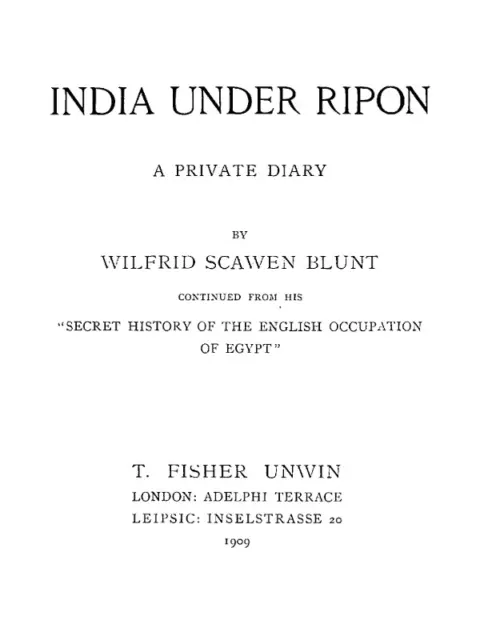
THE CLASSIC COLLECTION · 1909
"India under Ripon: A Private Diary" by Wilfrid Scawen Blunt is a historical account written in the early 20th century. The work provides insights into the socio-political climate of India during Lord Ripon's tenure as Viceroy in the late 19th century, exploring themes of governance, reform, and the burgeoning movement towards Indian self-assertion. Blunt's personal observations serve to illuminate a critical period in Indian history, marked by unrest and the quest for rights and equality among native populations. At the start of the diary, Blunt sets the stage for his journey through India, outlining his intentions to engage directly with the people and understand their perspectives on British rule. He reflects on the significant political changes occurring during Lord Ripon's administration, noting the tensions stemming from the oppressive policies of previous administrations and the hardship faced by the Indian populace, especially during famines. The narrative introduces the reader to the intricacies of Indian society, including the divisions between various communities and the impact of British rule on local governance and economic conditions, all of which are pivotal to understanding the historical dynamics of resistance and reform.
Introduction adapted from the source catalogue; source summaries may be automatically generated.
Free to read · English · 105,687 words · No account needed
MAKE TIME FOR A GOOD BOOK
On by default. Untick to stop anonymous reading totals. Each page counts after 10 seconds in view. How this works.
Anonymous counting is on unless you have switched it off.
Thus the Secretary of State, who is dependent on this blind guide, is in no other position at home than is the Viceroy in India. Ignorant, as a rule, of all things Indian, and dependent for advice on the India Office and his Anglo-Indian Council, he never gets at the truth of things, and blunders blindly on as they direct. It is almost impossible for him, however robust his will, to hold his own as a reformer.
The reforms, therefore, at home and in India which native opinion most strongly and immediately demands are, as regards India, that the active Civil Service should be remodelled, by the abolition of all covenants for lifelong employment, and by the liberal infusion of native blood into the non-covenanted service. It is proposed that as vacancies occur a certain proportion--say a third or a fourth--should be reserved exclusively for men of Indian birth, and that thus by degrees the whole Civil Service, with the exception of the highest posts, should become indigenous. Also, as regards the Government at home, that the Secretary of State for India should have the advice of native as well as Anglo-Indian retired officials on his Council in London. Until this is done they consider that the Government of India will continue to be carried on in the dark, and thus that reform will remain as hitherto, abortive.
It is obvious, however, that such initial changes are a first step only in the direction of reforms infinitely more important. What India really asks for as the goal of her ambitions is self-government--that is to say, that not merely executive but legislative and financial power should be vested in the native hands. At present the legislative authority of each Presidency resides in the Governor in Council, and there is no system whatsoever of popular representation, even of the most limited kind. The Councils are composed wholly of nominees, and, except in very small measure, of English official nominees, and their functions are limited to consultation and advice, for they are without any real power of initiative or even of veto. In each of these Councils a few natives have been given places, but they are in no sense representatives of the people, being, on the contrary, nominees of the Government, chosen specially for their subservience to the ideas of the Governor of the day; and their independence is effectually debarred by the further check that their appointment is for three years only, and reversible at the end of such period by the simple will of the Governor. All the other members--and they form the large majority--are English civil or military officers, who look to appointments on the Councils as the prizes of their service, and who usually represent the quintescence of official ideas. Lord Ripon, indeed, took pains to get together men of a liberal sort in his own supreme Council; but as a rule those who enjoy this position are anxious only to secure reappointment at the end of their three years’ term. Thus, instead of representing the ideas current among the native classes from which they spring, they serve merely as an echo or chorus to the Governor, or to the permanent officials who sway the Governor. This is not a healthy condition of things. The remedy should be, as a first condition, that the native councillors should be elected by the various classes of the community, and that their tenure of office should be made independent of the Governor’s pleasure. I am convinced that the system would work with good results; and if also the number of councillors were increased and their powers of debate and interpellation enlarged, an excellent basis would be laid for what all Indian reformers look to as the ideal of their hopes, provincial parliaments. That India is unfit for local parliamentary institutions of at least a rudimentary kind I cannot at all admit. Indeed it seems to me that few people would profit more rapidly from a public discussion of public affairs than the temperate conservative Hindus. For a while, indeed, it would doubtless be necessary to retain a large English element in their councils, but the Indian mind educates itself with great rapidity, and in another generation they might probably without danger be entrusted with the sole care of their own domestic legislation, and the sole control of their finances.
Your reading position is saved on this browser. Take it to another device with a library code. Reading pages adapt to text, rather than matching a printed edition.
Wilfrid Scawen Blunt
Wilfrid Scawen Blunt

Wilfrid Scawen Blunt
Wilfrid Scawen Blunt
BEHIND THE BOOK
This eBook is for the use of anyone anywhere in the United States and most other parts of the world at no cost and with almost no restrictions whatsoever. You may copy it, give it away or re-use it under the terms of the Project Gutenberg License included with this eBook or online at www.gutenberg.org. If you are not located in the United States, you will have to check the laws of the country where you are located before using this eBook. Read the source licence.
The original source file, including credits and licence, is retained by this library. Request an original-format copy at no charge. Please include the book title and Project Gutenberg identifier #49177.
KEEP YOUR CURIOSITY GOING
Wilfrid Scawen Blunt
Wilfrid Scawen Blunt

E. W. (Edgar Watson) Howe
Cécile Tormay

Moritz Busch
John L. Ransom