
Moving the Mountain
Charlotte Perkins Gilman

THE CLASSIC COLLECTION · 1893
"In This Our World" by Charlotte Perkins Gilman is a collection of poems and reflections written in the late 19th century. The work explores various themes such as nature, existential musings, societal roles, and the human experience, often addressing the struggles and aspirations of women. Through its multifaceted lenses, it sheds light on the joys and challenges of life, underlining the interconnectedness of all beings and the importance of understanding one's place in the world. The beginning of the work introduces readers to an intricate tapestry of thoughts and emotions. The opening poem, titled "Birth," conveys a profound appreciation for life and existence, celebrating the freedom and joy that comes from being alive. It depicts a journey from confinement to birth and connection with the universe. Following this, "Nature’s Answer" presents a more sobering view of existence, suggesting that life’s lessons often come through pain and loss, intertwining the beauty of life with its inherent struggles. The early verses set a reflective tone, inviting readers to ponder the deeper meanings behind their circumstances and the universal truths that bind humanity together.
Introduction adapted from the source catalogue; source summaries may be automatically generated.
Free to read · English · 34,956 words · No account needed
MAKE TIME FOR A GOOD BOOK
On by default. Untick to stop anonymous reading totals. Each page counts after 10 seconds in view. How this works.
Anonymous counting is on unless you have switched it off.
Yet you feel, being human. You shrink from the pain That each child, born a woman, must suffer again. From the strongest of bonds heart can feel, man can shape, You cannot rebel, or appeal, or escape. You must bear and endure. If the heart cannot sleep, And the pain groweth bitter,—too bitter,—then weep! For you feel, being human.
And she wept, being woman. The numberless years Have counted her burdens and counted her tears; The maid wept forsaken, the mother forlorn For the child that was dead, and the child that was born. Wept for joy—as a miracle!—wept in her pain! Wept aloud, wept in secret, wept ever in vain! Still she weeps, being woman.
Can you imagine nothing better, brother, Than that which you have always had before? Have you been so content with “wife and mother,” You dare hope nothing more?
Have you forever prized her, praised her, sung her, The happy queen of a most happy reign? Never dishonored her, despised her, flung her Derision and disdain?
Go ask the literature of all the ages! Books that were written before women read! Pagan and Christian, satirists and sages,— Read what the world has said!
There was no power on earth to bid you slacken The generous hand that painted her disgrace! There was no shame on earth too black to blacken That much praised woman-face!
Eve and Pandora!—always you begin it— The ancients called her Sin and Shame and Death! “There is no evil without woman in it,” The modern proverb saith!
She has been yours in uttermost possession,— Your slave, your mother, your well-chosen bride,— And you have owned, in million-fold confession, You were not satisfied.
Peace, then! Fear not the coming woman, brother! Owning herself, she giveth all the more! She shall be better woman, wife, and mother Than man hath known before!
How best can I serve thee, my child! My child! Flesh of my flesh and dear heart of my heart! Once thou wast within me—I held thee—I fed thee— By the force of my loving and longing I led thee— Now we are apart!
I may blind thee with kisses and crush with embracing, Thy warm mouth in my neck and our arms interlacing; But here in my body my soul lives alone, And thou answerest me from a house of thine own,— That house which I builded!
Which we builded together, thy father and I;
In which thou must live, O my darling, and die!
Not one stone can I alter, one atom relay,—
Not to save or defend thee or help thee to stay—
That gift is completed!
Your reading position is saved on this browser. Take it to another device with a library code. Reading pages adapt to text, rather than matching a printed edition.
Charlotte Perkins Gilman

Charlotte Perkins Gilman

Charlotte Perkins Gilman
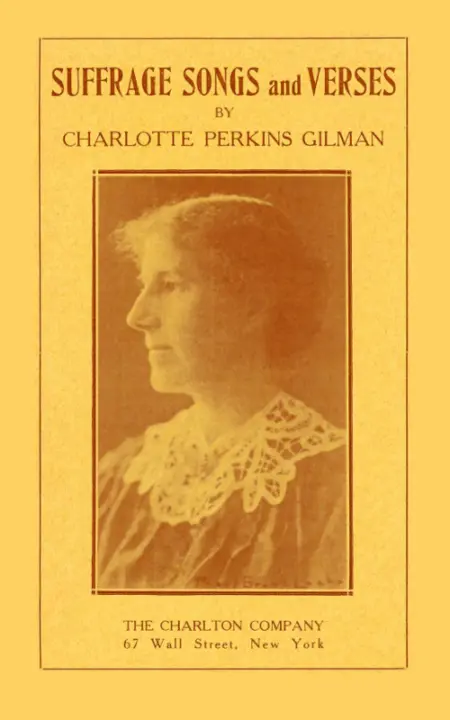
Charlotte Perkins Gilman
BEHIND THE BOOK
This eBook is for the use of anyone anywhere in the United States and most other parts of the world at no cost and with almost no restrictions whatsoever. You may copy it, give it away or re-use it under the terms of the Project Gutenberg License included with this eBook or online at www.gutenberg.org. If you are not located in the United States, you will have to check the laws of the country where you are located before using this eBook. Read the source licence.
The original source file, including credits and licence, is retained by this library. Request an original-format copy at no charge. Please include the book title and Project Gutenberg identifier #60481.
KEEP YOUR CURIOSITY GOING

Eric Mackay
Edmund Gosse
Sophia Margaretta Hensley
Gilbert Parker
George MacDonald

Elizabeth Bibesco