
Moving the Mountain
Charlotte Perkins Gilman

THE CLASSIC COLLECTION · 1893
"In This Our World" by Charlotte Perkins Gilman is a collection of poems and reflections written in the late 19th century. The work explores various themes such as nature, existential musings, societal roles, and the human experience, often addressing the struggles and aspirations of women. Through its multifaceted lenses, it sheds light on the joys and challenges of life, underlining the interconnectedness of all beings and the importance of understanding one's place in the world. The beginning of the work introduces readers to an intricate tapestry of thoughts and emotions. The opening poem, titled "Birth," conveys a profound appreciation for life and existence, celebrating the freedom and joy that comes from being alive. It depicts a journey from confinement to birth and connection with the universe. Following this, "Nature’s Answer" presents a more sobering view of existence, suggesting that life’s lessons often come through pain and loss, intertwining the beauty of life with its inherent struggles. The early verses set a reflective tone, inviting readers to ponder the deeper meanings behind their circumstances and the universal truths that bind humanity together.
Introduction adapted from the source catalogue; source summaries may be automatically generated.
Free to read · English · 34,956 words · No account needed
MAKE TIME FOR A GOOD BOOK
On by default. Untick to stop anonymous reading totals. Each page counts after 10 seconds in view. How this works.
Anonymous counting is on unless you have switched it off.
Housekeepers? Do you then, like those of yore, Keep house with power and pride, with grace and ease? No, you keep servants only! What is more, You don’t keep these!
Wives, say you? Wives! Blessed indeed are they Who hold of love the everlasting keys, Keeping their husbands’ hearts! Alas the day! You don’t keep these!
And mothers? Pitying Heaven! Mark the cry From cradle death-beds! Mothers on their knees! Why, half the children born—as children die! You don’t keep these!
And still the wailing babies come and go, And homes are waste, and husbands’ hearts fly far, There is no hope until you dare to know The thing you are!
Are you content, you pretty three-years’ wife? Are you content and satisfied to live On what your loving husband loves to give, And give to him your life?
Are you content with work,—to toil alone, To clean things dirty and to soil things clean; To be a kitchen-maid, be called a queen,— Queen of a cook-stove throne?
Are you content to reign in that small space— A wooden palace and a yard-fenced land— With other queens abundant on each hand, Each fastened in her place?
Are you content to rear your children so? Untaught yourself, untrained, perplexed, distressed, Are you so sure your way is always best? That you can always know?
Have you forgotten how you used to long In days of ardent girlhood, to be great, To help the groaning world, to serve the state, To be so wise—so strong?
And are you quite convinced this is the way,
The only way a woman’s duty lies—
Knowing all women so have shut their eyes?
Seeing the world to-day?
Have you no dream of life in fuller store?
Of growing to be more than that you are?
Doing the things you now do better far,
Yet doing others—more?
Losing no love, but finding as you grew
That as you entered upon nobler life
You so became a richer, sweeter wife,
A wiser mother too?
What holds you? Ah, my dear, it is your throne, Your paltry queenship in that narrow place, Your antique labors, your restricted space, Your working all alone!
Be not deceived! ’Tis not your wifely bond That holds you, nor the mother’s royal power, But selfish, slavish service hour by hour— A life with no beyond!
“Do you love me?” asked the mother of her child, And the baby answered, “No!” Great Love listened and sadly smiled; He knew the love in the heart of the child— That you could not wake it so.
Your reading position is saved on this browser. Take it to another device with a library code. Reading pages adapt to text, rather than matching a printed edition.
Charlotte Perkins Gilman

Charlotte Perkins Gilman

Charlotte Perkins Gilman
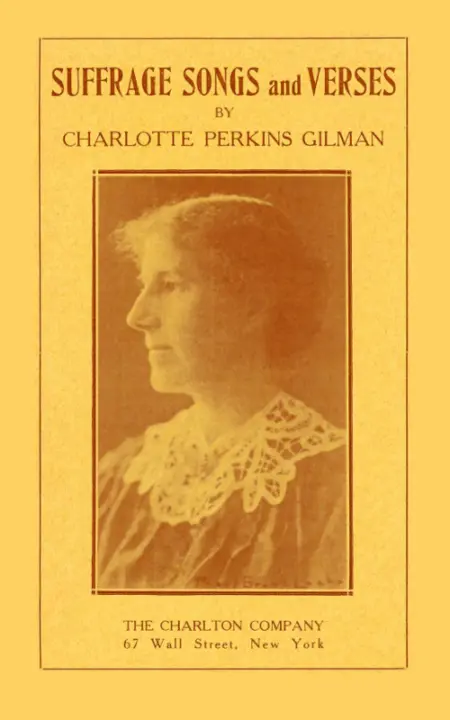
Charlotte Perkins Gilman
BEHIND THE BOOK
This eBook is for the use of anyone anywhere in the United States and most other parts of the world at no cost and with almost no restrictions whatsoever. You may copy it, give it away or re-use it under the terms of the Project Gutenberg License included with this eBook or online at www.gutenberg.org. If you are not located in the United States, you will have to check the laws of the country where you are located before using this eBook. Read the source licence.
The original source file, including credits and licence, is retained by this library. Request an original-format copy at no charge. Please include the book title and Project Gutenberg identifier #60481.
KEEP YOUR CURIOSITY GOING

Eric Mackay
Edmund Gosse
Sophia Margaretta Hensley
Gilbert Parker
George MacDonald

Elizabeth Bibesco