Moving the Mountain
Charlotte Perkins Gilman
THE CLASSIC COLLECTION · 1893
"In This Our World" by Charlotte Perkins Gilman is a collection of poems and reflections written in the late 19th century. The work explores various themes such as nature, existential musings, societal roles, and the human experience, often addressing the struggles and aspirations of women. Through its multifaceted lenses, it sheds light on the joys and challenges of life, underlining the interconnectedness of all beings and the importance of understanding one's place in the world. The beginning of the work introduces readers to an intricate tapestry of thoughts and emotions. The opening poem, titled "Birth," conveys a profound appreciation for life and existence, celebrating the freedom and joy that comes from being alive. It depicts a journey from confinement to birth and connection with the universe. Following this, "Nature’s Answer" presents a more sobering view of existence, suggesting that life’s lessons often come through pain and loss, intertwining the beauty of life with its inherent struggles. The early verses set a reflective tone, inviting readers to ponder the deeper meanings behind their circumstances and the universal truths that bind humanity together.
Introduction adapted from the source catalogue; source summaries may be automatically generated.
Free to read · English · 34,956 words · No account needed
MAKE TIME FOR A GOOD BOOK
On by default. Untick to stop anonymous reading totals. Each page counts after 10 seconds in view. How this works.
Anonymous counting is on unless you have switched it off.
“No,” said the Cultured Critic, gazing haughtily Whereon some untrained brush had wandered naughtily, From canons free; “Work such as this lacks value and perspective, Has no real feeling,—inner or reflective,— Does not appeal to me.”
Then quoth the vulgar, knowing art but meagrely, Their unbesought opinions airing eagerly, “Why, ain’t that flat?” Voicing their ignorance all unconcernedly, Saying of what the Critic scored so learnedly, “I don’t like that!”
The Critic now vouchsafed approval sparingly
Of what some genius had attempted daringly,
“This fellow tries;
He handles his conception frankly, feelingly.
Such work as this, done strongly and appealingly,
I recognize.”
The vulgar, gazing widely and unknowingly, Still volunteered their cheap impressions flowingly, “Oh, come and see!” But all that they could say of art’s reality Was this poor voice of poorer personality, “Now, that suits me!”
Cometh to-day the very skilful man;
Profoundly skilful in his chosen art;
All things that other men can do he can,
And do them better. He is very smart.
Sayeth, “My work is here before you all; Come now with duly cultured mind to view it. Here is great work, no part of it is small; Perceive how well I do it!
“I do it to perfection. Studious years Were spent to reach the pinnacle I’ve won; Labor and thought are in my work, and tears. Behold how well ’tis done!
“See with what power this great effect is shown; See with what ease you get the main idea; A master in my art, I stand alone; Now you may praise,—I hear.”
And I, “O master, I perceive your sway, I note the years of study, toil, and strain That brought the easy power you wield to-day, The height you now attain.
“Freely your well-trained power I see you spend, Such skill in all my life I never saw; You have done nobly; but, my able friend, What have you done it for?
“You have no doubt achieved your dearest end: Your work is faultless to the cultured view. You do it well, but, O my able friend, What is it that you do?”
“The pastelle is too strong,” said he.
“Lo! I will make it fainter yet!”
And he wrought with tepid ecstasy
A pastellette.
A touch—a word—a tone half caught— He softly felt and handled them; Flavor of feeling—scent of thought— Shimmer of gem— That we may read, and feel as he What vague, pale pleasure we can get From this mild, witless mystery,— The pastellette.
Your reading position is saved on this browser. Take it to another device with a library code. Reading pages adapt to text, rather than matching a printed edition.
Charlotte Perkins Gilman
Charlotte Perkins Gilman
Charlotte Perkins Gilman
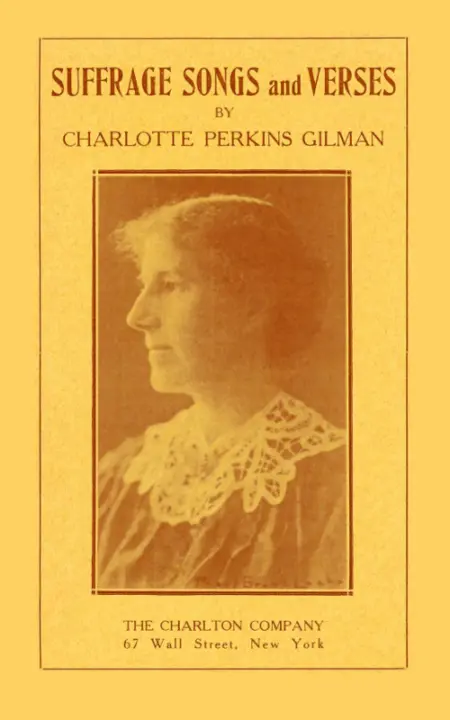
Charlotte Perkins Gilman
BEHIND THE BOOK
This eBook is for the use of anyone anywhere in the United States and most other parts of the world at no cost and with almost no restrictions whatsoever. You may copy it, give it away or re-use it under the terms of the Project Gutenberg License included with this eBook or online at www.gutenberg.org. If you are not located in the United States, you will have to check the laws of the country where you are located before using this eBook. Read the source licence.
The original source file, including credits and licence, is retained by this library. Request an original-format copy at no charge. Please include the book title and Project Gutenberg identifier #60481.
KEEP YOUR CURIOSITY GOING

Eric Mackay
Edmund Gosse
Sophia Margaretta Hensley
Gilbert Parker
George MacDonald

Elizabeth Bibesco