Adrift on the Amazon
Leo E. (Leo Edward) Miller
THE CLASSIC COLLECTION · 1917
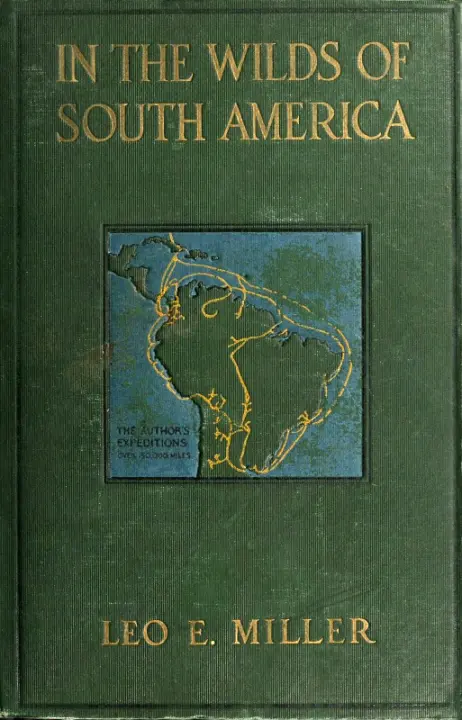
"In the Wilds of South America" by Leo E. Miller is a scientific exploration narrative written in the early 20th century. The work recounts six years of field exploration in various South American countries, emphasizing the rich biodiversity and unique experiences of a naturalist in the region. The focus of the book is on Miller's adventures as a field-naturalist, detailing encounters with diverse ecosystems, wildlife, and local cultures throughout Colombia, Venezuela, and other parts of South America. The opening of the narrative introduces the author and his expedition team as they embark on a zoological journey from Panama to Buenaventura, Colombia. The descriptions highlight the challenges of navigation along the treacherous coastlines and the striking beauty of South America’s landscapes. Miller sets the tone for the adventure ahead, vividly portraying the lush jungles, the vibrant wildlife, and the initial experiences in Buenaventura. He establishes the purpose of the expedition: to study and collect birds and mammals while also documenting the flora, fauna, and the cultures encountered along the way, laying the groundwork for the fascinating explorations that follow in the subsequent chapters.
Introduction adapted from the source catalogue; source summaries may be automatically generated.
Free to read · English · 146,660 words · No account needed
MAKE TIME FOR A GOOD BOOK
On by default. Untick to stop anonymous reading totals. Each page counts after 10 seconds in view. How this works.
Anonymous counting is on unless you have switched it off.
It is unfortunate that this passage of the lake is made at night. Nearly every one visiting the vast body of water for the first time is eager to see as much of it as possible, both on account of its being the highest great lake in the world (twelve thousand five hundred feet above sea-level) and by reason of its associations with the nation of the Incas.
Guaqui is a garrison town. There were numerous soldiers in evidence on the streets, and a troop of lancers, under the command of a German officer, were giving a skilful display of their prowess on the lake front. Their mounts were not much to look at and the uniforms of the men were rather shabby, but both were well drilled.
The train for La Paz left at noon. It moved at a good rate of speed across the high, level upland. The scenery is impressive. We were always in sight of snow-covered peaks, although there was little snow on the plateau itself. Indian huts built of stone, some very ancient, are scattered about abundantly, but it requires some experience in locating them before they can be readily distinguished from their immediate surroundings. There were numerous fields of wheat and oats, and llamas without number nibbled the scant vegetation on the slope. In a few isolated spots small herds of cattle, horses, and pigs were visible. Indians came to the coach-windows to sell fruits when the train stopped; they were doubtless brought from the deep, sheltered fissures that have been cut into the range by snow-water from high peaks.
Within a short time we had reached the ruins of an enormous city called Tiahuanaco, which is said to date back many centuries before the Incan era. When discovered it was buried in the sand level with the surface of the plateau, but archæologists have excavated many of the larger buildings and brought to light ancient treasures of rare beauty. Later, in La Paz, we met a man named Poznaski who had done a great deal of work in this region. He had a remarkable collection of hundreds of skulls, pieces of pottery, gold ornaments, and well-preserved cloth. Among the ceramics was a “death’s head” of exquisite workmanship, life size, and painted in gorgeous colors. He considered it the finest bit of pottery ever discovered in Bolivia and stated that a North American museum was negotiating for its purchase at a price that ran into five figures. This, however, did not seem probable. As we neared La Paz, the great mountains of Illimani, Murarata, and Huana Potosi loomed constantly more lofty and forbidding before us. They are the patriarchs of the Bolivian Andes, and are twenty-two thousand five hundred and eighty-one, twenty-one thousand, and twenty thousand two hundred and eighty-nine feet high respectively. The summits of all three have been reached by venturesome exploration-parties, but the task of climbing the steep, slippery slopes perpetually covered with deep snow and swept by frigid gales is a trying one that is not often attempted. Huana Potosi, the more distant of the group has a flat top, contrasting conspicuously with the sharp, pointed summits of the other two. The Indians tell a legend that explains this peculiar formation. In the days of long ago, when the world was young, vapors enveloped all the earth; suddenly the sun-god appeared and, beaming down from heaven, caused the mists to become dissipated and vanish. Illimani awoke to life and from his dizzy height beheld the queenly Huana Potosi smiling up at him. At the same time, however, Murarata emerged from the clouds and beholding the beautiful Huana Potosi fell violently in love with her. Illimani became insanely jealous and in a blind fury hurled forth fire, smoke, and stones of great size at his rival’s head; the latter promptly replied in kind and fought valiantly. For days the earth quaked and trembled with the thunderous roar of the death-struggle, while heavy clouds covered the terrifying spectacle with a mantle of darkness. After a seemingly endless time the combat stopped; daylight returned, revealing an appalling state of affairs. Finding it impossible to vanquish the rival suitor, Illimani had beheaded his fair lady-love to prevent her from falling into the other’s hands. The many streams of water rushing down the steep sides of Illimani are but the tears of grief and remorse over his hasty action; thus he is doomed to mourn and weep until the end of time. The legend has doubtless been handed down through many generations and obviously refers to one of the many volcanic disturbances that must have occurred when the Andes were young.
Your reading position is saved on this browser. Take it to another device with a library code. Reading pages adapt to text, rather than matching a printed edition.
Leo E. (Leo Edward) Miller
Leo E. (Leo Edward) Miller
BEHIND THE BOOK
This eBook is for the use of anyone anywhere in the United States and most other parts of the world at no cost and with almost no restrictions whatsoever. You may copy it, give it away or re-use it under the terms of the Project Gutenberg License included with this eBook or online at www.gutenberg.org. If you are not located in the United States, you will have to check the laws of the country where you are located before using this eBook. Read the source licence.
The original source file, including credits and licence, is retained by this library. Request an original-format copy at no charge. Please include the book title and Project Gutenberg identifier #59512.
KEEP YOUR CURIOSITY GOING
Wilfrid Scawen Blunt
Wilfrid Scawen Blunt

E. W. (Edgar Watson) Howe
Cécile Tormay

Moritz Busch
John L. Ransom