Adrift on the Amazon
Leo E. (Leo Edward) Miller
THE CLASSIC COLLECTION · 1917
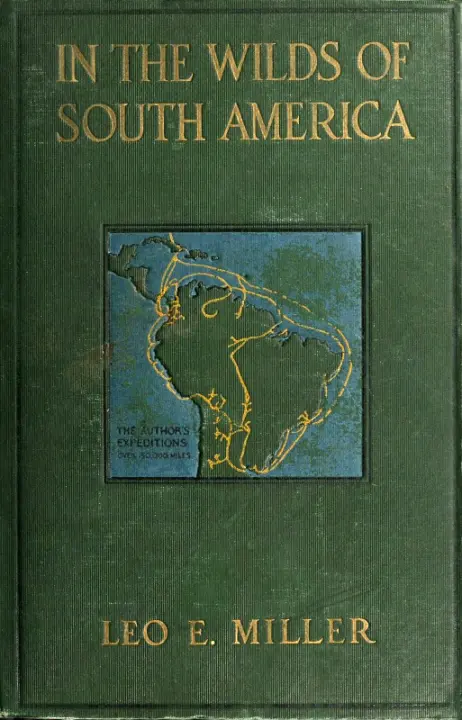
"In the Wilds of South America" by Leo E. Miller is a scientific exploration narrative written in the early 20th century. The work recounts six years of field exploration in various South American countries, emphasizing the rich biodiversity and unique experiences of a naturalist in the region. The focus of the book is on Miller's adventures as a field-naturalist, detailing encounters with diverse ecosystems, wildlife, and local cultures throughout Colombia, Venezuela, and other parts of South America. The opening of the narrative introduces the author and his expedition team as they embark on a zoological journey from Panama to Buenaventura, Colombia. The descriptions highlight the challenges of navigation along the treacherous coastlines and the striking beauty of South America’s landscapes. Miller sets the tone for the adventure ahead, vividly portraying the lush jungles, the vibrant wildlife, and the initial experiences in Buenaventura. He establishes the purpose of the expedition: to study and collect birds and mammals while also documenting the flora, fauna, and the cultures encountered along the way, laying the groundwork for the fascinating explorations that follow in the subsequent chapters.
Introduction adapted from the source catalogue; source summaries may be automatically generated.
Free to read · English · 146,660 words · No account needed
MAKE TIME FOR A GOOD BOOK
On by default. Untick to stop anonymous reading totals. Each page counts after 10 seconds in view. How this works.
Anonymous counting is on unless you have switched it off.
Realizing the importance of obtaining the good-will of the wild folk of whose existence in the surrounding forest there was such abundant evidence, the Brazilian Government had erected a number of small bamboo and palm-leaf sheds various distances apart, near some of the more recently used trails that led from the water into the dark jungle. Under each rough shelter a bench, made of long poles laid across sticks driven into the ground, had been built. It was the custom of the officials in going up or down the river to stop at each of these stations and place beads, knives, and trinkets on the benches as a peace-offering to the Indians; but so reticent had been the latter that not one of the articles had hitherto been touched. Great was our surprise and joy to find that all the precious offerings had been removed, and that the Indians themselves had left a number of tokens of friendship in return. They were arrows six feet long, beautifully adorned with the bright-colored feathers of trogons, toucans, and other birds; parcels of Brazil nuts neatly done up in leaves; a few ears of maize, a feather head-dress, and a small pottery bowl. We collected all these treasures and left many more presents in exchange.
As we neared one of the last stations the sound of loud hallooing came from the forest on our right. We swung the great batelão toward the shore. We landed, but no sooner had we climbed to the top of the steep bank than we realized how cleverly had been arranged the plan by the Indians to effect a meeting with the mysterious strangers who were passing through their country. Following a wide path that led into the dense forest for a distance of twenty yards, we suddenly came upon a small, swift stream that sped through a dark tunnel-like opening under the dense canopy of leaves and branches. As we stared in blank amazement into the impenetrable tangle of vegetation on the other side of the stream, there emerged from the forest four nude, bronze figures, gesticulating wildly and chattering in a strange jargon which, of course, we could not understand; they were of good build, though inferior in physique to the Nhambiquaras we had seen on the chapadão, and not over five feet tall, with long, straight hair, and, remarkable though it is, the tangled hair of two of them was of a decided auburn color. Their bodies were plentifully besmeared with dark-bluish paint, applied in queer zigzag designs and giving a grotesque effect. No wilder scene can be imagined than the quartet of naked, trembling savages faintly outlined against the dim background of merging shadows and sombre green; somehow they seemed to fit into the picture and to complete the impression of primality conveyed by the vast wilderness of the Brazilian hinterland. Our captain held up bunches of bright-red beads and started to wade into the stream toward them, but they immediately withdrew into the thick cover, so he came back. A moment later they reappeared and again began talking and waving their arms; by signs we tried to induce them to come nearer and to assure them of our peaceful intentions. Finally, after a powwow with his companions, one of their number approached to the margin of the stream and held out his hands. He then pointed to one of our men and motioned for him to take off his clothes and come over with the presents, which was done; the Indian grabbed the trinkets from the native’s outstretched hands, gave him a violent push back, and fled to his companions. This was repeated a number of times. Then we refused to permit our man to go farther than the centre of the stream--the water was nearly up to his chin--and after lengthy entreaties the Indian waded out and met him half-way. We laid out an attractive assortment of beads, knives, hatchets, and bright-colored trinkets on our side of the river and, retreating ten or fifteen feet with extended arms, invited the Indians to come over. Slowly they came, apparently with many misgivings. We approached them in a friendly manner; they made no attempt to flee, but cast meaning glances behind them where, obviously, an armed force was concealed near by to protect them in the event that our actions aroused suspicion. The chief was an intelligent fellow; his first deed was to enact before our eyes a drama that we shall never forget. Assuming a rigid pose, he pointed straight in front of him with one hand, as if taking aim; then with a sudden “pong” he clutched at his breast and fell upon his knees, gradually sinking to the ground, where he lay moaning. We understood the accusation; one of his tribe had been shot to death by our people, probably a rubber-collector farther down the river; that was the reason why they had mistrusted us. We showed them how to use the machetes and hatchets, and they seemed delighted; but when we demonstrated the use of matches their joy knew no bounds; they yelped and danced, made weird grimaces, and tried to set the trees and bushes afire, like so many monkeys. Finally, upon our urgent invitation, the chief shouted a guttural command, and three more savages appeared instantly and joined the group, making seven in all; the late arrivals were also treated in a generous manner, and then we withdrew to our boat. Before leaving, however, we promised to return and bring more machetes and matches, which they seemed particularly to appreciate, and they in turn promised to have the bench in the palm-leaf shed heaped with bows and arrows and other things of their making, promises which were religiously kept on both sides.
Your reading position is saved on this browser. Take it to another device with a library code. Reading pages adapt to text, rather than matching a printed edition.
Leo E. (Leo Edward) Miller
Leo E. (Leo Edward) Miller
BEHIND THE BOOK
This eBook is for the use of anyone anywhere in the United States and most other parts of the world at no cost and with almost no restrictions whatsoever. You may copy it, give it away or re-use it under the terms of the Project Gutenberg License included with this eBook or online at www.gutenberg.org. If you are not located in the United States, you will have to check the laws of the country where you are located before using this eBook. Read the source licence.
The original source file, including credits and licence, is retained by this library. Request an original-format copy at no charge. Please include the book title and Project Gutenberg identifier #59512.
KEEP YOUR CURIOSITY GOING
Wilfrid Scawen Blunt
Wilfrid Scawen Blunt

E. W. (Edgar Watson) Howe
Cécile Tormay

Moritz Busch
John L. Ransom