
The Residuary Legatee; Or, The Posthumous Jest of the Late John Austin
Frederic Jesup Stimson
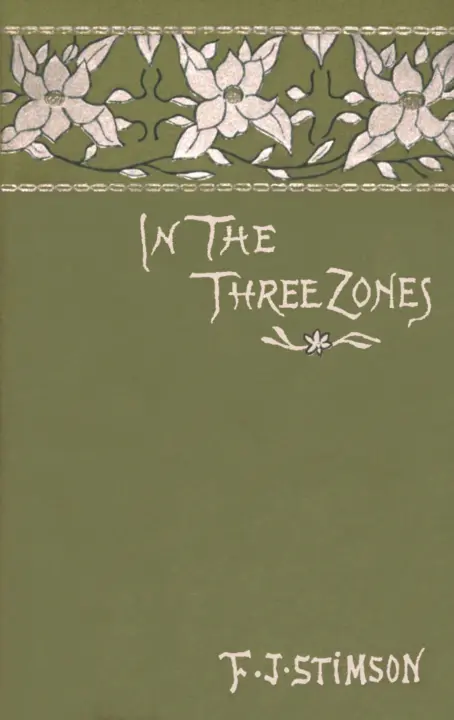
THE CLASSIC COLLECTION · 1893
"In the Three Zones" by Frederic Jesup Stimson is a novel written in the late 19th century. The book explores themes of idealism, materialism, and the complexities of human relationships through the journey of its main character, Rousseau Tetherby. Tetherby’s struggles with his health and the intellectual debates he encounters at college set the stage for his interactions with key figures around him, particularly a mysterious German professor named Dr. Materialismus. The opening of the novel establishes Rousseau Tetherby as a thoughtful and somewhat troubled character, originating from a cold region of Maine where people engage deeply with philosophical discussions. As he adjusts to life at a university where he develops a passion for debate, he becomes entangled in the ideas propagated by Dr. Materialismus, who represents scientific detachment and materialism. Their conversations challenge Tetherby’s beliefs and lead him to encounter both friendship and rivalry, particularly concerning the captivating Althea Hardy, a woman who embodies the emotional depth that Tetherby yearns for. Ultimately, the beginning of the story sets up a rich exploration of conflicting ideologies and human connections against the backdrop of Tetherby's struggles with his own identity and desires.
Introduction adapted from the source catalogue; source summaries may be automatically generated.
Free to read · English · 35,724 words · No account needed
MAKE TIME FOR A GOOD BOOK
On by default. Untick to stop anonymous reading totals. Each page counts after 10 seconds in view. How this works.
Anonymous counting is on unless you have switched it off.
“So--I must rest you a little between times,” he said. “Is my fine poet
convinced?”
But I was silent, and he turned another wheel.
“All these are only evil passions,” said I, “there may well be something physical in them.”
“Poh--I can gife you just so well the others,” he sneered. “I tell you why I do not gife you all at once----”
“You can produce lust,” I answered, “but not love.”
“Poh--it takes but a little greater speed. What you call love is but the multiple of lust and cosmic love, that is, gravitation.”
I stared at the man.
“It is quite as I say. About two hundred thousand vibrations make in man’s cerebrum what you call lust; about four billion per second, that is gravitation, make what the philosophers call will, the poets, cosmic love; this comes just after light, white light, which is the sum of all the lights. And their multiple again, of love and light, makes many sextillions, and that is love of God, what the priests name religion.”... I think I grew faint, for he said, “You must hafe some refreshments, or you cannot bear it.”
He broke some raw eggs in a glass, in some sherry, and placed it by my side, and I saw him bend the lever much farther.
“Perhaps,” I spoke out, then, “you can create the emotion, or the mental existence--whatever you call it--of God himself.” I spoke with scorn, for my mind was clearer than ever.
“I can--almost,” he muttered. “Just now I have turned the rhythm to the thought millions, which lie above what you call evil passions, between them and what you call the good ones. It is all a mere question of degree. In the eye of science all are the same; morally, one is alike so good as the other. Only motion--that is life; and slower, slower, that is nearer death; and life is good, and death is evil.”
“But I can have these thoughts without your machinery,” said I.
“Yes,” said he, “and I can cause them with it; that proves they are mechanical. Now, the rhythm is on the intellectual-process movement; hence you argue.”
Millions of thoughts, fancies, inspirations, flashed through my brain as he left me to busy himself with other levers. How long this time lasted I again knew not; but it seemed that I passed through all the experience of human life. Then suddenly my thinking ceased, and I became conscious only of a bad odor by my side. This was followed in a moment by an intense scarlet light.
Your reading position is saved on this browser. Take it to another device with a library code. Reading pages adapt to text, rather than matching a printed edition.
Frederic Jesup Stimson
Frederic Jesup Stimson
Frederic Jesup Stimson
Frederic Jesup Stimson
BEHIND THE BOOK
This eBook is for the use of anyone anywhere in the United States and most other parts of the world at no cost and with almost no restrictions whatsoever. You may copy it, give it away or re-use it under the terms of the Project Gutenberg License included with this eBook or online at www.gutenberg.org. If you are not located in the United States, you will have to check the laws of the country where you are located before using this eBook. Read the source licence.
The original source file, including credits and licence, is retained by this library. Request an original-format copy at no charge. Please include the book title and Project Gutenberg identifier #68351.
KEEP YOUR CURIOSITY GOING
Coulson Kernahan

Maurice Baring
Frances Wright
Cécile Tormay
Frederic Jesup Stimson

W. H. P. (William Henry Pope) Jarvis