
In the Name of the People
Arthur W. Marchmont
THE CLASSIC COLLECTION · 1900
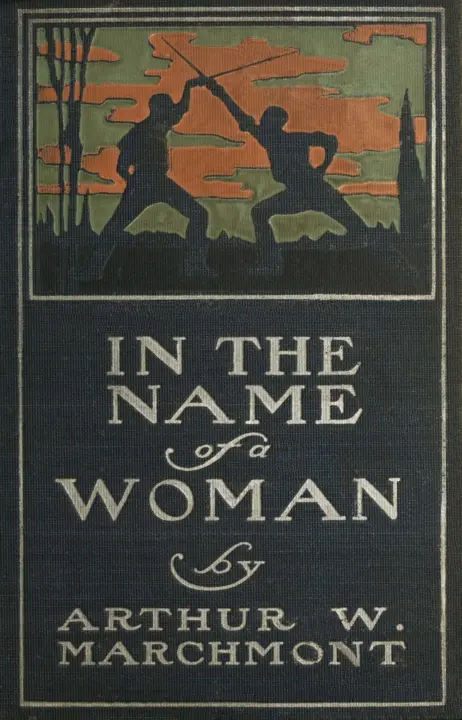
"In the Name of a Woman: A Romance" by Arthur W. Marchmont is a novel written in the late 19th century. The story unfolds in Sofia, Bulgaria, amidst a backdrop of political intrigue and social unrest, following the daring escapades of the protagonist, Gerald Winthrop, as he becomes entangled with a mysterious and attractive woman, Countess Anna Bokara. The narrative explores themes of honor, loyalty, and the tumultuous intersection of personal desire and political duty. The opening of the book introduces a dramatic rescue scene, where Winthrop intervenes to save the Countess from two assailants. This thrilling event sets the stage for their ensuing dialogue, revealing the Countess's strong character and her disdain for weakness in the face of danger. As she tends to her wound and expresses her gratitude, it becomes evident that she is embroiled in dangerous political machinations involving Russia's influence in Bulgaria. Winthrop, while captivated by her strength and beauty, is hesitant to align himself with her cause due to his own secret mission. The tension builds as the narrative hints at their complex relationship, underscoring not only their immediate peril but also the larger stakes at play in a country on the brink of turmoil.
Introduction adapted from the source catalogue; source summaries may be automatically generated.
Free to read · English · 104,650 words · No account needed
MAKE TIME FOR A GOOD BOOK
On by default. Untick to stop anonymous reading totals. Each page counts after 10 seconds in view. How this works.
Anonymous counting is on unless you have switched it off.
“Michel tells me you are half English. Is that a secret?”
“No, certainly not. We English are not afraid to own our nationality, as the actions of many of us show too prominently sometimes, I fear.”
“But Englishmen of wealth do not commonly choose Bulgaria as a place of residence--at least not without some strong motive.” And her eyes searched my face for the truth.
“Eccentricity has never yet been denied to us.”
“Is it in your case eccentricity--only?”
“I am also half a Roumanian,” I said, repeating the answer I had given in the morning to Zoiloff.
“And the Roumanians are all but Russians.”
“Is not the Princess Christina a Roumanian?” I retorted. “And also of the Russian Party here?”
“Do you think that?” she asked quickly, turning the battery of her eyes
full on me again.
“What time or means have I had to learn how to distinguish between
appearances and facts?”
She laughed--a very silvery, sweet laugh.
“You fence as cleverly with your tongue as with your sword, Count. What do you want to know?”
“Nothing that cannot be told me voluntarily, mademoiselle.”
“Why do we all trust you instinctively?” she asked. A quiet feminine
thrust.
“I am happy if you do,” I parried; and at the reply she shrugged her shoulders, and a shadow of impatience crossed her expressive face.
There was a pause, in which she looked down and played with her fan.
“We wish to trust you entirely,” she said next, in a low, earnest voice. “The Princess wishes it.” A swift glance shot up to notice the effect of this.
“I have no more earnest wish in life than to serve the Princess,” I declared, the words coming from my heart.
“To serve her is to serve the cause of freedom and the cause of
Bulgaria.”
“Freedom as the Russians interpret it?”
“Freedom as the English love it,” she answered, in a tone that vibrated with enthusiasm, her eyes flashing and her cheeks colouring. “The freedom that we true Bulgarians read and dream of, crave and would die for,” she added, her voice deep and low with feeling.
A long pause followed, in which my thoughts were busy. Had the Princess Christina inspired this feeling, and was this strange girl an agent in pressing me to join such a movement? My heart beat fast at the thought.
“Is that a cause you would serve, Count?” she asked.
“These are strange things to hear from those whom I find all gathered under the wings of the Russian Eagle!” I said cautiously.
“There may be stranger yet to hear,” she returned sharply.
“The Prince who is on your throne is no friend of Russia.”
Your reading position is saved on this browser. Take it to another device with a library code. Reading pages adapt to text, rather than matching a printed edition.
Arthur W. Marchmont
Arthur W. Marchmont
Arthur W. Marchmont

Arthur W. Marchmont
BEHIND THE BOOK
This eBook is for the use of anyone anywhere in the United States and most other parts of the world at no cost and with almost no restrictions whatsoever. You may copy it, give it away or re-use it under the terms of the Project Gutenberg License included with this eBook or online at www.gutenberg.org. If you are not located in the United States, you will have to check the laws of the country where you are located before using this eBook. Read the source licence.
The original source file, including credits and licence, is retained by this library. Request an original-format copy at no charge. Please include the book title and Project Gutenberg identifier #67546.
KEEP YOUR CURIOSITY GOING
Coulson Kernahan

Maurice Baring
Frances Wright
Cécile Tormay

Frederic Jesup Stimson

W. H. P. (William Henry Pope) Jarvis