
In the Name of the People
Arthur W. Marchmont
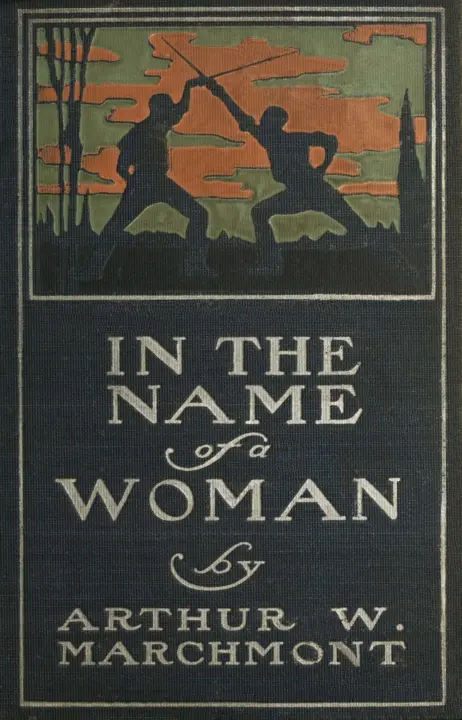
THE CLASSIC COLLECTION · 1900
"In the Name of a Woman: A Romance" by Arthur W. Marchmont is a novel written in the late 19th century. The story unfolds in Sofia, Bulgaria, amidst a backdrop of political intrigue and social unrest, following the daring escapades of the protagonist, Gerald Winthrop, as he becomes entangled with a mysterious and attractive woman, Countess Anna Bokara. The narrative explores themes of honor, loyalty, and the tumultuous intersection of personal desire and political duty. The opening of the book introduces a dramatic rescue scene, where Winthrop intervenes to save the Countess from two assailants. This thrilling event sets the stage for their ensuing dialogue, revealing the Countess's strong character and her disdain for weakness in the face of danger. As she tends to her wound and expresses her gratitude, it becomes evident that she is embroiled in dangerous political machinations involving Russia's influence in Bulgaria. Winthrop, while captivated by her strength and beauty, is hesitant to align himself with her cause due to his own secret mission. The tension builds as the narrative hints at their complex relationship, underscoring not only their immediate peril but also the larger stakes at play in a country on the brink of turmoil.
Introduction adapted from the source catalogue; source summaries may be automatically generated.
Free to read · English · 104,650 words · No account needed
MAKE TIME FOR A GOOD BOOK
On by default. Untick to stop anonymous reading totals. Each page counts after 10 seconds in view. How this works.
Anonymous counting is on unless you have switched it off.
“If the door is not opened we shall break it in.”
Getting no reply, he returned to his men, and sent four of them round to the back of the house. Then one of the men called his attention to something at the side of the yard, and eight of them went and picked up a heavy balk of timber lying there.
“They’re going to use it as a battering-ram,” said Zoiloff. “We must
stop that.”
“Wait,” I said quickly. “When they are in position I’ll warn them, and through the open windows we can then shoot the horses. Remember, men, level your guns first at the men, and when I tell you, aim at the horses, and shoot straight.”
The timber was heavy, the afternoon hot, the men fatigued and with no great zest for the business, so that they took a long time before they had brought it round near the door.
Then I threw up the window sharply, and called, in a ringing voice:
“Stop! We sha’n’t allow that.”
Looking up, the troopers found themselves covered by the guns of our party, and, dropping the timber, they rushed like hares for cover--all save the leader, who flung curses at them for their cowardice.
“Now fire,” I said; and, levelling my rifle, I picked out a horse, and we fired our first volley.
“Quick! again!” and a second volley rang out.
The effect was indescribable. Five horses fell at the first round, and the rest stampeded and plunged so violently that any accurate aim the second time was very difficult. Only three fell, but the rest broke from their fastenings in a very frenzy of fear and galloped wildly off, plunging across country at a speed that made any thought of pursuit hopeless.
The men started to follow them, but were recalled by the leader, and came slinking back to cover like whipped dogs.
The loss of the horses was not their only misfortune, however, for in getting the log they had set down their carbines near the gate in a spot which we could cover with our guns. Seeing this, I called again:
“The man who touches one of those guns will be shot!”
The sergeant had plenty of pluck, and, though sorely perplexed by the turn things had thus suddenly taken, was as cool as if he had been on parade.
“What do you want here?” I cried.
“I want to know who’s in the house,” he said.
“I am. What next?”
“Who else?”
“I decline to say.”
“Will you surrender without causing any more trouble?” he asked coolly.
Your reading position is saved on this browser. Take it to another device with a library code. Reading pages adapt to text, rather than matching a printed edition.
Arthur W. Marchmont
Arthur W. Marchmont
Arthur W. Marchmont

Arthur W. Marchmont
BEHIND THE BOOK
This eBook is for the use of anyone anywhere in the United States and most other parts of the world at no cost and with almost no restrictions whatsoever. You may copy it, give it away or re-use it under the terms of the Project Gutenberg License included with this eBook or online at www.gutenberg.org. If you are not located in the United States, you will have to check the laws of the country where you are located before using this eBook. Read the source licence.
The original source file, including credits and licence, is retained by this library. Request an original-format copy at no charge. Please include the book title and Project Gutenberg identifier #67546.
KEEP YOUR CURIOSITY GOING
Coulson Kernahan

Maurice Baring
Frances Wright
Cécile Tormay

Frederic Jesup Stimson

W. H. P. (William Henry Pope) Jarvis