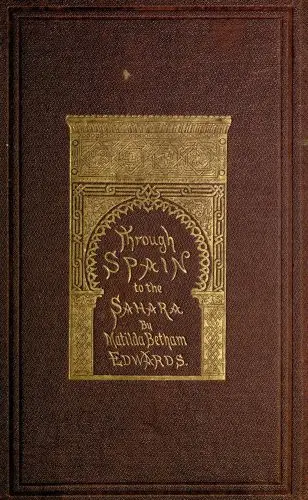
Through Spain to the Sahara
Matilda Betham-Edwards
THE CLASSIC COLLECTION · 1912
"In the Heart of the Vosges and Other Sketches" by Miss Betham-Edwards is a travelogue written in the early 20th century that presents a personal exploration of eastern France, particularly the Vosges and Alsace regions. The narrative captures the beauty of the landscapes, the richness of local traditions, and the charm of the towns and people encountered along the journey. The author's vivid descriptions reflect a deep appreciation for the hidden corners of France that were little explored by other writers, inviting readers to share in her unique experiences as an English traveler. The opening portion of the book introduces readers to the picturesque region of Gérardmer and its surroundings, emphasizing the beauty of the countryside and the delights of local gastronomy. The author describes the historical and architectural significance of towns along the way, such as Châlons-sur-Marne and Nancy, showcasing a blend of art, culture, and charm. As the journey unfolds, the reader is immersed in the tranquil life of the Vosges, where the simple yet idyllic existence of rural residents contrasts with the more frenetic pace of modern life. The author reflects on the interactions with the locals, the natural beauty that encompasses the area, and the delightful experiences that characterize her travels, setting a tone of exploration infused with both admiration and elegance.
Introduction adapted from the source catalogue; source summaries may be automatically generated.
Free to read · English · 60,514 words · No account needed
MAKE TIME FOR A GOOD BOOK
On by default. Untick to stop anonymous reading totals. Each page counts after 10 seconds in view. How this works.
Anonymous counting is on unless you have switched it off.
We were offered hospitality for days, nay, weeks, if we chose to stay, and even the use of Oberlin's study to sit and write in! A summer might be pleasantly spent here, with quiet mornings in this cheerful chamber, full of pious memories, and in the afternoon long rambles with the children over the peaceful hills. From Foudai, too, you may climb the wild rocky plateau known as the Champ de Feu--no spot in the Vosges chain is more interesting from a geological point of view.
After much pleasant talk we took leave of our kind hosts, not going away, however, without visiting the church. A tablet with medallion portrait of Oberlin bears the touching inscription that for fifty-nine years he was "the father of this parish." Then we drove back as we had come, stopping at Foudai to rest the horse and drink tea. We were served in a cool little parlour opening on to a garden, and, so tempting looked the tiny inn that we regretted we could not stay there a week. A pleasant pastoral country rather than romantic or picturesque is the Ban de la Roche, but close at hand is the lofty Donon, which may be climbed from Rothau or Foudai, and there are many other excursions within reach.
Here, for the present, the romance of Alsace travel ends, and all is prose of a somewhat painful kind. The first object that attracted our attention on reaching Strasburg was the new railway station, of which we had already heard so much. This handsome structure, erected by the German Government at an enormous cost, had only been recently opened, and so great was the soreness of feeling excited by certain allegorical bas-reliefs decorating the façade that for many days after the opening of the station police-officers in plain clothes carefully watched the crowd of spectators, carrying off the more seditious to prison. To say the least of it, these mural decorations are not in the best of taste, and at any rate it would have been better to have withheld them for a time. The two small bas-reliefs in question bear respectively the inscription, "Im alten, und im neuen Reich" ("In the old and new Empire"), improved by a stander-by, to the great relish of others, thus, "Im alten, reich, im neuen, arm" ("In the old, rich, in the new, poor"). They give a somewhat ideal representation of the surrender of Strasburg to the German Emperor. But the bombardment of their city, the destruction of public monuments and the loss of life and property thereby occasioned, were as yet fresh in the memories of the inhabitants, and they needed no such reminder of the new state of things. Their better feelings towards Germany had been bombarded out of them, as an Alsacienne wittily observed to the Duchess of Baden after the surrender. The duchess, daughter to the Emperor William, made the round of the hospitals, and not a single Alsatian soldier but turned his face to the wall, whereupon she expressed her astonishment at not finding a better sentiment. Nor can the lover of art help drawing a painful contrast between the Strasburg of the old and the new régime. There was very little to see at Strasburg except the cathedral at this time. The Library, with its 300,000 volumes and 1,500 manuscripts--the priceless Hortus Deliciarium of the twelfth century, richly illuminated and ornamented with miniatures invaluable to the student of men and manners of the Middle Ages, the missal of Louis XII., bearing his arms, the Recueil de Prières of the eighth century--all these had been completely destroyed by the ruthless Prussian bombardment. The Museum, rich in chefs d'oeuvre of the French school, both of sculpture and painting, the handsome Protestant church, the theatre, the Palais de Justice, all shared the same fate, not to speak of buildings of lesser importance, including four hundred private dwellings, and of the fifteen hundred civilians, men, women and children, killed and wounded by the shells. The fine church of St. Thomas suffered greatly. Nor was the cathedral spared, and it would doubtless have perished altogether, too, but for the enforced surrender of the heroic city. On my second visit ten years later I found immense changes, new German architecture to be seen everywhere.
Your reading position is saved on this browser. Take it to another device with a library code. Reading pages adapt to text, rather than matching a printed edition.
Matilda Betham-Edwards
Matilda Betham-Edwards
Matilda Betham-Edwards
Matilda Betham-Edwards
BEHIND THE BOOK
This eBook is for the use of anyone anywhere in the United States and most other parts of the world at no cost and with almost no restrictions whatsoever. You may copy it, give it away or re-use it under the terms of the Project Gutenberg License included with this eBook or online at www.gutenberg.org. If you are not located in the United States, you will have to check the laws of the country where you are located before using this eBook. Read the source licence.
The original source file, including credits and licence, is retained by this library. Request an original-format copy at no charge. Please include the book title and Project Gutenberg identifier #9480.
KEEP YOUR CURIOSITY GOING
Wilfrid Scawen Blunt
Wilfrid Scawen Blunt

E. W. (Edgar Watson) Howe
Francis Greenleaf Allinson & Anne C. E. (Anne Crosby Emery) Allinson
Cyrenus Cole

John Martineau