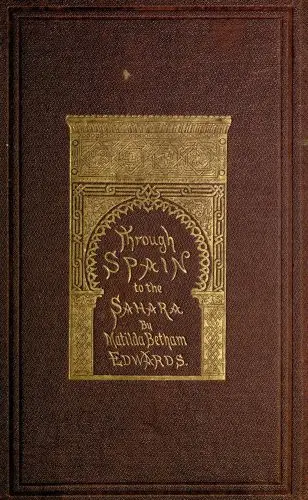
Through Spain to the Sahara
Matilda Betham-Edwards
THE CLASSIC COLLECTION · 1912
"In the Heart of the Vosges and Other Sketches" by Miss Betham-Edwards is a travelogue written in the early 20th century that presents a personal exploration of eastern France, particularly the Vosges and Alsace regions. The narrative captures the beauty of the landscapes, the richness of local traditions, and the charm of the towns and people encountered along the journey. The author's vivid descriptions reflect a deep appreciation for the hidden corners of France that were little explored by other writers, inviting readers to share in her unique experiences as an English traveler. The opening portion of the book introduces readers to the picturesque region of Gérardmer and its surroundings, emphasizing the beauty of the countryside and the delights of local gastronomy. The author describes the historical and architectural significance of towns along the way, such as Châlons-sur-Marne and Nancy, showcasing a blend of art, culture, and charm. As the journey unfolds, the reader is immersed in the tranquil life of the Vosges, where the simple yet idyllic existence of rural residents contrasts with the more frenetic pace of modern life. The author reflects on the interactions with the locals, the natural beauty that encompasses the area, and the delightful experiences that characterize her travels, setting a tone of exploration infused with both admiration and elegance.
Introduction adapted from the source catalogue; source summaries may be automatically generated.
Free to read · English · 60,514 words · No account needed
MAKE TIME FOR A GOOD BOOK
On by default. Untick to stop anonymous reading totals. Each page counts after 10 seconds in view. How this works.
Anonymous counting is on unless you have switched it off.
Few shops remained open after mid-day, except one or two very large groceries, at which fresh vegetables were sold. It is pleasant to note a gradual diminution of Sunday labour throughout France.
The celebration of May-Day, which date occurred soon after my visit, was not calculated either to alarm the Republic or the world in general. It was a monster manifestation in favour of the Three Eights, and I think few of us, were we suddenly transformed into Roubaix machinists, would not speedily become Three Eighters as well.
At five o'clock in the morning the firing of cannon announced the annual "Fête du Travail," or workmen's holiday, not accorded by Act of Parliament, but claimed by the people as a legitimate privilege.
Unwonted calm prevailed in certain quarters. Instead of men, women, boys and girls pouring by tens of thousands into the factories, the streets leading to them were empty. In one or two cases, where machinery had been set in motion and doors opened, public opinion immediately effected a stoppage of work. Instead, therefore, of being imprisoned from half-past five in the morning till seven or eight at night, the entire Roubaisien population had freed itself to enjoy "a sunshine holiday." Such a day cannot be too long, and at a quarter past seven vast crowds had collected before the Hôtel de Ville.
Here a surprise was in store for the boldest Three Eighter going. The tricolour had been hoisted down, and replaced, not by a red flag, but by a large transparency, showing the following device in red letters upon a white ground:--
FÊTE INTERNATIONALE DU TRAVAIL,
1er Mai 1893.
Huit Heures du Travail,
Huit Heures du Loisir,
Huit Heures du Repos.
[Footnote: Translation-International festival of labour; eight hours' work, eight hours' leisure, eight hours' repose.]
The mayor, in undress, that is to say in garments of every day, having surveyed these preparations, returned to his estaminet, the Plat d'Or, and there folded his newspapers as usual for the day's distribution.
In the meantime the finishing touch was put to other decorations, consisting of flags, devices and red drapery, everywhere the Three Eights being conspicuous.
A monster procession was then formed, headed by the Town Council and a vast number of bands. There was the music of the Fire Brigade, the socialist brass band, the children's choir, the Choral Society of Roubaix, the Franco-Belgian Choral Society, and many others. Twenty thousand persons took part in this procession, the men wearing red neckties and a red flower in their button-holes, the forty-seven groups of the workmen's federation bearing banners, all singing, bands playing, drums beating, cannons firing as they went.
Your reading position is saved on this browser. Take it to another device with a library code. Reading pages adapt to text, rather than matching a printed edition.
Matilda Betham-Edwards
Matilda Betham-Edwards
Matilda Betham-Edwards
Matilda Betham-Edwards
BEHIND THE BOOK
This eBook is for the use of anyone anywhere in the United States and most other parts of the world at no cost and with almost no restrictions whatsoever. You may copy it, give it away or re-use it under the terms of the Project Gutenberg License included with this eBook or online at www.gutenberg.org. If you are not located in the United States, you will have to check the laws of the country where you are located before using this eBook. Read the source licence.
The original source file, including credits and licence, is retained by this library. Request an original-format copy at no charge. Please include the book title and Project Gutenberg identifier #9480.
KEEP YOUR CURIOSITY GOING
Wilfrid Scawen Blunt
Wilfrid Scawen Blunt

E. W. (Edgar Watson) Howe
Francis Greenleaf Allinson & Anne C. E. (Anne Crosby Emery) Allinson
Cyrenus Cole

John Martineau