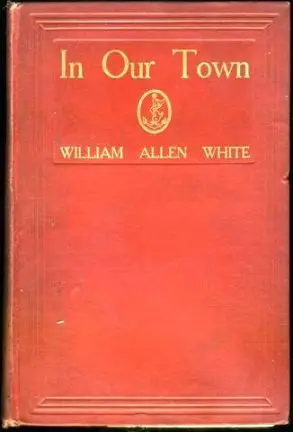
In Our Town
William Allen White
THE CLASSIC COLLECTION · 1918
"In the Heart of a Fool" by William Allen White is a novel written in the early 20th century. The book delves into the lives of residents in the fictional town of Harvey, a community shaped by the American Civil War and the ideals of the early settlers. Central to the story are the Adams family, particularly Amos Adams, and their aspirations that intertwine with the societal developments of the budding town where they reside. At the start of the narrative, we witness the scene being set in the prairies of a new America, echoing the dream of opportunity and equality sought by its early inhabitants. The arrival of various characters marks the evolution of the town, each with distinct ambitions and dreams. The opening establishes Amos Adams as a pivotal figure, whose experiences as a printer and soldier shape the aspirations of his family and community. Simultaneously, the narrative alludes to larger themes of idealism versus materialism and the complexities of human relationships, hinting at the deeper narratives that will unfold as the story progresses. The introduction also suggests a rich tapestry of social interactions bound to the characters' personal journeys in a society grappling with its own identity.
Introduction adapted from the source catalogue; source summaries may be automatically generated.
Free to read · English · 227,716 words · No account needed
MAKE TIME FOR A GOOD BOOK
On by default. Untick to stop anonymous reading totals. Each page counts after 10 seconds in view. How this works.
Anonymous counting is on unless you have switched it off.
Young Joe Calvin stood with his hands on the shoulders of the two sitting men. "Mr. Mayor, do you know that tune?" said Young Joe.
Mr. Mayor, whose only secular tune was "Yankee Doodle," confessed his ignorance. "Listen to the words," suggested Young Joe. Old Joe put his hand to his right ear. Ahab Wright leaned forward, and the words of the old, old cry of the Reds of the Midi came surging up:
"To arms! to arms!--ye brave!
The avenging sword unsheathe!
March on! March on! all hearts resolved
On victory or death."
When Ahab Wright caught the words he was open mouthed with astonishment. "Why--why," he cried, "that--why, that is sedition. They're advocating murder!"
Young Joe Calvin's face did not betray him, and he nodded a warning head. Old Joe looked the genuine consternation which he felt.
"We can't have this, Ahab--this won't do--a few days of this and we'll
have bloodshed."
It did not occur to Ahab Wright that he had been singing "Onward, Christian Soldiers," and "I Am a Soldier of the Cross," and "I'll Be Washed in the Blood of the Lamb," all of his pious life, without ever meaning anything particularly sanguinary. He heard the war song of the revolution, and being a literal and peth-headed man, prepared to defend the flag with all the ardor that had burned in John Kollander's heart for fifty years.
"I tell you, Mr. Mayor, we need the troops. The Sheriff agrees with me--now you hear that," said young Joe. "Will you wait until some one is killed or worse, until a mine is flooded, before sending for them?"
"You know, Ahab," put in old Joe, "the Governor said on the phone this morning, not to let this situation get away from you."
The crowd was joining the singing. The words--the inspiring words of the labor chant had caught the people on the sidewalk, and a great diapason was rising:
"March on! March on!--all hearts resolved
On victory or death."
"Hear that--hear that, Ahab!" cried old Joe. "Why, the decent people up town here are going crazy--they're all singing it--and that little devil is waving a red flag with the white one!"
Ahab Wright looked and was aghast. "Doesn't that mean rebellion--anarchy--and bloodshed?" he gasped.
"It means socialism," quoth young Joe, laconically, "which is the same
thing."
"Well, well! my! my! Dear me," fretted Ahab, "we mustn't let this go
on."
"Shall I get the Governor on the phone--you know we have the Sheriff's order here--just waiting for you to join him?" asked young Joe.
The Haves were moving the realm of the discussion about their property from pure reason to the baser emotions.
Your reading position is saved on this browser. Take it to another device with a library code. Reading pages adapt to text, rather than matching a printed edition.
BEHIND THE BOOK
This eBook is for the use of anyone anywhere in the United States and most other parts of the world at no cost and with almost no restrictions whatsoever. You may copy it, give it away or re-use it under the terms of the Project Gutenberg License included with this eBook or online at www.gutenberg.org. If you are not located in the United States, you will have to check the laws of the country where you are located before using this eBook. Read the source licence.
The original source file, including credits and licence, is retained by this library. Request an original-format copy at no charge. Please include the book title and Project Gutenberg identifier #30627.
KEEP YOUR CURIOSITY GOING
Coulson Kernahan

Maurice Baring
Frances Wright
Cécile Tormay

Frederic Jesup Stimson

W. H. P. (William Henry Pope) Jarvis