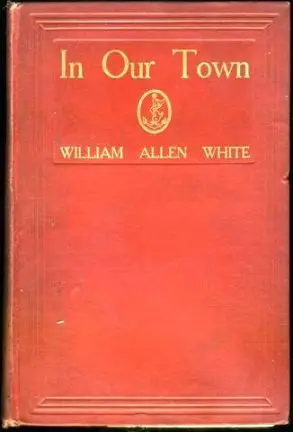
In Our Town
William Allen White
THE CLASSIC COLLECTION · 1918
"In the Heart of a Fool" by William Allen White is a novel written in the early 20th century. The book delves into the lives of residents in the fictional town of Harvey, a community shaped by the American Civil War and the ideals of the early settlers. Central to the story are the Adams family, particularly Amos Adams, and their aspirations that intertwine with the societal developments of the budding town where they reside. At the start of the narrative, we witness the scene being set in the prairies of a new America, echoing the dream of opportunity and equality sought by its early inhabitants. The arrival of various characters marks the evolution of the town, each with distinct ambitions and dreams. The opening establishes Amos Adams as a pivotal figure, whose experiences as a printer and soldier shape the aspirations of his family and community. Simultaneously, the narrative alludes to larger themes of idealism versus materialism and the complexities of human relationships, hinting at the deeper narratives that will unfold as the story progresses. The introduction also suggests a rich tapestry of social interactions bound to the characters' personal journeys in a society grappling with its own identity.
Introduction adapted from the source catalogue; source summaries may be automatically generated.
Free to read · English · 227,716 words · No account needed
MAKE TIME FOR A GOOD BOOK
On by default. Untick to stop anonymous reading totals. Each page counts after 10 seconds in view. How this works.
Anonymous counting is on unless you have switched it off.
"I couldn't leave home," she said finally, as she pulled out a sheet of paper. "It wouldn't be the thing--do you think so?"
He put his feet on the desk, showing his ankles of pride, and fingering his mustache, smiling a squinty smile with his handsome, beady eyes as he said: "Oh, I'd take care of you. You aren't afraid of me, are you?"
They both laughed. And the girl came over with a sheet of paper. "Here is that Midland Valley letter. Will you sign it now?"
He managed to touch her hand as she handed him the sheet, and again to touch her bare forearm as he handed it back after signing it. For which he got two darts from her eyes.
A client came in. Joseph Calvin hurried in and out, a busy little rat of a man who always wore shiny clothes that bagged at the knees and elbows. George Brotherton crashed in through the office on city business, and so the afternoon wore away. At the end of the day, Thomas Van Dorn and Miss Mauling locked up the office and went down the hall and the stairs to the street together. He released her arm as they came to the street, and tipped his hat as she rounded the corner for home. He saw the white-clad Doctor trudging up the low incline that led to Elm Street.
Dr. Nesbit was asking the question, Who are the fit? Who should survive? His fingers had been pinched in the door of the young Judge's philosophy and the Doctor was considering much that might be behind the door. He wondered if it was the rich and the powerful who should survive. Or he thought perhaps it is those who give themselves for others. There was Captain Morton with his one talent, pottering up and down the town talking all kinds of weather, and all kinds of rebuffs that he might keep the girls in school and make them ready to serve society; yet according to Tom's standards of success the Captain was unfit; and there was George Brotherton, ignorant, but loyal, foolishly blind, of a tender heart, yet compared with those who used his ignorance and played upon his blindness (and the Doctor winced at his part in that game) Mr. Brotherton was cast aside among the world's unfit; and so was Henry Fenn, fighting with his devil like a soldier; and so was Dick Bowman going into the mines for his family, sacrificing light and air and the joy of a free life that the wife and children might be clad, housed and fed and that they might enjoy something of the comforts of the great civilization which his toil was helping to build up around them; yet in his grime Dick was accounted exceedingly unfit. Dick only had a number on the company's books and his number corresponded to a share of stock and it was the business of the share of stock to get as much out of Dick and give him back as little, and to take as much from society in passing for coal as it could, and being without soul or conscience or feeling of any kind, the share of stock put the automatic screws on Dick--as their numbers corresponded. And for squeezing the sweat out of him the share was accounted unusually fit, while poor Dick--why he was merely a number on the books and was called a unit of labor. Then there was Daniel Sands. He had spread his web all over the town. It ran in the pipes under ground that brought water and gas, and the wires above ground, that brought light and power and communication. The web found its way into the earth--through deep cuts in the earth, worming along caverns where it held men at work; then the web ran into foul dens where the toilers were robbed of their health and strength and happiness and even of the money the toilers toiled for, and the web brought it all back slimey and stinking from unclean hands into the place where the spider sat spinning. And there was his son and daughter; Mr. Sands had married at least four estimable ladies with the plausible excuse that he was doing it only to give his children a home. Mr. Sands had given his son a home, to be sure; but his son had not taken a conscience from the home--for who was there at home to give it? Not the estimable ladies who had married Mr. Sands, for they had none or they would have been somewhere else, to be sure; not Mr. Sands himself, for he was busy with his web, and conscience rips such webs as his endways, and Daniel would have none of that. And the servants who had reared the youth had no conscience to give him; for it was made definite and certain in that home that they were paid for what they did, so they did what they were paid for, and bestowing consciences upon young gentlemen is no part of the duty of the "help" in a home like that.
Your reading position is saved on this browser. Take it to another device with a library code. Reading pages adapt to text, rather than matching a printed edition.
BEHIND THE BOOK
This eBook is for the use of anyone anywhere in the United States and most other parts of the world at no cost and with almost no restrictions whatsoever. You may copy it, give it away or re-use it under the terms of the Project Gutenberg License included with this eBook or online at www.gutenberg.org. If you are not located in the United States, you will have to check the laws of the country where you are located before using this eBook. Read the source licence.
The original source file, including credits and licence, is retained by this library. Request an original-format copy at no charge. Please include the book title and Project Gutenberg identifier #30627.
KEEP YOUR CURIOSITY GOING
Coulson Kernahan

Maurice Baring
Frances Wright
Cécile Tormay

Frederic Jesup Stimson

W. H. P. (William Henry Pope) Jarvis