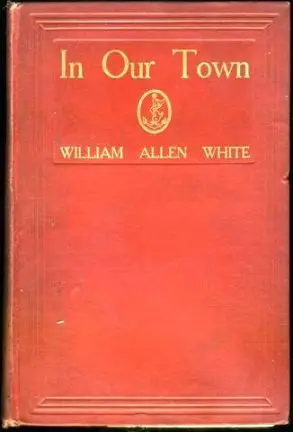
In Our Town
William Allen White
THE CLASSIC COLLECTION · 1918
"In the Heart of a Fool" by William Allen White is a novel written in the early 20th century. The book delves into the lives of residents in the fictional town of Harvey, a community shaped by the American Civil War and the ideals of the early settlers. Central to the story are the Adams family, particularly Amos Adams, and their aspirations that intertwine with the societal developments of the budding town where they reside. At the start of the narrative, we witness the scene being set in the prairies of a new America, echoing the dream of opportunity and equality sought by its early inhabitants. The arrival of various characters marks the evolution of the town, each with distinct ambitions and dreams. The opening establishes Amos Adams as a pivotal figure, whose experiences as a printer and soldier shape the aspirations of his family and community. Simultaneously, the narrative alludes to larger themes of idealism versus materialism and the complexities of human relationships, hinting at the deeper narratives that will unfold as the story progresses. The introduction also suggests a rich tapestry of social interactions bound to the characters' personal journeys in a society grappling with its own identity.
Introduction adapted from the source catalogue; source summaries may be automatically generated.
Free to read · English · 227,716 words · No account needed
MAKE TIME FOR A GOOD BOOK
On by default. Untick to stop anonymous reading totals. Each page counts after 10 seconds in view. How this works.
Anonymous counting is on unless you have switched it off.
She did not let him finish, but bent to kiss him and she could feel the shudder of a smothered sob rack him as she touched his cheek.
Then he smiled at her and chirped: "Just Eendiany--sis'. Just pore, dumb Eendiany! Hi, ho! Now run and be a good girl! And here's a jim-crack your daddy got you!"
From his pocket he drew out a little package, and dangled a sparkling jewel in his hands. He saw a flash of pleasure on her face. But his heart was full, and he turned away his head as he handed the gift to her. Her eyes were upon the sparkling jewel, as he led her into the house, saying with a great sigh: "Come on, my dear--let's go in."
At nine o'clock that night, the great foundry of a house, with its half a score of chimneys, marking its various epochs of growth, literally was stuffed with smilax, ferns, roses, orange blossoms, and daisy chains. In the mazes of these aisles of verdure, a labyrinth of Van Dorns and Satterthwaites and visiting statesmen with highly powdered womankind was packed securely. George Brotherton, who was born a drum major, wearing all of his glittering insignia of a long line of secret societies, moved as though the welding humanity were fluid. He had presided at too many funerals not to know the vast importance of keeping the bride's kin from the groom's kin, and when he saw that they were ushered into the wedding supper, in due form and order, it was with the fine abandon of a grand duke lording it over the populace. Senators, Supreme Court justices, proud Satterthwaites, haughty Van Dorns, Congressmen, governors, local gentry, were packed neatly but firmly in their proper boxes.
The old families of Harvey--Captain Morton and his little flock, the Kollanders, Ahab Wright with his flaring side-whiskers, his white necktie and his shadow of a wife; Joseph Calvin and his daughter in pigtails, Mrs. Calvin having written Mrs. Nesbit that it seemed that she just never did get to go anywhere and be anybody, having said as much and more to Mr. Calvin with emphasis; Mrs. Brotherton, mother of George, beaming with pride at her son's part; stuttering Kyle Perry and his hatchet-faced son, the Adamses all starched for the occasion, Daniel Sands, a widower pro tem. with a broadening interest in school teachers, Mrs. Herdicker, the ladies' hatter, classifying the Satterthwaites and the Van Dorns according to the millinery of their womenkind; Morty Sands wearing the first white silk vest exhibited in Harvey and making violent eyes at a daughter of the railroad aristocracy--either a general manager's daughter or a general superintendent's, and for the life of her Mrs. Nesbit couldn't say; for she had not the highest opinion in the world of the railroad aristocracy, but took them, president, first, second and third vice, general managers, ticket and passenger agents, and superintendents, as a sort of social job-lot because they came in private cars, and the Doctor desired them, to add to his trophies of the occasion,--Henry Fenn, wearing soberly the suit in which he appeared when he rode the skyrocket, and forming part of the bridal chorus, stationed in the cigar-box of a sewing-room on the second floor to sing, "Oh, Day So Dear," as the happy couple came down the stairs--the old families of Harvey were all invited to the wedding. And the old and the new and most of the intermediary families of no particular caste or standing, came to the reception after the ceremony. But because she had the best voice in town, Margaret Mueller sang "Oh, Promise Me," in a remote bedroom--to give the effect of distant music, low and sweet, and after that song was over, and after Henry Fenn's great pride had been fairly sated, Margaret Mueller mingled with the guests and knew more of the names and stations of the visiting nobility from the state house and railroad offices than any other person present. And such is the perversity of the male sex that there were more "by Georges," and more "Look--look, looks," and more faint whistles, and more "Tch--tch tchs," and more nudging and pointing among the men when Margaret appeared than when the bride herself, pink and white and beautiful, came down the stairs. Even the eyes of the groom, as he stood beside the bride, tall, youthful, strong, and handsome as a man may dare to be and earn an honest living, even his eyes sometimes found themselves straying toward the figure and face of the beautiful girl whom he had scarcely noticed while she worked in the court house. But this may be said for the groom, that when his eyes did wander, he pulled them back with an almost irritated jerk, and seemed determined to keep them upon the girl by his side.
Your reading position is saved on this browser. Take it to another device with a library code. Reading pages adapt to text, rather than matching a printed edition.
BEHIND THE BOOK
This eBook is for the use of anyone anywhere in the United States and most other parts of the world at no cost and with almost no restrictions whatsoever. You may copy it, give it away or re-use it under the terms of the Project Gutenberg License included with this eBook or online at www.gutenberg.org. If you are not located in the United States, you will have to check the laws of the country where you are located before using this eBook. Read the source licence.
The original source file, including credits and licence, is retained by this library. Request an original-format copy at no charge. Please include the book title and Project Gutenberg identifier #30627.
KEEP YOUR CURIOSITY GOING
Coulson Kernahan

Maurice Baring
Frances Wright
Cécile Tormay

Frederic Jesup Stimson

W. H. P. (William Henry Pope) Jarvis