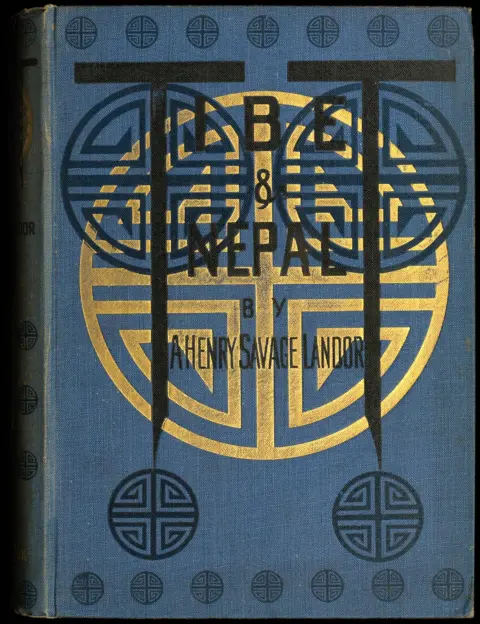
Tibet & Nepal
Arnold Henry Savage Landor
THE CLASSIC COLLECTION · 1909
"In the Forbidden Land: An Account of a Journey into Tibet, Capture by the Tibetan Authorities" by A. Henry Savage Landor is a historical account written in the late 19th century. The narrative details Landor's expedition into Tibet, during which he faced not only the challenges of navigating a rugged and largely unexplored environment but also endured the harsh realities of capture, imprisonment, and torture at the hands of Tibetan authorities. The work serves both as a gripping travelogue and an essential record of the customs and culture of the Tibetan people. At the start of the book, Landor recounts his preparations for the journey, detailing the essential provisions, scientific instruments, and various challenges he encountered even before reaching Tibet. Despite initial excitement, his adventure becomes increasingly fraught with difficulties such as the overwhelming heat of India, logistical setbacks with carriers, and the necessity of recruiting reliable servants for the treacherous journey ahead. The narrative quickly establishes a sense of urgency and peril, providing readers a glimpse into Landor's determination and resourcefulness as he embarks on an expedition that promises to be both enlightening and harrowing. The opening chapters set the stage for a vivid exploration of not just the physical landscape, but also the human experiences that will unfold in the forbidding and mysterious region of Tibet.
Introduction adapted from the source catalogue; source summaries may be automatically generated.
Free to read · English · 147,046 words · No account needed
MAKE TIME FOR A GOOD BOOK
On by default. Untick to stop anonymous reading totals. Each page counts after 10 seconds in view. How this works.
Anonymous counting is on unless you have switched it off.
All valuables were removed, his gold earrings, his silver locket and bracelets; and a large knife was used for some purpose or other which I could not quite see, except in slitting the lobes of the corpse's ears to remove his earrings more quickly. Branches of pine-tree were deposited on the body, and a large pot of butter was set by its side. A brass bowl of choekti (wine) was poured on the head, and then, in profound silence, fire was set to the pile.
A few white puffs showed that it had caught fire, and then a dense column of black smoke rose from it, filling the atmosphere with a sickening smell of singed hair and burning flesh. The wind blew the smoke towards me, and I was enveloped in it for some moments, during which I could see nothing of what was going on, and I felt my eyes smart and my nostrils fill with the smoke and the stench. Gradually a tall flame, over twenty feet high, leaked out, consuming the body and showing me, as the atmosphere cleared, the Shokas down by the river washing their hands and faces to cleanse themselves of what they look upon as unclean, the contact with a corpse. Retracing their steps to the village, the women cried and moaned, carrying back to the house the clothes of the deceased and his brass bowls.
Reaching home, it was incumbent on them to provide lavishly for the amusement of the dead man's soul. A lay figure crudely constructed of straw and sticks was attired by them in the clothes of the departed, and covered over with Indian fabrics embroidered in gold and red and blue, and a turban was stuck on the head, with a panache made of a branch of fir-tree. The Kalihe was at the side of the image. When the fire was extinguished, a visit was paid to the cremation spot by the relatives of the deceased, and such pieces of bone as the knee-joints, elbows, and the larger vertebrae of the spine, usually left undestroyed by the flames, were collected and deposited inside the clothes of the image. Wheat, rice, and flour were purchased in large quantities and cooked to provide food for the multitude of friends who remained the guests of the family during the whole time of the funeral. A sheep a day is usually killed and eaten on such occasions, and cask after cask of choekti (wine), zahn (a liquor distilled from barley, rice and wheat), and anag (from fermented grain of various kinds) are emptied by the mourning crowd. The women folk of the dead man mourned round the effigy, resting their heads on it, crying and imploring the beloved one to return to life. Other rows of women, with their hoods turned inside out in sign of mourning, danced gracefully in circles round the dressed-up figure, left the house by one door in the basement, described an arc in the open, and returned by another door, while men were dancing a doleful dance outside the house. Beating of drums went on the whole day--languid and sad at moments; excited, violent and rowdy at others, according to the mood of the musicians and the quantity of liquor consumed by them. On each day of these proceedings, which lasted for three or four days, rice, baked wheat, and wine were placed before the effigy, until, when it was assumed that the soul of the dead had had a sufficiently amusing time, arrangements were made for its transmigration from the lay figure into a live sheep or yak. If the deceased is a man, the animal chosen to represent him is a male; if a woman, a female; but no ceremony of this sort follows the cremation of children under ten or twelve. In the case of the old man whose funeral I witnessed, a sheep was chosen, instead of the time-hallowed yak, the procuring of which from Tibet used to be a very costly business. The use of a sheep for these sacrifices is quite a recent innovation, brought into fashion by the greatest Shoka trader in Garbyang, called Gobaria, whose intention it was to put down the unnecessary waste of these ceremonies; but many pious Shokas, I was assured, are not satisfied with so small an offering as a single sheep, and slaughter two or even more on these occasions.
Your reading position is saved on this browser. Take it to another device with a library code. Reading pages adapt to text, rather than matching a printed edition.
Arnold Henry Savage Landor
Arnold Henry Savage Landor
Arnold Henry Savage Landor
Arnold Henry Savage Landor
BEHIND THE BOOK
This eBook is for the use of anyone anywhere in the United States and most other parts of the world at no cost and with almost no restrictions whatsoever. You may copy it, give it away or re-use it under the terms of the Project Gutenberg License included with this eBook or online at www.gutenberg.org. If you are not located in the United States, you will have to check the laws of the country where you are located before using this eBook. Read the source licence.
The original source file, including credits and licence, is retained by this library. Request an original-format copy at no charge. Please include the book title and Project Gutenberg identifier #22210.
KEEP YOUR CURIOSITY GOING
Wilfrid Scawen Blunt
Wilfrid Scawen Blunt

E. W. (Edgar Watson) Howe
Cécile Tormay

Moritz Busch
John L. Ransom