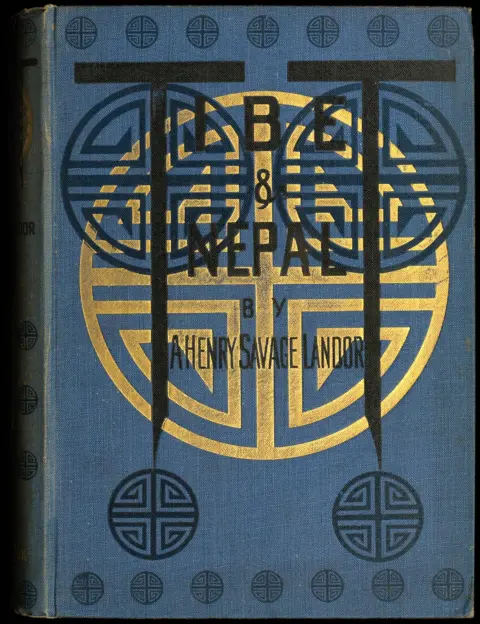
Tibet & Nepal
Arnold Henry Savage Landor
THE CLASSIC COLLECTION · 1909
"In the Forbidden Land: An Account of a Journey into Tibet, Capture by the Tibetan Authorities" by A. Henry Savage Landor is a historical account written in the late 19th century. The narrative details Landor's expedition into Tibet, during which he faced not only the challenges of navigating a rugged and largely unexplored environment but also endured the harsh realities of capture, imprisonment, and torture at the hands of Tibetan authorities. The work serves both as a gripping travelogue and an essential record of the customs and culture of the Tibetan people. At the start of the book, Landor recounts his preparations for the journey, detailing the essential provisions, scientific instruments, and various challenges he encountered even before reaching Tibet. Despite initial excitement, his adventure becomes increasingly fraught with difficulties such as the overwhelming heat of India, logistical setbacks with carriers, and the necessity of recruiting reliable servants for the treacherous journey ahead. The narrative quickly establishes a sense of urgency and peril, providing readers a glimpse into Landor's determination and resourcefulness as he embarks on an expedition that promises to be both enlightening and harrowing. The opening chapters set the stage for a vivid exploration of not just the physical landscape, but also the human experiences that will unfold in the forbidding and mysterious region of Tibet.
Introduction adapted from the source catalogue; source summaries may be automatically generated.
Free to read · English · 147,046 words · No account needed
MAKE TIME FOR A GOOD BOOK
On by default. Untick to stop anonymous reading totals. Each page counts after 10 seconds in view. How this works.
Anonymous counting is on unless you have switched it off.
1. Of yourself; 2. Of Chanden Sing;
3. Of Man Sing; 4. Of Rev. Harkua Wilson;
5. Of Pundit Gobaria; 6. Of Kharak Sing;
7. Of Suna
I have the honour to be, Sir,
Your most obedient Servant,
H. N. WRIGHT,
Under-Secretary to Government, North-Western
Provinces and Oudh. N.M.
IN THE COURT OF J. LARKIN, Esq., Magistrate of the 1st class.
In re The Matter of the Tortures, Robbery, &c., of A. HENRY
SAVAGE LANDOR, Esq., and his servants, by the Thibetan
Authorities.
DEPOSITION OF MR. A. HENRY SAVAGE LANDOR; taken on the 4th day of October 1897. Oath administered by me.
My name is Arnold Henry Savage Landor; my father's name is Charles Savage Landor; I am by caste European. British subject; by occupation artist and traveller; my home is at Empoli (Calappiano), police station Empoli, district Florence, Tuscany, Italy; I reside at London.
Having made up my mind to travel in Turkistan and Tibet, for geographical and scientific purposes as well as to study the manners and customs of those people, I obtained a British passport from the Foreign Office and one from the Chinese Legation in London. I had already a passport granted me by the Chinese Government through the British Consul at Tientsin, China. I also possess letters from Lord Salisbury and the officials of the British Museum. I am prepared to submit all these for scrutiny. I arrived in India by the P. and O. ss. Peninsular about the beginning of April. I travelled rapidly up to Almora. I stayed there a short time to make arrangements for my travels in Tibet. I entered that country through the Lumpia Lek. I kept away from the road and paths, passing over several ranges of high mountains, camping at very high altitudes, for nearly three weeks. When I started I had thirty men with me. Twenty-one of them left me when I was only five days in. At Mansarowar Lake five Shokas declined to go any farther. I paid them up and they left. It was they who gave the Lamas of Tucker information of my intention to go to Lhassa. I had proceeded but three marches towards the Maium La Pass when my only two remaining Shokas deserted during the night. They carried off all my stock of provisions for my Hindu servants, ropes, straps, &c. My party had now dwindled down to Chanden Sing (bearer) and Man Sing (coolie). The latter was ill; I fear he is developing leprosy. His feet were in a very sore and cut condition, hence he could scarcely get along. I went over the Maium Pass and followed the course of the Brahmaputra River for many troublesome marches, until we reached the Neo Tsambo (river), in crossing which one of my yaks sank and its load went down and was lost. I tried hard, by diving and swimming in this very cold and rapid river, to recover my goods, but failed to do so, owing to the depth and muddiness of the water. The load contained all my provisions, some clothes, and all my shoes, cash rupees eight hundred, my lantern, some ammunition, and sundry knives and razors. This misfortune drove me to Toxem, which place we reached in a state of starvation. It had taken us several days to get there. Owing to the weak, fatigued, and starved condition of my two followers, I had to seek to get them food and horses, as it was impossible for them to get on without horses. I would not desert them, as I might have, as I was still prepared to push on despite the many difficulties I had to encounter hourly. Toxem consisted of one mud house and an encampment of about eighty tents. The shepherds received us kindly and consented to sell me horses and provisions. I encamped for the night about two miles beyond the settlement. During the evening several persons visited my encampment, bringing me gifts of provisions. I invariably gave them money in return, certainly three or four times more than the value of the articles presented. During the night I was disturbed several times, and went out into the darkness, but failed to discover any one. This, however, was my nightly experience; hence I grew to attach little moment to these noises. In the morning (August 20), two or three Thibetans came offering to sell me provisions and ponies. While I and my two servants were engaged examining and selecting ponies, I noticed that numbers of villagers came up one by one, spinning their wool or carrying bags of tsamba (meal), while others arrived with more ponies. My servants, overjoyed at the hope of getting mounts, rode first one pony and then another to suit themselves, Chanden Sing, having selected one, called me to see it and try it. I walked to the spot, which was about a hundred yards from my tent. Naturally I was unarmed. The demeanour of these people had been so friendly that it gave me no cause to suspect that any treachery was anticipated. While I stood with my hands behind my back, enjoying the delight of my long-suffering servants, I was suddenly seized from the back by several persons. I was seized simultaneously by the neck, arms, wrists, and legs, and was thrown down in a prone position. I fought and struggled and managed to shake off some of my captors, so that I was able to regain my feet; but others rushed up and I was quickly surrounded and overpowered by twenty-five or thirty persons. Ropes were thrown round my neck, legs and body, and thus entangled, I was thrown three several times more to the ground. I fought with my head, teeth, legs, arms, and succeeded in regaining my legs four times. They overcame me at last by strangling me with the rope which they had thrown round my neck. Then they bound me hand, foot, and neck. When I had an opportunity to look round, I saw Chanden Sing struggling against some fifteen or twenty foes. He was quickly entangled, thrown, and secured by ropes. Even Man Sing, the weak and jaded coolie, was overcome by four stout powerful men, though he was not able to offer any resistance. He, too, was bound. While we were struggling against our treacherous foes, some person gave a signal--a shrill whistle--which brought up an ambush of four hundred armed soldiers. These soldiers took up a position round us and covered us with their muskets. Then they searched us and rifled us of any things we had in our pockets. They next proceeded to my tent and took possession of everything I possessed. They sealed up my things in bags subsequent to having overhauled and examined them. Then with shouts and hisses they led us prisoners to Toxem. There we were separated, being placed in separate tents. Guards of many armed soldiers were placed to watch us. In the afternoon of the same day a Pombo (a man in authority), with several high Lamas and military officers, held a Court under a gaudy tent. I saw Chanden Sing led forward to this Court. I was led to the rear of the mud-house to preclude my witnessing the scene. I heard Chanden Sing being interrogated in a loud angry tone and accused of having been my guide. Next I heard Chanden Sing's moans and groans. Then a company of soldiers led me before this tribunal. I was ordered to kneel, and as I would not do so, they tried to compel me to do so by forcing me on my knees. I succeeded in maintaining a standing posture. Then I beheld my servant Chanden Sing lying down, stripped from the waist downwards, in the midst of a number of Lamas and soldiers. I saw two stalwart Lamas, one on each side of him, castigating him with knotted leather thongs. They were laying on him with vigorous arms from his waist to his feet. He was bleeding. As I could not be compelled to kneel, I was allowed to sit down before the Pombo's officer. Then my note-books and printed maps were produced, and I was interrogated, first as to the route I had taken, then as to why I had drawn my maps and sketches. I explained as best I could, partly through my servant Chanden Sing and partly through an interpreter (a person who styled himself a Gurkha and who knew a little Hindustani. He wore the garb of the Tibetan). I explained to the officers that Chanden Sing, my servant, did not know the route or anything about the maps and sketches; that I had brought him as my servant, and that I alone was responsible for the route taken by me, and for the maps and sketches; that my servant was not to be punished; that I should be if anybody was punishable. Thereupon one of the Lamas struck me a hard blow on the head with the butt-end of his riding-crop, and they continued to castigate my servant Chanden Sing. I was led away captive, but nevertheless heard the moans of my unfortunate servant. It began raining heavily, and I was taken to a tent, where I was cruelly bound. Soldiers were placed within and without the tent to guard me. I was thus kept the greater part of the night with my arms manacled behind my back and my legs bound. I was so bound that rest or sleep was impossible. The tent was swarming with vermin, which quickly covered me; and I may here remark that I suffered unspeakable tortures from this pest all the time I was in captivity, as I was never permitted to wash, bathe, or change my clothes. In the tent my guard lighted a fire of yak's dung, and the tent was filled with a suffocating smoke, which well-nigh choked me. I was placed near a heap of this stinking fuel. I must say that it was a night full of indescribable misery for me. Though I was fasting all that day and night, yet my cruel jailers gave me no food. I was thus kept a prisoner the following day until about 3 or 4 P.M. Then a soldier entered the tent and informed me that I was to be flogged, my legs broken, my eyes burnt out, and then beheaded. I merely laughed at him; I could not but think that this was said merely to intimidate me. Half an hour later another person arrived and signalled to my guard to lead me out. Not considering me sufficiently secure already, they tightened my bonds and tied others round my body. In this fashion I was taken to the sole house (mud one) in the encampment. Here an enormous pair of heavy handcuffs were put on my hands, which were still kept behind my back. Even in this the treachery of my captors was shown, for they patted me on the back and called me a good man and told me I was to be taken back to Taklakot. This they said fearing I would resist. Then, after locking the handcuffs, they made the key over to one person, who rode away quickly with it lest I might possibly manage to get the key and unlock my handcuffs. For this reason I was never permitted to see or know who carried the key. Just then I heard the voice of my servant, Chanden Sing, calling to me in a very weak tone. He said: "Hazur! Hazur! Hum murjaiega!" I endeavoured to get to the poor wretch's assistance. Upon my trying to move towards him my several guards sprang upon me and ruthlessly grappled me and threw me on to the back of a horse. I could only call aloud to my poor servant that I was being taken to Taklakot that day, and that he would be brought after me the following day. I noticed that Chanden Sing was roughly seized and hurled back into one of the rooms of the house, so that we could hold no conversation. My other servant, Man Sing, had his arms pinioned, and he was put on a bare-backed pony. The saddle of the horse I had been thrown upon is worthy of description. It was merely the wooden frame of a very high-backed saddle. From this high projecting back or crupper four or five sharp iron spikes were sticking out. These caught me on the small of my back. My guard was then augmented by some twenty or thirty mounted soldiers with muskets and swords. My pony was held by a horseman, who rode before me. We set off at a furious gallop. Thus we travelled for miles until we arrived at a spot where the Pombo with a following of Lamas, banner-men, and soldiers, some two hundred in all, were drawn up. Here my pony was allowed to go on first, and the others reined up and drew aside. As I passed before the Pombo and his following a person named Nerba (the Private Secretary of the Tokchim Tarjum) deliberately knelt and fixed his musket on its rest and fired at me from a few paces. The bullet whizzed past me: I was still at a gallop, which no doubt saved my life, as the marksman could not take a steady aim. My pony took fright and reared and plunged, but I maintained my seat, though I was being cruelly pricked by the spikes in the crupper. My pony was then seized and a long cord with a swivel at the end was fastened to my handcuffs. The cord was about fifty yards long. The other end was held by a horseman. In this way we all set off at a hard gallop, and in order to accelerate the speed, a horseman rode by my side and he lashed my pony furiously to make it go at its hardest; meanwhile the horseman who held the cord did his utmost to pull me out of the saddle, so that I would have of a certainty been trampled to death by the cohort behind me. While thus riding furiously with my arms extended backwards I had the flesh rubbed off my hands and knuckles, so much so that the bone was exposed in places, and as the horseman at the back tugged to get me off and I clung hard with my knees, every tug brought me into forcible contact with the spikes in the crupper and wounded me cruelly. The cord was one made of yak's hair. It was strong, but it eventually gave way. The shock unhorsed the soldier. I was all but thrown. This ludicrous incident provoked much mirth among my guards. They stopped my pony and the runaway steed of the dismounted cavalier. The cord was retied with sundry strong knots, and after an interruption of a few minutes we resumed our breakneck gallop, I being in front. When nearing Galshio, and as I was going round the curve of a sandhill, a soldier, who had been posted in ambush, fired a shot at me from a few paces distant. The shot did not strike me. This incident did not stop our headlong career, and we continued on until we arrived at Galshio about sunset. This was the 21st August last. At this place there is a large monastery on the crown of a low hill. At some distance from the base of the hill, and on the plain, was pitched the large white tent of the Pombo. Our cavalcade drew up there. I was then roughly torn out of my saddle by two or three men. I requested to stop for one moment. My captors refused me this and, roughly thrusting me forward, said that, as I was about to be beheaded in an instant, it was unnecessary. I was hustled to the left front of the tent, where, on the ground, lay a log of wood in the shape of a prism. Upon the sharp edge of it I was made to stand. I was held by the body by several persons, while others pulled my legs as wide apart as they could be stretched. Then my feet were very securely tied by cords of yak-hair. The cords were so tight that they cut into the flesh in numerous places, some of the cuts or wounds being about three inches long. When I was thus secured one ruffian (Nerba), whom I have alluded to above, came forward and seized me by the hair of my head. He pulled my hair as hard as he could. My hair was long, as I had not had it cut since the day preceding my departure from London about the middle of March. The others formed up in front of me in a semicircle. Then the Pombo arose and was handed a bar of iron, which had been made red hot in a brazier, the end grasped by the Pombo being bound round with red cloths. He strode up to me, urged on by the Lamas, and said jeeringly that as I had gone to see the country, my punishment would be to have my eyes burnt out. This was in allusion to what I had said at Toxem, viz.--that I was a traveller and merely wished to see the country. He then placed the red-hot bar of iron parallel to and about an inch and a half or two inches from my eyeballs, and all but touching the nose. The heat was so intense that it seemed as if my eyes were desiccated and my nose scorched. There is still a mark of the burn on my nose. I was forced to shut my eyes instinctively. He seemed to me to have kept the bar of heated iron before my eyes for fully thirty seconds or so. After some moments I opened my eyes and beheld the hot iron on the ground. I saw him take a musket from the hands of one of the soldiers standing by. He placed this against my forehead and discharged it upwards, giving me a severe shock, though nothing worse. Handing back the discharged weapon to the soldier, the Pombo seized a long two-handed sword and came at me. He swung it from side to side, all the time foaming from his mouth. This foaming, I believe, was produced artificially. He then motioned to the man who all this time held me by the hair of my head to bend my neck. I resisted with all my might to keep my head erect. Then the Pombo touched my neck with the sharp blade of his sword as if to measure the distance for a clean, effective stroke. Then he raised the sword and made a blow at me with all his might. The sword passed disagreeably close to my neck, but did not touch me. I did not flinch; and my cool indifferent demeanour seemed to impress him, so much so that he seemed reluctant to continue his diabolical performance, but the posse of Lamas urged him on by gesticulations and vociferous shouts. Thereupon he went through the same performance on the other side of my neck. This time the blade passed so near that I felt that the blow had not been more than half an inch from my neck. This terminated the sword exercise, much to the disgust of the Lamas, who still continued to urge the swordsman on. Then they held an excited consultation. About this time my coolie, Man Sing, who had frequently fallen off his bare-backed pony, arrived. The person who held my hair then relinquished his hold, and another person came up and gave me a forcible push, which gave me a nasty fall on my back, straining all the tendons of my legs. Then my servant Man Sing was brought forward and tied by his legs to the same log of wood to which I was fastened. Then they made it appear that they were going to behead Man Sing. I was pushed up into a sitting posture and a cloth thrown over my head and face, so that I could not see what was being enacted. I heard Man Sing groan, and I concluded he had been despatched. I was left in this terrible suspense for about a quarter of an hour. Then the cloth was removed, and I beheld my servant lying before me bound to the log. We both asked for food. This seemed to amuse our torturers, for they laughed. In the meanwhile the day was beginning to wane, and our jailers made us understand that our execution was merely put off to the following day. After some time tsamba (meal) and tea, were brought in, and it was stuffed into our mouths by our captors. We were kept out in the open without any shelter from the pouring rain. We were sitting in one or two inches of rain and were drenched and numbed with cold. I have already said my hands were manacled from the back; so also were Man Sing's. But at nightfall our captors increased our tortures by straining our manacled arms upwards as high as they could be forced, and then secured them to an upright pole at the back. This caused very severe pain, straining the spine in an incredible way. Then they tied a cord from Man Sing's neck to mine, the effect of which was to make us maintain a most painful position. A guard encircled us, and with them were two watch-dogs tied to pegs. The guard were apparently so confident of our not being able to escape, that they drew their heavy blankets over their heads and slept. One of them left his sword lying by his side. This made me conceive the plan to try to escape. Knowing the extremely supple nature of my hands, I succeeded in drawing the right hand out of my handcuffs. After an hour's anxious and stealthy work I managed to unloose Man Sing's bonds round his feet. In his joy at feeling partly free, Man Sing moved his legs rather clumsily, which the vigilant watch-dogs detected and gave the alarm by barking. The guard were aroused. They went and fetched lights and examined our fastenings. I had succeeded in replacing my hand inside the handcuff. They found Man Sing's bonds loose and, giving him a few cuts with a whip, warned him that if he undid them again they would decapitate him, and refastened them. Then they placed the light between us and put a shelter overhead to prevent the rain extinguishing the light. At about 6 or 7 A.M. the following day they undid Man Sing's feet. I was kept all that day until sunset in the same uncomfortable and painful posture. Thus I was kept fully twenty-four hours. During the day my property had been overhauled and sealed. One of the Lamas picked up my Martini-Henry rifle and put a cartridge in the breach, but failed to push it home firmly. He then discharged the gun. The muzzle of the barrel burst and the face of the Lama was much injured thereby. I laughed heartily at this, and this apparently amused the Pombo, for he, too, joined in. About half an hour after this incident my feet were untied. It was then sunset. I found I had lost the use of my feet. It took my right foot some two or three hours before the blood began to circulate freely, but my left foot remained like dead until the following day. That night my feet were secured by cords. A bowl of some boiling steaming liquid, which I was informed was tea, was presented to me to drink. The eagerness of the surrounding Lamas that I should partake of it aroused my suspicion. When it was pushed up to my lips I merely sipped it and declined it. After a short time I felt most sharp, excruciating, pains in my stomach, which continued for several days. I could not but conclude that the drink proffered had been poisoned. The following day Man Sing and I were led back on foot to Toxem, our jailers riding on horses. We had to go at a great speed despite our severely lacerated feet. We crossed several cold streams, sinking in mud and water to the waist. At Toxem, to my great delight, I beheld Chanden Sing still alive. We were detained there for that night. On the following day we were placed on yaks' backs and hurried off towards Taklakot. Thus we journeyed at an unpleasantly fast pace for fifteen days, from before daybreak to nightfall. Our guards were bent on taking us via the Lumpiya Pass; but as this meant a long protracted journey of fifteen or sixteen days, over ice and snow, I knew that we would, in our starved, weakened state, succumb. We were all but naked. This was a day's journey on this side of Mansarowar, where our bonds had been unloosed. We rebelled, and it well-nigh ended in a fight, but our guards consented to halt at Dogmar, until they sent to inquire if the Jong Pen of Taklakot would give us passage through his jurisdiction. After much demur we were eventually taken to Taklakot. This arrangement, I subsequently learnt, was entirely due to the good offices and energy of the Political Peshkar Kharak Sing Pal, Rev. H. Wilson, and Pundit Gobaria. On arriving at Taklakot we hastened to Rev. Harkua Wilson's tent, where we were warmly received, attended to, fed, and clothed. My injuries were examined by the Rev. Harkua Wilson, who is a hospital assistant, and who will be able to depose to their nature and extent. In this gentleman's tent, and in the hearing of several persons, among whom were Peshkar Kharak Sing, Rev. H. Wilson, and Pundit Gobaria, the man Nerba, above mentioned, the Toxem Tarjum, and the Jong Pen's secretary, and also Lapsang, chief secretary to the Jong Pen, admitted that my account of the affair was perfectly true. Some of my property, more or less damaged, was then restored me by the Tokchim Tarjum. I then gave him two lists, one showing articles restored me, and the other the articles missing. The Peshkar, Kharak Sing, has copies of the lists. I was in a very weak state, very exhausted through what I had suffered and little food. It was due to the kind, liberal, and attentive care and treatment of the Rev. H. Wilson and Peshkar Kharak Sing Pal that I recovered. The few ragged clothes I had on were literally swarming with lice, as I had no change of raiment, nor was I ever allowed to wash. I contracted the vermin from the tents I was kept in and also from my guards who at first slept round me.
Your reading position is saved on this browser. Take it to another device with a library code. Reading pages adapt to text, rather than matching a printed edition.
Arnold Henry Savage Landor
Arnold Henry Savage Landor
Arnold Henry Savage Landor
Arnold Henry Savage Landor
BEHIND THE BOOK
This eBook is for the use of anyone anywhere in the United States and most other parts of the world at no cost and with almost no restrictions whatsoever. You may copy it, give it away or re-use it under the terms of the Project Gutenberg License included with this eBook or online at www.gutenberg.org. If you are not located in the United States, you will have to check the laws of the country where you are located before using this eBook. Read the source licence.
The original source file, including credits and licence, is retained by this library. Request an original-format copy at no charge. Please include the book title and Project Gutenberg identifier #22210.
KEEP YOUR CURIOSITY GOING
Wilfrid Scawen Blunt
Wilfrid Scawen Blunt

E. W. (Edgar Watson) Howe
Cécile Tormay

Moritz Busch
John L. Ransom