
In the Name of the People
Arthur W. Marchmont
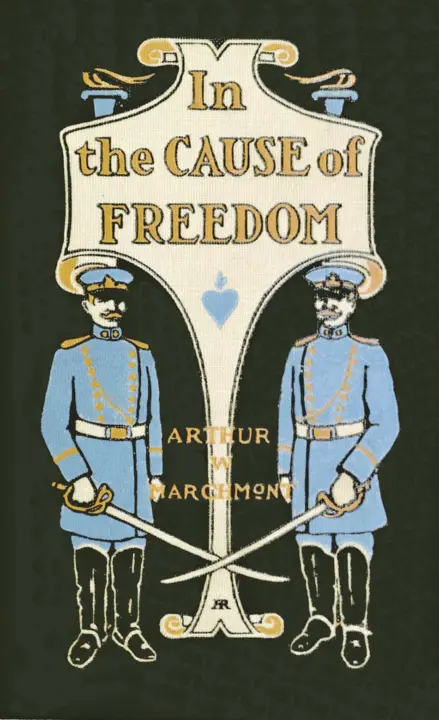
THE CLASSIC COLLECTION · 1907
"In the Cause of Freedom" by Arthur W. Marchmont is a novel written in the early 20th century. The book delves into themes of political intrigue and revolutionary struggles in Russian-occupied Poland, focusing on the life of the protagonist, Robert Anstruther, an Englishman drawn into these tumultuous events. As he navigates the dangers of the oppressive regime, he finds himself embroiled in a conspiracy involving the Polish Freedom Fraternity and a mysterious young woman named Volna Drakona. The opening of the story introduces Robert Anstruther as he confronts a police agent in Bratinsk, who suspects him of being involved with a conspiracy against the government. Tension escalates when Anstruther meets Volna, who is revealed to be connected to a powerful political figure, Count Peter Valdemar. The narrative unfolds with Anstruther's determination to assist Volna and thwart the authorities, delving into their shared peril as they seek to navigate the treacherous landscape of revolutionary Poland. This opening sets the stage for an adventurous tale filled with danger, romance, and the quest for freedom amidst oppression.
Introduction adapted from the source catalogue; source summaries may be automatically generated.
Free to read · English · 73,399 words · No account needed
MAKE TIME FOR A GOOD BOOK
On by default. Untick to stop anonymous reading totals. Each page counts after 10 seconds in view. How this works.
Anonymous counting is on unless you have switched it off.
“The police are here, madame, and ask for you,” she cried.
An officer followed the girl, and out in the hallway I saw a file of
men drawn up.
“Madame Drakona?” he asked.
“I am Madame Drakona. What do you want with me?” asked the old lady,
rising.
I noticed that Paul instead of stepping forward to the mother’s side
remained by his sister.
“I have to ask you to accompany me to the offices of the Department, madame,” said the agent.
“To ask me? I don’t understand,” she replied feebly. “Katinka, Paul, what can this mean? When do you wish me to go, sir?”
“My instructions are that you accompany me immediately.”
“But there must be a mistake. I am sure there must be. I cannot go until I have seen my daughter. She is out. Can I not wait until she returns?”
“Are you sure there is no mistake?” asked Paul; as Katinka crossed to
Madame Drakona.
“My instructions are too precise to admit of that.”
“By whose instructions do you act?” I asked.
“I cannot answer that,” was the reply.
“Do you mean that any charge is preferred against this lady?”
“I have only to do my duty, sir.”
I turned to Paul. “Could you not telephone to Colonel Bremenhof?”
Katinka took this to herself. “You hear your orders, Paul,” she snapped. Even in that moment her spite predominated.
“I do not need your advice, sir,” he said; and this perfectly obvious step was not taken, for no reason apparently except that I had suggested it.
“Can I wait for my daughter to return, sir?” asked Madame Drakona.
“Volna can do nothing,” declared Katinka.
“I regret, madame, that I have no power to permit that.”
“Can you tell us nothing about the reasons for this?” asked Paul.
“Nothing whatever. I know no more than yourself. I wish indeed that the unpleasant duty had been given to some one else to perform.”
“I do not blame you, sir,” said Madame Drakona, very graciously, despite her agitation. “I will get ready.”
“I must ask you not to be longer than five minutes.”
He held the door open for her to leave. Katinka went with her and at a sign from the leader, one of the men followed them up the stairs and remained at the door of the room into which they went. The leader stayed with the rest in the hall.
“What can this mean?” asked Ladislas, aghast.
“A good thing that no one else is on the list,” said Paul.
“You must find that a great consolation,” I could not help saying. Paul turned on me angrily, and Ladislas held up his hand.
Your reading position is saved on this browser. Take it to another device with a library code. Reading pages adapt to text, rather than matching a printed edition.
Arthur W. Marchmont
Arthur W. Marchmont
Arthur W. Marchmont
Arthur W. Marchmont
BEHIND THE BOOK
This eBook is for the use of anyone anywhere in the United States and most other parts of the world at no cost and with almost no restrictions whatsoever. You may copy it, give it away or re-use it under the terms of the Project Gutenberg License included with this eBook or online at www.gutenberg.org. If you are not located in the United States, you will have to check the laws of the country where you are located before using this eBook. Read the source licence.
The original source file, including credits and licence, is retained by this library. Request an original-format copy at no charge. Please include the book title and Project Gutenberg identifier #67751.
KEEP YOUR CURIOSITY GOING
Coulson Kernahan

Maurice Baring
Frances Wright
Cécile Tormay

Frederic Jesup Stimson

W. H. P. (William Henry Pope) Jarvis