THE CLASSIC COLLECTION✦The haunts of menCLASSIC FREE BOOKS
The haunts of men
Robert W. (Robert William) Chambers
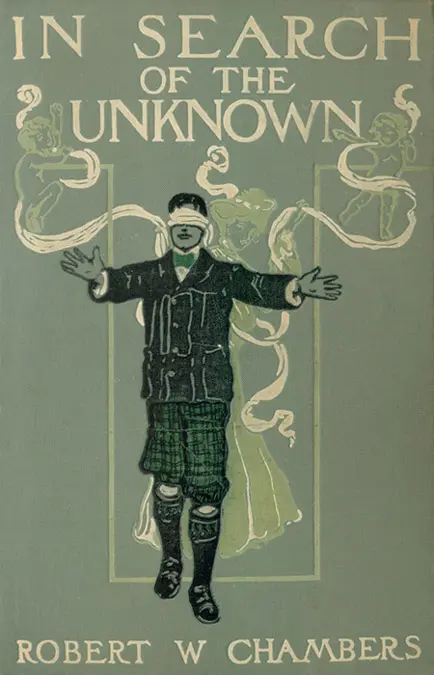
THE CLASSIC COLLECTION · 1904
"In Search of the Unknown" by Robert W. Chambers is a fictional work written in the early 20th century. The narrative revolves around the main character, who is a superintendent at the Bronx Zoological Gardens, as he embarks on a peculiar expedition to find the elusive and thought-to-be extinct great auk, along with a mysterious amphibious biped referenced in correspondence from a hermit named Burton Halyard. The story intertwines elements of adventure, mystery, and potential encounters with the unknown in nature. The opening portion of the book introduces us to the protagonist's rather skeptical disposition regarding a letter claiming the existence of live great auks. As he begins his new role, he is urged by his superior, Professor Farrago, to take the lead on an expedition to Black Harbor to investigate Halyard's assertions. Halyard, a somewhat eccentric character, hints at additional peculiarities involving another creature called the harbor-master. The narrative establishes a blend of scientific ambition and personal intrigue as the protagonist wrestles with his duties and the strange occurrences surrounding him, ultimately setting the stage for further adventures into the unknown.
Introduction adapted from the source catalogue; source summaries may be automatically generated.
Free to read · English · 71,474 words · No account needed
MAKE TIME FOR A GOOD BOOK
On by default. Untick to stop anonymous reading totals. Each page counts after 10 seconds in view. How this works.
Anonymous counting is on unless you have switched it off.
"I was writing," she replied, steadily. "Did my elbow touch you?"
"By-the-way," said Professor Farrago, "I fear I forgot to congratulate you upon your choice of a stenographer, Mr. Gilland."
A rosy light stole over her pale face.
"Am I to record that too?" she asked, raising her blue eyes.
"Certainly," he replied, gravely.
"But, professor," I began, a prey to increasing excitement, "do you propose to attempt the capture of one of these animals?"
"That is what the cage is for," he said. "I supposed you had guessed
that."
"I had," murmured the pretty stenographer.
"I do not doubt it," said Professor Farrago, gravely.
"What are the chemicals for--and the tank and hose attachment?"
"Think, Mr. Gilland."
"I can't; I'm almost stunned by what you tell me."
He laughed. "The rosium oxide and salts of strontium are to be dumped into the tank together. They'll effervesce, of course."
"Of course," I muttered.
"And I can throw a rose-colored spray over any object by the hose
attachment, can't I?"
"Yes."
"Well, I tried it on a transparent jelly-fish and it became perfectly visible and of a beautiful rose-color: and I tried it on rock-crystal, and on glass, and on pure gelatine, and all became suffused with a delicate pink glow, which lasted for hours or minutes according to the substance.... Now you understand, don't you?"
"Yes; you want to see what sort of creature you have to deal with."
"Exactly; so when I've trapped it I am going to spray it." He turned half humorously towards the stenographer: "I fancy you understood long before Mr. Gilland did."
"I don't think so," she said, with a sidelong lifting of the heavy lashes; and I caught the color of her eyes for a second.
"You see how Miss Barrison spares your feelings," observed Professor Farrago, dryly. "She owes you little gratitude for bringing her here, yet she proves a generous victim."
"Oh, I am very grateful for this rarest of chances!" she said, shyly. "To be among the first in the world to discover such wonders ought to make me very grateful to the man who gave me the opportunity."
"Do you mean Mr. Gilland?" asked the professor, laughing.
I had never before seen Professor Farrago laugh such a care-free laugh; I had never suspected him of harboring even an embryo of the social graces. Dry as dust, sapless as steel, precise as the magnetic needle, he had hitherto been to me the mummified embodiment of science militant. Now, in the guise of a perfectly human and genial old gentleman, I scarcely recognized my superior of the Bronx Park society. And as a woman-hater he was a miserable failure.
Your reading position is saved on this browser. Take it to another device with a library code. Reading pages adapt to text, rather than matching a printed edition.
Robert W. (Robert William) Chambers
Robert W. (Robert William) Chambers

Robert W. (Robert William) Chambers
Robert W. (Robert William) Chambers
BEHIND THE BOOK
This eBook is for the use of anyone anywhere in the United States and most other parts of the world at no cost and with almost no restrictions whatsoever. You may copy it, give it away or re-use it under the terms of the Project Gutenberg License included with this eBook or online at www.gutenberg.org. If you are not located in the United States, you will have to check the laws of the country where you are located before using this eBook. Read the source licence.
The original source file, including credits and licence, is retained by this library. Request an original-format copy at no charge. Please include the book title and Project Gutenberg identifier #18668.
KEEP YOUR CURIOSITY GOING
Coulson Kernahan

Maurice Baring
Frances Wright
Cécile Tormay
Francis Greenleaf Allinson & Anne C. E. (Anne Crosby Emery) Allinson

Frederic Jesup Stimson