THE CLASSIC COLLECTION✦The haunts of menCLASSIC FREE BOOKS
The haunts of men
Robert W. (Robert William) Chambers
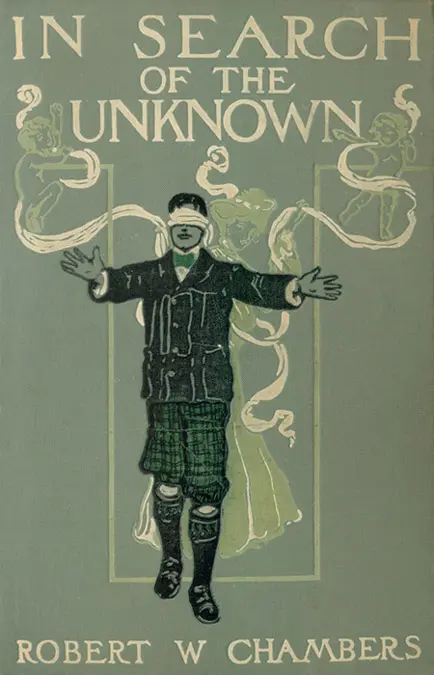
THE CLASSIC COLLECTION · 1904
"In Search of the Unknown" by Robert W. Chambers is a fictional work written in the early 20th century. The narrative revolves around the main character, who is a superintendent at the Bronx Zoological Gardens, as he embarks on a peculiar expedition to find the elusive and thought-to-be extinct great auk, along with a mysterious amphibious biped referenced in correspondence from a hermit named Burton Halyard. The story intertwines elements of adventure, mystery, and potential encounters with the unknown in nature. The opening portion of the book introduces us to the protagonist's rather skeptical disposition regarding a letter claiming the existence of live great auks. As he begins his new role, he is urged by his superior, Professor Farrago, to take the lead on an expedition to Black Harbor to investigate Halyard's assertions. Halyard, a somewhat eccentric character, hints at additional peculiarities involving another creature called the harbor-master. The narrative establishes a blend of scientific ambition and personal intrigue as the protagonist wrestles with his duties and the strange occurrences surrounding him, ultimately setting the stage for further adventures into the unknown.
Introduction adapted from the source catalogue; source summaries may be automatically generated.
Free to read · English · 71,474 words · No account needed
MAKE TIME FOR A GOOD BOOK
On by default. Untick to stop anonymous reading totals. Each page counts after 10 seconds in view. How this works.
Anonymous counting is on unless you have switched it off.
"If you don't mind I'll read my instructions," I said, in high
good-humor.
"Pray do not hesitate," she said, smiling in sympathy.
So I opened the little packet and read:
"Drive to Cape Canaveral along the beach. You will find a gang of men at work on a government breakwater. The superintendent is Mr. Rowan. Show him this letter.
Rather disappointed--for I had been expecting to find in the packet some key to the interesting mystery which had sent Professor Farrago into the Everglades--I thrust the missive into my pocket and resumed a study of the immediate landscape. It had not changed as we progressed: ocean, sand, low dunes crowned with impenetrable tangles of wild bay, sparkleberry, and live-oak, with here and there a weather-twisted palmetto sprawling, and here and there the battered blades of cactus and Spanish-bayonet thrust menacingly forward; and over all the vultures, sailing, sailing--some mere circling motes lost in the blue above, some sheering the earth so close that their swiftly sweeping shadows slanted continually across our road.
"I detest a buzzard," I said, aloud.
"I thought they were crows," she confessed.
"Carrion-crows--yes.
"'The carrion-crows
Sing, Caw! caw!'
--only they don't," I added, my song putting me in good-humor once more. And I glanced askance at the pretty stenographer.
"It is a pleasure to be employed by agreeable people," she said,
innocently.
"Oh, I can be much more agreeable than that," I said.
"Is Professor Farrago--amusing?" she asked.
"Well--oh, certainly--but not in--in the way I am."
Suddenly it flashed upon me that my superior was a confirmed hater of unmarried women. I had clean forgotten it; and now the full import of what I had done scared me silent.
"Is anything the matter?" asked Miss Barrison.
"No--not yet," I said, ominously.
How on earth could I have overlooked that well-known fact. The hurry and anxiety, the stress of instant preparation and departure, had clean driven it from my absent-minded head.
Jogging on over the sand, I sat silent, cudgelling my brains for a solution of the disastrous predicament I had gotten into. I pictured the astonished rage of my superior--my probable dismissal from employment--perhaps the general overturning and smash-up of the entire expedition.
A distant, dark object on the beach concentrated my distracted thoughts; it must be the breakwater at Cape Canaveral. And it was the breakwater, swarming with negro workmen, who were swinging great blocks of coquina into cemented beds, singing and whistling at their labor.
I forgot my predicament when I saw a thin white man in sun-helmet and khaki directing the work from the beach; and as our horses plodded up, I stepped out and hailed him by name.
Your reading position is saved on this browser. Take it to another device with a library code. Reading pages adapt to text, rather than matching a printed edition.
Robert W. (Robert William) Chambers
Robert W. (Robert William) Chambers

Robert W. (Robert William) Chambers
Robert W. (Robert William) Chambers
BEHIND THE BOOK
This eBook is for the use of anyone anywhere in the United States and most other parts of the world at no cost and with almost no restrictions whatsoever. You may copy it, give it away or re-use it under the terms of the Project Gutenberg License included with this eBook or online at www.gutenberg.org. If you are not located in the United States, you will have to check the laws of the country where you are located before using this eBook. Read the source licence.
The original source file, including credits and licence, is retained by this library. Request an original-format copy at no charge. Please include the book title and Project Gutenberg identifier #18668.
KEEP YOUR CURIOSITY GOING
Coulson Kernahan

Maurice Baring
Frances Wright
Cécile Tormay
Francis Greenleaf Allinson & Anne C. E. (Anne Crosby Emery) Allinson

Frederic Jesup Stimson