THE CLASSIC COLLECTION✦The haunts of menCLASSIC FREE BOOKS
The haunts of men
Robert W. (Robert William) Chambers
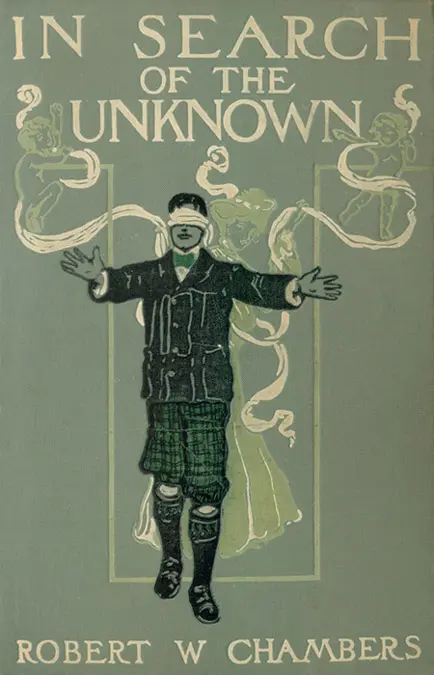
THE CLASSIC COLLECTION · 1904
"In Search of the Unknown" by Robert W. Chambers is a fictional work written in the early 20th century. The narrative revolves around the main character, who is a superintendent at the Bronx Zoological Gardens, as he embarks on a peculiar expedition to find the elusive and thought-to-be extinct great auk, along with a mysterious amphibious biped referenced in correspondence from a hermit named Burton Halyard. The story intertwines elements of adventure, mystery, and potential encounters with the unknown in nature. The opening portion of the book introduces us to the protagonist's rather skeptical disposition regarding a letter claiming the existence of live great auks. As he begins his new role, he is urged by his superior, Professor Farrago, to take the lead on an expedition to Black Harbor to investigate Halyard's assertions. Halyard, a somewhat eccentric character, hints at additional peculiarities involving another creature called the harbor-master. The narrative establishes a blend of scientific ambition and personal intrigue as the protagonist wrestles with his duties and the strange occurrences surrounding him, ultimately setting the stage for further adventures into the unknown.
Introduction adapted from the source catalogue; source summaries may be automatically generated.
Free to read · English · 71,474 words · No account needed
MAKE TIME FOR A GOOD BOOK
On by default. Untick to stop anonymous reading totals. Each page counts after 10 seconds in view. How this works.
Anonymous counting is on unless you have switched it off.
The next day it rained again, more or less. Professor Smawl complained of the cooking, demanded my resignation, and finally marched out to explore, lugging the reluctant William with her. Dorothy and I sat down behind the largest tree we could find.
I don't remember what we were saying when a peculiar sound interrupted us, and we listened earnestly.
It was like a bell in the woods, ding-dong! ding-dong! ding-dong!--a low, mellow, golden harmony, coming nearer, then stopping.
I clasped Dorothy in my arms in my excitement.
"It is the note of the dingue!" I whispered, "and that explains its name, handed down from remote ages along with the names of the behemoth and the coney. It was because of its bell-like cry that it was named! Darling!" I cried, forgetting our short acquaintance, "we have made a discovery that the whole world will ring with!"
Hand in hand we tiptoed through the forest to our trap. There was something in it that took fright at our approach and rushed panic-stricken round and round the interior of the trap, uttering its alarm-note, which sounded like the jangling of a whole string of bells.
I seized the strangely beautiful creature; it neither attempted to bite nor scratch, but crouched in my arms, trembling and eying me.
Delighted with the lovely, tame animal, we bore it tenderly back to the camp and placed it on my blanket. Hand in hand we stood before it, awed by the sight of this beast, so long believed to be extinct.
"It is too good to be true," sighed Dorothy, clasping her white hands under her chin and gazing at the dingue in rapture.
"Yes," said I, solemnly, "you and I, my child, are face to face with the fabled dingue--Dingus solitarius! Let us continue to gaze at it, reverently, prayerfully, humbly--"
Dorothy yawned--probably with excitement.
We were still mutely adoring the dingue when Professor Smawl burst
into the tent at a hand-gallop, bawling hoarsely for her kodak and
note-book.
Dorothy seized her triumphantly by the arm and pointed at the dingue, which appeared to be frightened to death.
"What!" cried Professor Smawl, scornfully; "that a dingue? Rubbish!"
"Madam," I said, firmly, "it is a dingue! It's a monodactyl! See! It
has but a single toe!"
"Bosh!" she retorted; "it's got four!"
"Four!" I repeated, blankly.
"Yes; one on each foot!"
"Of course," I said; "you didn't suppose a monodactyl meant a beast
with one leg and one toe!"
But she laughed hatefully and declared it was a woodchuck.
Your reading position is saved on this browser. Take it to another device with a library code. Reading pages adapt to text, rather than matching a printed edition.
Robert W. (Robert William) Chambers
Robert W. (Robert William) Chambers

Robert W. (Robert William) Chambers
Robert W. (Robert William) Chambers
BEHIND THE BOOK
This eBook is for the use of anyone anywhere in the United States and most other parts of the world at no cost and with almost no restrictions whatsoever. You may copy it, give it away or re-use it under the terms of the Project Gutenberg License included with this eBook or online at www.gutenberg.org. If you are not located in the United States, you will have to check the laws of the country where you are located before using this eBook. Read the source licence.
The original source file, including credits and licence, is retained by this library. Request an original-format copy at no charge. Please include the book title and Project Gutenberg identifier #18668.
KEEP YOUR CURIOSITY GOING
Coulson Kernahan

Maurice Baring
Frances Wright
Cécile Tormay
Francis Greenleaf Allinson & Anne C. E. (Anne Crosby Emery) Allinson

Frederic Jesup Stimson