THE CLASSIC COLLECTION✦The haunts of menCLASSIC FREE BOOKS
The haunts of men
Robert W. (Robert William) Chambers
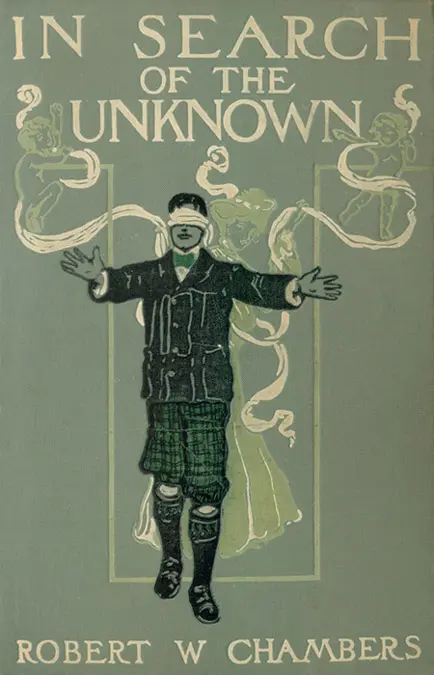
THE CLASSIC COLLECTION · 1904
"In Search of the Unknown" by Robert W. Chambers is a fictional work written in the early 20th century. The narrative revolves around the main character, who is a superintendent at the Bronx Zoological Gardens, as he embarks on a peculiar expedition to find the elusive and thought-to-be extinct great auk, along with a mysterious amphibious biped referenced in correspondence from a hermit named Burton Halyard. The story intertwines elements of adventure, mystery, and potential encounters with the unknown in nature. The opening portion of the book introduces us to the protagonist's rather skeptical disposition regarding a letter claiming the existence of live great auks. As he begins his new role, he is urged by his superior, Professor Farrago, to take the lead on an expedition to Black Harbor to investigate Halyard's assertions. Halyard, a somewhat eccentric character, hints at additional peculiarities involving another creature called the harbor-master. The narrative establishes a blend of scientific ambition and personal intrigue as the protagonist wrestles with his duties and the strange occurrences surrounding him, ultimately setting the stage for further adventures into the unknown.
Introduction adapted from the source catalogue; source summaries may be automatically generated.
Free to read · English · 71,474 words · No account needed
MAKE TIME FOR A GOOD BOOK
On by default. Untick to stop anonymous reading totals. Each page counts after 10 seconds in view. How this works.
Anonymous counting is on unless you have switched it off.
"A faint noise broke upon my ear, and my heart grew sick, but I strode into the darkness, calling, hoarsely:
"'Aunt Tabby! It is your nephew!'
"Again the faint sound. Something was stirring there among the shadows--a shape moving softly along the wall, a shade which glided by me, paused, wavered, and darted under the bed. Then I threw myself on the floor, profoundly moved, begging, imploring my aunt to come to me.
"'Aunty! Aunty!' I murmured. 'Your nephew is waiting to take you to
his heart!'
"At last I saw my great-aunt's eyes shining in the dark."
The young man's voice grew hushed and solemn, and he lifted his hand
in silence:
"Close the door. That meeting is not for the eyes of the world! Close the door upon that sacred scene where great-aunt and nephew are united at last."
A long pause followed; deep emotion was visible in Miss Barrison's
sensitive face. She said:
"Then--you are married?"
"No," replied Mr. Kensett, in a mortified voice.
"Why not?" I asked, amazed.
"Because," he said, "although my fiancee was prepared to accept a cat
as her great-aunt, she could not endure the complications that
followed."
"What complications?" inquired Miss Barrison.
The young man sighed profoundly, shaking his head.
"My great-aunt had kittens," he said, softly.
The tremendous scientific importance of these experiences excited me beyond measure. The simplicity of the narrative, the elaborate attention to corroborative detail, all bore irresistible testimony to the truth of these accounts of phenomena vitally important to the entire world of science.
We all dined together that night--a little earnest company of knowledge-seekers in the vast wilderness of the unexplored; and we lingered long in the dining-car, propounding questions, advancing theories, speculating upon possibilities of most intense interest. Never before had I known a man whose relatives were cats and kittens, but he did not appear to share my enthusiasm in the matter.
"You see," he said, looking at Miss Barrison, "it may be interesting from a purely scientific point of view, but it has already proved a bar to my marrying."
"Were the kittens black?" I inquired.
"No," he said, "my aunt drew the color-line, I am proud to say."
"I don't see," said Miss Barrison, "why the fact that your great-aunt is a cat should prevent you from marrying."
"It wouldn't prevent me!" said the young man, quickly.
"Nor me," mused Miss Barrison--"if I were really in love."
Meanwhile I had been very busy thinking about Professor Farrago, and, coming to an interesting theory, advanced it.
"If," I began, "he marries one of those transparent ladies, what about
the children?"
"Some would be, no doubt, transparent," said Kensett.
Your reading position is saved on this browser. Take it to another device with a library code. Reading pages adapt to text, rather than matching a printed edition.
Robert W. (Robert William) Chambers
Robert W. (Robert William) Chambers

Robert W. (Robert William) Chambers
Robert W. (Robert William) Chambers
BEHIND THE BOOK
This eBook is for the use of anyone anywhere in the United States and most other parts of the world at no cost and with almost no restrictions whatsoever. You may copy it, give it away or re-use it under the terms of the Project Gutenberg License included with this eBook or online at www.gutenberg.org. If you are not located in the United States, you will have to check the laws of the country where you are located before using this eBook. Read the source licence.
The original source file, including credits and licence, is retained by this library. Request an original-format copy at no charge. Please include the book title and Project Gutenberg identifier #18668.
KEEP YOUR CURIOSITY GOING
Coulson Kernahan

Maurice Baring
Frances Wright
Cécile Tormay
Francis Greenleaf Allinson & Anne C. E. (Anne Crosby Emery) Allinson

Frederic Jesup Stimson