THE CLASSIC COLLECTION✦The haunts of menCLASSIC FREE BOOKS
The haunts of men
Robert W. (Robert William) Chambers
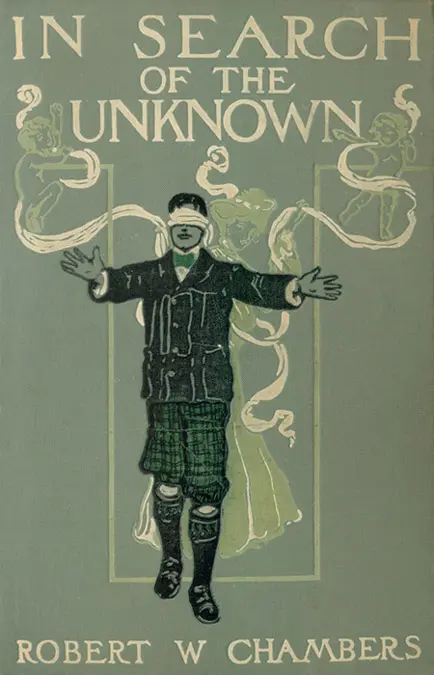
THE CLASSIC COLLECTION · 1904
"In Search of the Unknown" by Robert W. Chambers is a fictional work written in the early 20th century. The narrative revolves around the main character, who is a superintendent at the Bronx Zoological Gardens, as he embarks on a peculiar expedition to find the elusive and thought-to-be extinct great auk, along with a mysterious amphibious biped referenced in correspondence from a hermit named Burton Halyard. The story intertwines elements of adventure, mystery, and potential encounters with the unknown in nature. The opening portion of the book introduces us to the protagonist's rather skeptical disposition regarding a letter claiming the existence of live great auks. As he begins his new role, he is urged by his superior, Professor Farrago, to take the lead on an expedition to Black Harbor to investigate Halyard's assertions. Halyard, a somewhat eccentric character, hints at additional peculiarities involving another creature called the harbor-master. The narrative establishes a blend of scientific ambition and personal intrigue as the protagonist wrestles with his duties and the strange occurrences surrounding him, ultimately setting the stage for further adventures into the unknown.
Introduction adapted from the source catalogue; source summaries may be automatically generated.
Free to read · English · 71,474 words · No account needed
MAKE TIME FOR A GOOD BOOK
On by default. Untick to stop anonymous reading totals. Each page counts after 10 seconds in view. How this works.
Anonymous counting is on unless you have switched it off.
"'Good!' cried the professor, beaming all over. 'I knew you were a fellow-scientist. Possibly you are a brother-member of the Boston Dodo Society of Pythagorean Research. Are you a dodo?'
"I shook my head. 'No, I am not a dodo.'
"'Only a jay?'
"'A--what?' I said, angrily.
"'A jay. We call the members of the Junior Ornithological Jay Society of New York, jays, just as we refer to ourselves as dodos. Are you not even a jay?'
"'I am not,' I said, watching him suspiciously.
"'I must convert you, I see,' said the professor, smiling.
"'I'm afraid I do not approve of Pythagorean research,' I began, but the beautiful Miss Wyeth turned to me very seriously, and, looking me frankly in the eyes, said:
"'I trust you will be open to conviction.'
"'Good Lord!' I thought. 'Can she be another lunatic?' I looked at her steadily. What a little beauty she was! She also, then, belonged to the Pythagoreans--a sect I despised. Everybody knows all about the Pythagorean craze, its rise in Boston, its rapid spread, and its subsequent consolidation with mental and Christian science, theosophy, hypnotism, the Salvation Army, the Shakers, the Dunkards, and the mind-cure cult, upon a business basis. I had hitherto regarded all Pythagoreans with the same scornful indifference which I accorded to the faith-curists; being a member of no particular church, I was scarcely prepared to take any of them seriously. Least of all did I approve of the 'business basis,' and I looked very much askance indeed at the 'Scientific and Religious Trust Company,' duly incorporated and generally known as the Pythagorean Trust, which, consolidating with mind-curists, faith-curists, and other flourishing salvation syndicates, actually claimed a place among ordinary trusts, and at the same time pretended to a control over man's future life. No, I could never listen--I was ashamed of even entertaining the notion, and I shook my head.
"'No, Miss Wyeth, I am afraid I do not care to listen to any reasoning
on this subject.'
"'Don't you believe in Pythagoras?' demanded the professor, subduing
his excitement with difficulty, and adding another knot to his
coat-tails.
"'No,' I said, 'I do not.'
"'How do you know you don't?' inquired the professor.
"'Because,' I said, firmly, 'it is nonsense to say that the soul of a human being can inhabit a hen!'
"'Put it in a more simplified form!' insisted the professor. 'Do you believe that the soul of a hen can inhabit a human being?'
"'No, I don't!'
Your reading position is saved on this browser. Take it to another device with a library code. Reading pages adapt to text, rather than matching a printed edition.
Robert W. (Robert William) Chambers
Robert W. (Robert William) Chambers

Robert W. (Robert William) Chambers
Robert W. (Robert William) Chambers
BEHIND THE BOOK
This eBook is for the use of anyone anywhere in the United States and most other parts of the world at no cost and with almost no restrictions whatsoever. You may copy it, give it away or re-use it under the terms of the Project Gutenberg License included with this eBook or online at www.gutenberg.org. If you are not located in the United States, you will have to check the laws of the country where you are located before using this eBook. Read the source licence.
The original source file, including credits and licence, is retained by this library. Request an original-format copy at no charge. Please include the book title and Project Gutenberg identifier #18668.
KEEP YOUR CURIOSITY GOING
Coulson Kernahan

Maurice Baring
Frances Wright
Cécile Tormay
Francis Greenleaf Allinson & Anne C. E. (Anne Crosby Emery) Allinson

Frederic Jesup Stimson