THE CLASSIC COLLECTION✦The haunts of menCLASSIC FREE BOOKS
The haunts of men
Robert W. (Robert William) Chambers
THE CLASSIC COLLECTION · 1904
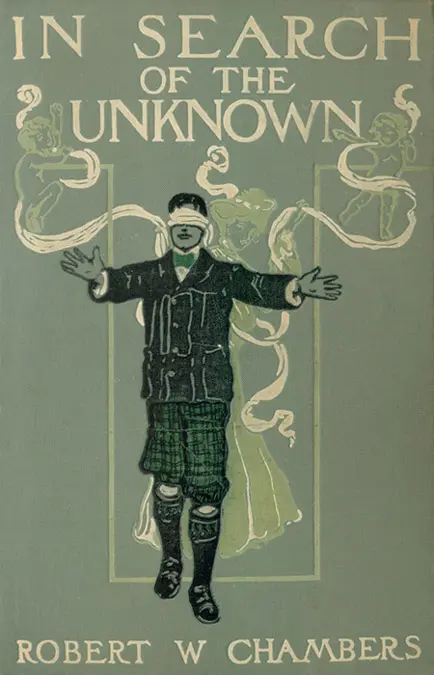
"In Search of the Unknown" by Robert W. Chambers is a fictional work written in the early 20th century. The narrative revolves around the main character, who is a superintendent at the Bronx Zoological Gardens, as he embarks on a peculiar expedition to find the elusive and thought-to-be extinct great auk, along with a mysterious amphibious biped referenced in correspondence from a hermit named Burton Halyard. The story intertwines elements of adventure, mystery, and potential encounters with the unknown in nature. The opening portion of the book introduces us to the protagonist's rather skeptical disposition regarding a letter claiming the existence of live great auks. As he begins his new role, he is urged by his superior, Professor Farrago, to take the lead on an expedition to Black Harbor to investigate Halyard's assertions. Halyard, a somewhat eccentric character, hints at additional peculiarities involving another creature called the harbor-master. The narrative establishes a blend of scientific ambition and personal intrigue as the protagonist wrestles with his duties and the strange occurrences surrounding him, ultimately setting the stage for further adventures into the unknown.
Introduction adapted from the source catalogue; source summaries may be automatically generated.
Free to read · English · 71,474 words · No account needed
MAKE TIME FOR A GOOD BOOK
On by default. Untick to stop anonymous reading totals. Each page counts after 10 seconds in view. How this works.
Anonymous counting is on unless you have switched it off.
"'I have been to the Zoo to-day,' announced the bald one, turning
towards me.
"'Ah, indeed,' I observed; 'er--I trust you enjoyed it.'
"'I have been contemplating the apes,' he continued, dreamily. 'Yes,
contemplating the apes.'
"I tried to look interested.
"'Yes, the apes,' he murmured, fixing his mild eyes on me. Then he leaned towards me confidentially and whispered, 'Can you tell me what a monkey thinks?'
"'I cannot,' I replied, sharply.
"'Ah,' he sighed, sinking back in his chair, and patting the slender hand of the girl beside him--'ah, who can tell what a monkey thinks?' His gentle face lulled my suspicions, and I replied, very gravely:
"'Who can tell whether they think at all?'
"'True, true! Who can tell whether they think at all; and if they do think, ah! who can tell what they think?'
"'But,' I began, 'if you can't tell whether they think at all, what's the use of trying to conjecture what they would think if they did think?'
"He raised his hand in deprecation. 'Ah, it is exactly that which is of such absorbing interest--exactly that! It is the abstruseness of the proposition which stimulates research--which stirs profoundly the brain of the thinking world. The question is of vital and instant importance. Possibly you have already formed an opinion.'
"I admitted that I had thought but little on the subject.
"'I doubt,' he continued, swathing his knees in his coat-tails--'I doubt whether you have given much attention to the subject lately discussed by the Boston Dodo Society of Pythagorean Research.'
"'I am not sure,' I said, politely, 'that I recall that particular discussion. May I ask what was the question brought up?'
"'The Felis domestica question.'
"'Ah, that must indeed be interesting! And--er--what may be the Felis
do--do--'
"'Domestica--not dodo. Felis domestica, the common or garden cat.'
"'Indeed,' I murmured.
"'You are not listening,' he said.
"I only half heard him. I could not turn my eyes from his daughter's
face.
"'Cat!' shouted the bald one, and I almost leaped from my chair. 'Are you deaf?' he inquired, sympathetically.
"'No--oh no!' I replied, coloring with confusion; 'you were--pardon me--you were--er--speaking of the dodo. Extraordinary bird that--'
"'I was not discussing the dodo,' he sighed. 'I was speaking of cats.'
"'Of course,' I said.
"'The question is,' he continued, twisting his frayed coat-tails into a sort of rope--'the question is, how are we to ameliorate the present condition and social status of our domestic cats?'
"'Feed 'em,' I suggested.
Your reading position is saved on this browser. Take it to another device with a library code. Reading pages adapt to text, rather than matching a printed edition.
Robert W. (Robert William) Chambers
Robert W. (Robert William) Chambers

Robert W. (Robert William) Chambers
Robert W. (Robert William) Chambers
BEHIND THE BOOK
This eBook is for the use of anyone anywhere in the United States and most other parts of the world at no cost and with almost no restrictions whatsoever. You may copy it, give it away or re-use it under the terms of the Project Gutenberg License included with this eBook or online at www.gutenberg.org. If you are not located in the United States, you will have to check the laws of the country where you are located before using this eBook. Read the source licence.
The original source file, including credits and licence, is retained by this library. Request an original-format copy at no charge. Please include the book title and Project Gutenberg identifier #18668.
KEEP YOUR CURIOSITY GOING
Coulson Kernahan

Maurice Baring
Frances Wright
Cécile Tormay
Francis Greenleaf Allinson & Anne C. E. (Anne Crosby Emery) Allinson

Frederic Jesup Stimson