THE CLASSIC COLLECTION✦The haunts of menCLASSIC FREE BOOKS
The haunts of men
Robert W. (Robert William) Chambers
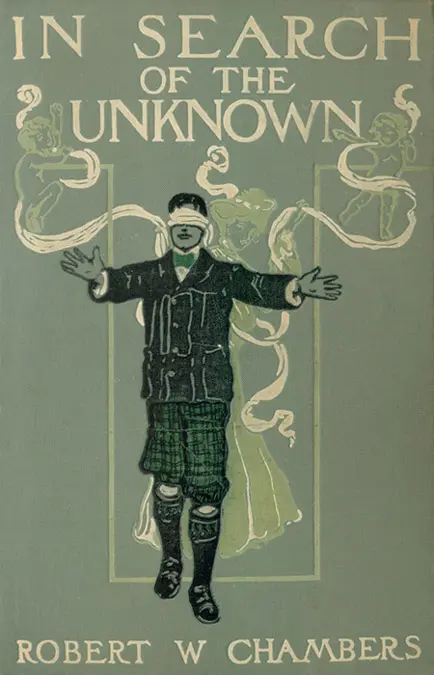
THE CLASSIC COLLECTION · 1904
"In Search of the Unknown" by Robert W. Chambers is a fictional work written in the early 20th century. The narrative revolves around the main character, who is a superintendent at the Bronx Zoological Gardens, as he embarks on a peculiar expedition to find the elusive and thought-to-be extinct great auk, along with a mysterious amphibious biped referenced in correspondence from a hermit named Burton Halyard. The story intertwines elements of adventure, mystery, and potential encounters with the unknown in nature. The opening portion of the book introduces us to the protagonist's rather skeptical disposition regarding a letter claiming the existence of live great auks. As he begins his new role, he is urged by his superior, Professor Farrago, to take the lead on an expedition to Black Harbor to investigate Halyard's assertions. Halyard, a somewhat eccentric character, hints at additional peculiarities involving another creature called the harbor-master. The narrative establishes a blend of scientific ambition and personal intrigue as the protagonist wrestles with his duties and the strange occurrences surrounding him, ultimately setting the stage for further adventures into the unknown.
Introduction adapted from the source catalogue; source summaries may be automatically generated.
Free to read · English · 71,474 words · No account needed
MAKE TIME FOR A GOOD BOOK
On by default. Untick to stop anonymous reading totals. Each page counts after 10 seconds in view. How this works.
Anonymous counting is on unless you have switched it off.
"We lay and watched the little ring-necks running along the water's edge, now backing away from the incoming tide, now boldly wading after the undertow. The harmony of silence, the deep perfume, the mystery of waiting for that something that all await--what is it? love? death? or only the miracle of another morrow?--troubled me with vague restlessness. As sunlight casts shadows, happiness, too, throws a shadow, an the shadow is sadness.
"And so the morning wore away until Freda came with a cool-looking hamper. Then delicious cold fowl and lettuce sandwiches and champagne cup set our tongues wagging as only very young tongues can wag. Daisy went back with Freda after luncheon, leaving me a case of cigars, with a bantering smile. I dozed, half awake, keeping a partly closed eye on the ocean, where a faint gray streak showed plainly amid the azure water all around. That was the Gulf Stream loop.
"About four o'clock Frisby appeared with a bamboo shelter-tent, for which I was unaffectedly grateful.
"After he had erected it over me he stopped to chat a bit, but the conversation bored me, for he could talk of nothing but bill-posting.
"'You wouldn't ruin the landscape here, would you?' I asked.
"'Ruin it!' repeated Frisby, nervously. 'It's ruined now; there ain't
a place to stick a bill.'
"'The snipe stick bills--in the sand,' I said, flippantly.
"There was no humor about Frisby. 'Do they?' he asked.
"I moved with a certain impatience.
"'Bills,' said Frisby, 'give spice an' variety to nature. They break the monotony of the everlastin' green and what-you-may-call-its.'
"I glared at him.
"'Bills,' he continued, 'are not easy to stick, lemme tell you, sir. Sign-paintin's a soft snap when it comes to bill-stickin'. Now, I guess I've stuck more bills onto New York State than ennybody.'
"'Have you?' I said, angrily.
"'Yes, siree! I always pick out the purtiest spots--kinder filled chuck full of woods and brooks and things; then I h'ist my paste-pot onto a rock, and I slather that rock with gum, and whoop she goes!'
"'Whoop what goes?'
"'The bill. I paste her onto the rock, with one swipe of the brush for the edges and a back-handed swipe for the finish--except when a bill is folded in two halves.'
"'And what do you do then?' I asked, disgusted.
"'Swipe twice,' said Frisby, with enthusiasm.
"'And you don't think it injures the landscape?'
"'Injures it!' he exclaimed, convinced that I was attempting to joke.
"I looked wearily out to sea. He also looked at the water and sighed
sentimentally.
Your reading position is saved on this browser. Take it to another device with a library code. Reading pages adapt to text, rather than matching a printed edition.
Robert W. (Robert William) Chambers
Robert W. (Robert William) Chambers

Robert W. (Robert William) Chambers
Robert W. (Robert William) Chambers
BEHIND THE BOOK
This eBook is for the use of anyone anywhere in the United States and most other parts of the world at no cost and with almost no restrictions whatsoever. You may copy it, give it away or re-use it under the terms of the Project Gutenberg License included with this eBook or online at www.gutenberg.org. If you are not located in the United States, you will have to check the laws of the country where you are located before using this eBook. Read the source licence.
The original source file, including credits and licence, is retained by this library. Request an original-format copy at no charge. Please include the book title and Project Gutenberg identifier #18668.
KEEP YOUR CURIOSITY GOING
Coulson Kernahan

Maurice Baring
Frances Wright
Cécile Tormay
Francis Greenleaf Allinson & Anne C. E. (Anne Crosby Emery) Allinson

Frederic Jesup Stimson