THE CLASSIC COLLECTION✦The haunts of menCLASSIC FREE BOOKS
The haunts of men
Robert W. (Robert William) Chambers
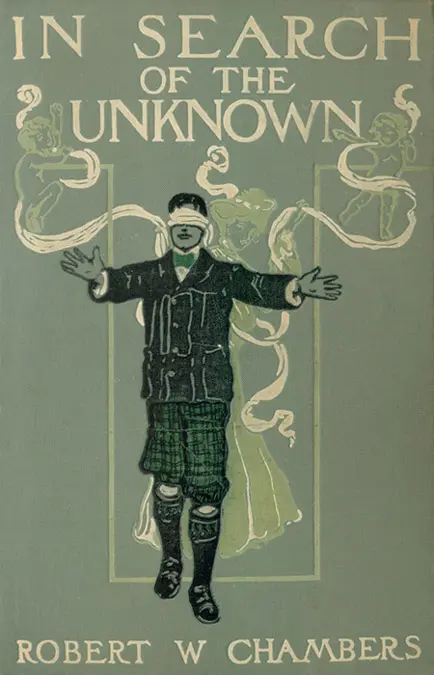
THE CLASSIC COLLECTION · 1904
"In Search of the Unknown" by Robert W. Chambers is a fictional work written in the early 20th century. The narrative revolves around the main character, who is a superintendent at the Bronx Zoological Gardens, as he embarks on a peculiar expedition to find the elusive and thought-to-be extinct great auk, along with a mysterious amphibious biped referenced in correspondence from a hermit named Burton Halyard. The story intertwines elements of adventure, mystery, and potential encounters with the unknown in nature. The opening portion of the book introduces us to the protagonist's rather skeptical disposition regarding a letter claiming the existence of live great auks. As he begins his new role, he is urged by his superior, Professor Farrago, to take the lead on an expedition to Black Harbor to investigate Halyard's assertions. Halyard, a somewhat eccentric character, hints at additional peculiarities involving another creature called the harbor-master. The narrative establishes a blend of scientific ambition and personal intrigue as the protagonist wrestles with his duties and the strange occurrences surrounding him, ultimately setting the stage for further adventures into the unknown.
Introduction adapted from the source catalogue; source summaries may be automatically generated.
Free to read · English · 71,474 words · No account needed
MAKE TIME FOR A GOOD BOOK
On by default. Untick to stop anonymous reading totals. Each page counts after 10 seconds in view. How this works.
Anonymous counting is on unless you have switched it off.
"Who spoke of dying?" he inquired, mildly. "What I said was that I do not expect to come out of this affair unscathed."
I did not comprehend his meaning, but I understood the reproof
conveyed.
He closed and locked the cage door again and came towards us, balancing the key across the palm of his hand.
Miss Barrison had seated herself on the leaves; I stood back as the professor sat down beside her; then, at a gesture from him, took the place he indicated on his left.
"Before we begin," he said, calmly, "there are several things you ought to know and which I have not yet told you. The first concerns the feminine wearing apparel which Mr. Gilland brought me."
He turned to Miss Barrison and asked her whether she had brought a
complete outfit, and she opened the bundle on her knees and handed it
to him.
"I cannot," he said, "delicately explain in so many words what use I expect to make of this apparel. Nor do I yet know whether I shall have any use at all for it. That can only be a theoretical speculation until, within a few more hours, my theory is proven or disproven--and," he said, suddenly turning on me, "my theory concerning these invisible creatures is the most extraordinary and audacious theory ever entertained by man since Columbus presumed that there must lie somewhere a hidden continent which nobody had ever seen."
He passed his hand over his protruding forehead, lost for a moment in
deepest reflection. Then, "Have you ever heard of the Sphyx?" he
asked.
"It seems to me that Ponce de Leon wrote of something--" I began,
hesitating.
"Yes, the famous lines in the third volume which have set so many wise men guessing. You recall them:
"'And there, alas! within sound of the Fountain of Youth whose waters tint the skin till the whole body glows softly like the petal of a rose--there, alas! in the new world already blooming, THE ETERNAL ENIGMA I beheld, in the flesh living; yet it faded even as I looked, although I swear it lived and breathed. This is the Sphyx.'"
A silence; then I said, "Those lines are meaningless to me."
"Not to me," said Miss Barrison, softly.
The professor looked at her. "Ah, child! Ever subtler, ever surer--the Eternal Enigma is no enigma to you."
"What is the Sphyx?" I asked.
"Have you read De Soto? Or Goya?"
"Yes, both. I remember now that De Soto records the Syachas legend of the Sphyx--something about a goddess--"
"Not a goddess," said Miss Barrison, her lips touched with a smile.
"Sometimes," said the professor, gently. "And Goya said:
Your reading position is saved on this browser. Take it to another device with a library code. Reading pages adapt to text, rather than matching a printed edition.
Robert W. (Robert William) Chambers
Robert W. (Robert William) Chambers

Robert W. (Robert William) Chambers
Robert W. (Robert William) Chambers
BEHIND THE BOOK
This eBook is for the use of anyone anywhere in the United States and most other parts of the world at no cost and with almost no restrictions whatsoever. You may copy it, give it away or re-use it under the terms of the Project Gutenberg License included with this eBook or online at www.gutenberg.org. If you are not located in the United States, you will have to check the laws of the country where you are located before using this eBook. Read the source licence.
The original source file, including credits and licence, is retained by this library. Request an original-format copy at no charge. Please include the book title and Project Gutenberg identifier #18668.
KEEP YOUR CURIOSITY GOING
Coulson Kernahan

Maurice Baring
Frances Wright
Cécile Tormay
Francis Greenleaf Allinson & Anne C. E. (Anne Crosby Emery) Allinson

Frederic Jesup Stimson