THE CLASSIC COLLECTION✦The haunts of menCLASSIC FREE BOOKS
The haunts of men
Robert W. (Robert William) Chambers
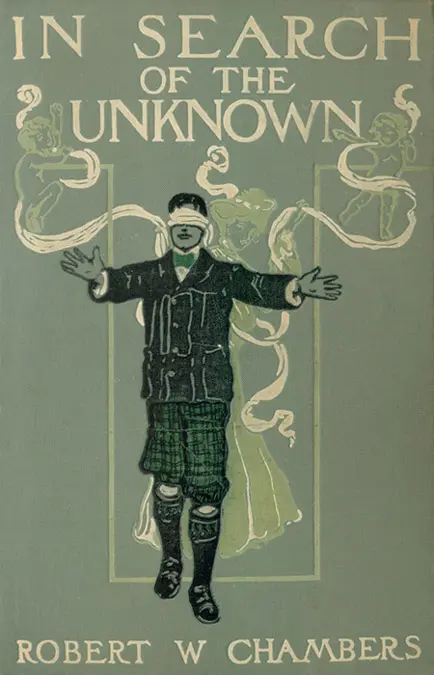
THE CLASSIC COLLECTION · 1904
"In Search of the Unknown" by Robert W. Chambers is a fictional work written in the early 20th century. The narrative revolves around the main character, who is a superintendent at the Bronx Zoological Gardens, as he embarks on a peculiar expedition to find the elusive and thought-to-be extinct great auk, along with a mysterious amphibious biped referenced in correspondence from a hermit named Burton Halyard. The story intertwines elements of adventure, mystery, and potential encounters with the unknown in nature. The opening portion of the book introduces us to the protagonist's rather skeptical disposition regarding a letter claiming the existence of live great auks. As he begins his new role, he is urged by his superior, Professor Farrago, to take the lead on an expedition to Black Harbor to investigate Halyard's assertions. Halyard, a somewhat eccentric character, hints at additional peculiarities involving another creature called the harbor-master. The narrative establishes a blend of scientific ambition and personal intrigue as the protagonist wrestles with his duties and the strange occurrences surrounding him, ultimately setting the stage for further adventures into the unknown.
Introduction adapted from the source catalogue; source summaries may be automatically generated.
Free to read · English · 71,474 words · No account needed
MAKE TIME FOR A GOOD BOOK
On by default. Untick to stop anonymous reading totals. Each page counts after 10 seconds in view. How this works.
Anonymous counting is on unless you have switched it off.
The dog, who had slept under my bunk, and who had contributed to my entertainment by sighing and moaning all night, now appeared ready for business--business in his case being the operation of feeding. I presented him with a concentrated tablet, which he cautiously investigated and then rolled on.
"Nice testimonial for the people who concocted it," I said, in
disgust. "I wish I had an egg."
"There are some concentrated egg tablets in the shanty," said Miss Barrison; but the idea was not attractive.
"I refuse to fry a pill for breakfast," I said, sullenly, and set the
coffee-pot on the coals.
In spite of the dewy beauty of the morning, breakfast was not a cheerful function. Professor Farrago appeared, clad in sun-helmet and khaki. I had seldom seen him depressed; but he was now, and his very efforts to disguise it only emphasized his visible anxiety.
His preparations for the day, too, had an ominous aspect to me. He gave his orders and we obeyed, instinctively suppressing questions. First, he and I transported all personal luggage of the company to the big electric launch--Miss Barrison's effects, his, and my own. His private papers, the stenographic reports, and all memoranda were tied up together and carried aboard.
Then, to my surprise, two weeks' concentrated rations for two and mineral water sufficient for the same period were stowed away aboard the launch. Several times he asked me whether I knew how to run the boat, and I assured him that I did.
In a short time nothing was left ashore except the bare furnishings of the cabin, the female wearing-apparel, the steel cage and chemicals which I had brought, and the twelve apple-pies--the latter under lock and key in my room.
As the preparations came to an end, the professor's gentle melancholy seemed to deepen. Once I ventured to ask him if he was indisposed, and he replied that he had never felt in better physical condition.
Presently he bade me fetch the pies; and I brought them, and, at a sign from him, placed them inside the steel cage, closing and locking the door.
"I believe," he said, glancing from Miss Barrison to me, and from me to the dog--"I believe that we are ready to start."
He went to the cabin and locked the door on the outside, pocketing the
key.
Then he backed up to the steel cage, stooped and lifted his end as I lifted mine, and together we started off through the forest, bearing the cage between us as porters carry a heavy piece of luggage.
Your reading position is saved on this browser. Take it to another device with a library code. Reading pages adapt to text, rather than matching a printed edition.
Robert W. (Robert William) Chambers
Robert W. (Robert William) Chambers

Robert W. (Robert William) Chambers
Robert W. (Robert William) Chambers
BEHIND THE BOOK
This eBook is for the use of anyone anywhere in the United States and most other parts of the world at no cost and with almost no restrictions whatsoever. You may copy it, give it away or re-use it under the terms of the Project Gutenberg License included with this eBook or online at www.gutenberg.org. If you are not located in the United States, you will have to check the laws of the country where you are located before using this eBook. Read the source licence.
The original source file, including credits and licence, is retained by this library. Request an original-format copy at no charge. Please include the book title and Project Gutenberg identifier #18668.
KEEP YOUR CURIOSITY GOING
Coulson Kernahan

Maurice Baring
Frances Wright
Cécile Tormay
Francis Greenleaf Allinson & Anne C. E. (Anne Crosby Emery) Allinson

Frederic Jesup Stimson