THE CLASSIC COLLECTION✦Knocking the NeighborsCLASSIC FREE BOOKS
Knocking the Neighbors
George Ade
THE CLASSIC COLLECTION · 1906
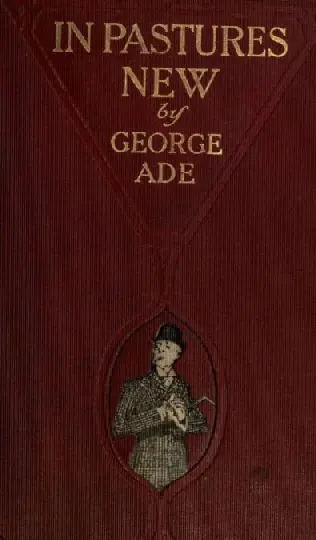
"In Pastures New" by George Ade is a collection of travel essays written in the early 20th century. The work primarily reflects on the experiences and observations of American travelers, particularly focusing on their cultural encounters in Europe. Key figures, notably Mr. Peasley, navigate the contrasts between American and British customs, as well as the challenges of communication and integration into foreign societies. The opening of the book sets the stage for exploring themes of cultural bewilderment and the humorous complexities of travel. It begins with a witty commentary on how an American businessman feels out of place upon arriving in England, highlighting the striking differences in language and social norms that lead to feelings of inadequacy. As the narrative unfolds, we see Mr. Peasley wrestling with misunderstandings of the English language and society, revealing both comedic incidents and poignant truths about the perceptions and realities of transatlantic travel. This engaging introduction promises a blend of humor and insightful commentary on American culture as seen through the lens of European experiences.
Introduction adapted from the source catalogue; source summaries may be automatically generated.
Free to read · English · 53,419 words · No account needed
MAKE TIME FOR A GOOD BOOK
On by default. Untick to stop anonymous reading totals. Each page counts after 10 seconds in view. How this works.
Anonymous counting is on unless you have switched it off.
"Tell him, please, that I am educate at the Presbyterian Mission," said he. "I speak only English and Arabic."
We questioned him later and learned that he took Mr. Peasley to be a Russian. This one little experience rather discouraged our travelling companion. He said it was foolish to waste important dialogue on a lot of benighted ignorami who did not know their own language.
As a matter of fact, English carries the tourist everywhere in Egypt. The American Mission School, supported by the Presbyterians, is a proud local institution in each good-sized town. At every landing along the river small boys from the mission schools would come down to the boat to ask for English books. These requests were such a welcome variation from the everlasting howl for "baksheesh" that the over-generous passengers soon gave away all the reading matter on board and had nothing left for themselves except Baedekers and time tables. I saw a silver-haired old lady from Philadelphia give to a coal-black and half-naked child of eight a volume of Browning's poems in paper cover. The dusky infant clasped the book to his bare bosom and shouted his thanks as the boat headed up stream, and the old lady was so gratified and happy that she stood looking at him with tear-dimmed eyes and never gave a thought as to what might happen to his intellect. At one town, just as we were casting off, I threw an American magazine to a handsome little tike who had been asking for English literature. It fell on the dock, and twenty small boys began fighting for it and tearing it to pieces. I never saw such a thirst for advertising matter.
Our voyage from Cairo to Luxor was punctuated with so many new experiences that possibly it would be better to take them in order. Egypt is the land of leisurely travel. If you look at the map the distance from Cairo to Luxor seems only a good hop, skip, and jump. It is 458 miles by rail and the lightning express does it in fifteen hours, the same being considered a record performance. Our boat left Cairo one Friday afternoon and arrived at Luxor the following Thursday morning. We chugged slowly against the current all the way, tying up every night and getting away before daybreak next morning. Several times we changed pilots. The Nile pilot is usually a grizzled old sheikh with the doubtful combination of a department store spring overcoat and a red fez. He stands at the wheel bossing the crew while the ostensible captain or manager, who is a budding European in a neat uniform, has nothing much to do except circulate on the upper deck and pour tea for a little cluster of intellectual giantesses from England. Two sailors stand well forward on the lower deck, one on each side, jabbing at the river with poles in order to get the depth of the channel. If the boat runs into water less than six inches deep they become alarmed and start to yelp. Occasionally the gallant craft strikes a bar and comes to a tired pause, whereupon all the passengers say "Mgh!" and lurch out of their camp stools. Then there is a little welcome excitement and the natives of the crew run around in circles and call upon Allah for temporary assistance. With much grunting, both by the boat and the men at the poles, the good Hatasoo backs out of the mud and takes a fresh start, zigzagging through the shallows until deep water is found--that is, a depth of anywhere from three to four feet. The Nile is just as finical and unreliable as a Missouri or Mississippi, the tortuous channel constantly shifting, and the pilot needs to be an expert with a memory like an encyclopaedia. Fortunately there are no snags. Wood is about the most precious commodity in Egypt, and all the snags were fished out and utilised some two thousand years before we happened along. Although our voyage lasted five full days we went ashore only three times. As I have already explained, the traveller need not leave the Nile steamer in order to see nearly everything that is happening in Egypt. Leaving Cairo late on Friday afternoon, we made two stops on Saturday to discharge freight and take on natives. Many of the women came aboard closely veiled and were at once secreted in a canvas compartment on the lower deck. These precautions seemed to be needless. Two adjectives will best describe the pride of the harem--shabby and flabby. Unless you wish to lose all enthusiasm for the Arabian Nights, keep away from Egypt.
Your reading position is saved on this browser. Take it to another device with a library code. Reading pages adapt to text, rather than matching a printed edition.
George Ade
George Ade
George Ade
George Ade
BEHIND THE BOOK
This eBook is for the use of anyone anywhere in the United States and most other parts of the world at no cost and with almost no restrictions whatsoever. You may copy it, give it away or re-use it under the terms of the Project Gutenberg License included with this eBook or online at www.gutenberg.org. If you are not located in the United States, you will have to check the laws of the country where you are located before using this eBook. Read the source licence.
The original source file, including credits and licence, is retained by this library. Request an original-format copy at no charge. Please include the book title and Project Gutenberg identifier #38364.
KEEP YOUR CURIOSITY GOING
Wilfrid Scawen Blunt
Wilfrid Scawen Blunt

E. W. (Edgar Watson) Howe

David Patterson (Spirit) Hatch

David Patterson (Spirit) Hatch

David Patterson (Spirit) Hatch