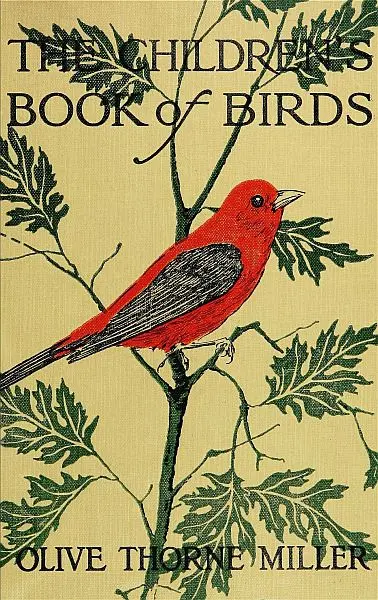
The Children’s Book of Birds
Olive Thorne Miller
THE CLASSIC COLLECTION · 1888
"In Nesting Time" by Olive Thorne Miller is a collection of observational essays on bird behavior written in the late 19th century. The work explores the intricate lives of various bird species through careful study, providing a vivid account of their habits, nesting practices, and interactions within their environments. It offers insights into the belief that each bird is, in essence, a character deserving of individual attention and appreciation. The opening of the book presents a vivid introduction into the world of baby birds, particularly focusing on the purple crow blackbird and Baltimore oriole families. The author recounts her observations while witnessing the challenges faced by these fledgling birds as they leave their nests and navigate the dangers of the outside world. Through detailed accounts of their behaviors—such as the clumsy attempts at flight, the protective nature of the parents, and the various threats posed by predators and environmental factors—Miller establishes a heartfelt connection to these creatures. She elegantly argues that understanding birds requires more than mere scientific observation; it necessitates an empathetic engagement with their lives.
Introduction adapted from the source catalogue; source summaries may be automatically generated.
Free to read · English · 55,445 words · No account needed
MAKE TIME FOR A GOOD BOOK
On by default. Untick to stop anonymous reading totals. Each page counts after 10 seconds in view. How this works.
Anonymous counting is on unless you have switched it off.
His wooing, however, the bird did not intend me to see, though two or three times I surprised him at it. The first part that I chanced upon was curious and amusing. A female, probably the "beloved object," stood demurely on one of the dead top branches of a large tree down in the garden, while her admirer performed fantastic evolutions in the air about her. No flycatcher ever made half the eccentric movements this aerial acrobat indulged in. He flew straight up very high, executing various extraordinary turns and gyrations, so rapidly they could not be followed and described, and came back singing; in a moment he departed in another direction, and repeated the grotesque performance. He was plainly exerting himself to be agreeable and entertaining, in mocking-bird style, and I noticed that every time he returned from an excursion he perched a little nearer his audience of one, until, after some time, he stood upon the same twig, a few inches from her. They were facing and apparently trying to stare each other out of countenance; and as I waited, breathless, to see what would happen next, the damsel coquettishly flitted to another branch. Then the whole scene was repeated; the most singular and graceful evolutions, the songs, and the gradual approach. Sometimes, after alighting on a top twig, he dropped down through the branches, singing, in a way to suggest the "dropping song" so graphically described by Maurice Thompson, but never really falling, and never touching the ground. Each performance ended in his reaching the twig which she occupied and her flight to another, until at last, by some apparently mutual agreement, both flew, and I saw no more.
A remarkable "dance" which I also saw, with the same bird as principal actor, seems to me another phase of the wooing, though I must say it resembled a war-dance as well; but love is so like war among the lower orders, even of men, that it is hard to distinguish between them. I shall not try to decide, only to relate, and, I beg to say, without the smallest exaggeration. The dances I saw were strictly pas-de-deux, and they always began by a flash of wings and two birds alighting on the grass, about a foot apart. Both instantly drew themselves up perfectly erect, tail elevated at an angle of forty-five degrees, and wings held straight down at the sides. Then followed a most droll dance. Number one stood like a statue, while number two pranced around, with short, mincing steps and dainty little hops which did not advance him an inch; first he passed down the right, then turned and went down the left, all in the queer, unnatural manner of short hops and steps, and holding himself rigidly erect, while number one always faced the dancer, whichever way he turned. After a few moments of this movement, number one decided to participate, and when his partner moved to the right he did the same; to the left he still accompanied him, always facing, and maintaining the exact distance from him. Then number two described a circle around number one, who turned to face him with short hops where he stood. Next followed a chasse of both birds to the right; then a separation, one dancing to the right and the other to the left, always facing, and always slowly and with dignity. This stately minuet they kept up for some time, and appeared so much like a pair of old-fashioned human dancers that when, on one occasion, number two varied the performance by a spring over the head of his partner, I was startled, as if an old gentleman had suddenly hopped over the head of the grand dame his vis-a-vis. When this strange new figure was introduced, number one proved equal to the emergency, hopping backward, and turning so dexterously that when his partner alighted they were facing, and about a foot apart, as before. The object of all this was very uncertain to a looker-on. It might be the approaches of love, and quite as probably the wary beginnings of war, and the next feature of the programme was not explanatory; they rose together in the air ten feet or more, face to face, fluttering and snatching at each other, apparently trying to clinch; succeeding in doing so, they fell to the ground, separated just before they touched it, and flew away. O wings! most maddening to a bird-student.
Your reading position is saved on this browser. Take it to another device with a library code. Reading pages adapt to text, rather than matching a printed edition.
Olive Thorne Miller
Olive Thorne Miller
Olive Thorne Miller
Olive Thorne Miller
BEHIND THE BOOK
This eBook is for the use of anyone anywhere in the United States and most other parts of the world at no cost and with almost no restrictions whatsoever. You may copy it, give it away or re-use it under the terms of the Project Gutenberg License included with this eBook or online at www.gutenberg.org. If you are not located in the United States, you will have to check the laws of the country where you are located before using this eBook. Read the source licence.
The original source file, including credits and licence, is retained by this library. Request an original-format copy at no charge. Please include the book title and Project Gutenberg identifier #25292.
KEEP YOUR CURIOSITY GOING

David Patterson (Spirit) Hatch

David Patterson (Spirit) Hatch

David Patterson (Spirit) Hatch

Ralph Waldo Emerson

Maurice Baring

Oscar Wilde & James McNeill Whistler