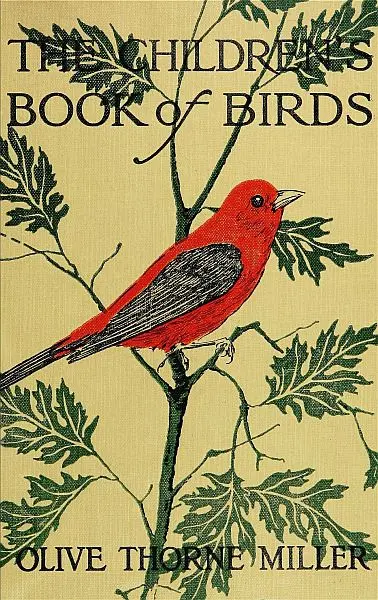
The Children’s Book of Birds
Olive Thorne Miller
THE CLASSIC COLLECTION · 1888
"In Nesting Time" by Olive Thorne Miller is a collection of observational essays on bird behavior written in the late 19th century. The work explores the intricate lives of various bird species through careful study, providing a vivid account of their habits, nesting practices, and interactions within their environments. It offers insights into the belief that each bird is, in essence, a character deserving of individual attention and appreciation. The opening of the book presents a vivid introduction into the world of baby birds, particularly focusing on the purple crow blackbird and Baltimore oriole families. The author recounts her observations while witnessing the challenges faced by these fledgling birds as they leave their nests and navigate the dangers of the outside world. Through detailed accounts of their behaviors—such as the clumsy attempts at flight, the protective nature of the parents, and the various threats posed by predators and environmental factors—Miller establishes a heartfelt connection to these creatures. She elegantly argues that understanding birds requires more than mere scientific observation; it necessitates an empathetic engagement with their lives.
Introduction adapted from the source catalogue; source summaries may be automatically generated.
Free to read · English · 55,445 words · No account needed
MAKE TIME FOR A GOOD BOOK
On by default. Untick to stop anonymous reading totals. Each page counts after 10 seconds in view. How this works.
Anonymous counting is on unless you have switched it off.
In truth, it is so transcendently beautiful that hunters have been astonished into forgetfulness of their guns, and no triumph was ever greater, for to recognize an attractive creature and lift the gun to take its life seems to be a single operation of many who carry the murderous weapon.
The Twelve-wired, one of the better known varieties of the Birds of Paradise, is usually figured, and probably always mounted, with its exquisite plumes closely folded against its sides, but the French naturalist and traveler Le Vaillant, in his large work published early in the century, gives a representation of it under the name of Le Nebuleux, with feathers expanded to the uttermost, a truly magnificent display. All his figures, though sometimes incorrect, owing to the scanty knowledge of the time, have a great deal of life. Each bird is presented both in repose, with plumage all folded smoothly back, and in excitement, with every fan and ruff and erectile ornament fully spread.
This peerless family takes kindly to captivity, as has been amply proved by their enduring the voyage and living two years in the unfavorable climate of England, as well as by spending at least nine years in an aviary in China, and there is no reason why we in America should not have opportunity to admire them and study their habits from life. Would that some of our young explorers could be induced to turn from the ice-fields of the Poles, and the death-swamps of the Tropics, to seek these inimitable birds in the mountains and woods of the Papuan Islands--not to shoot for our museum shelves, but to study their manners and customs, and above all to introduce them into American aviaries, that a new and absorbing chapter might be added to our Natural Histories, and the Bird of Paradise cease to be the Bird of Mystery.
African Parrot and Mocking-Bird, 90.
Baltimore Oriole.
pursue a blackbird, 4.
baby ways, 9.
attacked by robin, 10.
an unnatural baby, 11.
one at a time, 11.
the father as drudge, 12.
visited by the Cardinal, 215.
Bird of Paradise, 253.
where found, 253.
mythical stories of, 253.
dancing parties, 255.
colors, 255.
arrangement of plumage, 255.
Red Bird of, 255.
Golden, 256.
Standard-wing, 256.
change of form, 256.
feathers an index of the mind, 256.
interesting new discoveries, 257.
Signor d'Albertis, 257.
Six-shafted, 257.
dusting itself, 258.
curious scene, 258.
a rare bird, 259.
description of, 259.
another new one, 259.
specimen in N. Y. Museum, 260.
description of P. Raggiana, 260.
danger of beauty, 260.
a bare-headed bird, 261.
Manucodia, 261.
M. Comrii, 262.
M. Chalybea, 262.
Long-tailed, 263.
changeable, 263.
Epimachus Ellioti, 263.
the Gardener bird, 264.
description of nest, 264.
a clever builder, 265.
manners of P. Apoda, 266.
toilet, 266.
dancing parties, 267.
twelve-wired, 268.
Le Vaillant's work, 268.
Your reading position is saved on this browser. Take it to another device with a library code. Reading pages adapt to text, rather than matching a printed edition.
Olive Thorne Miller
Olive Thorne Miller
Olive Thorne Miller
Olive Thorne Miller
BEHIND THE BOOK
This eBook is for the use of anyone anywhere in the United States and most other parts of the world at no cost and with almost no restrictions whatsoever. You may copy it, give it away or re-use it under the terms of the Project Gutenberg License included with this eBook or online at www.gutenberg.org. If you are not located in the United States, you will have to check the laws of the country where you are located before using this eBook. Read the source licence.
The original source file, including credits and licence, is retained by this library. Request an original-format copy at no charge. Please include the book title and Project Gutenberg identifier #25292.
KEEP YOUR CURIOSITY GOING

David Patterson (Spirit) Hatch

David Patterson (Spirit) Hatch

David Patterson (Spirit) Hatch

Ralph Waldo Emerson

Maurice Baring

Oscar Wilde & James McNeill Whistler