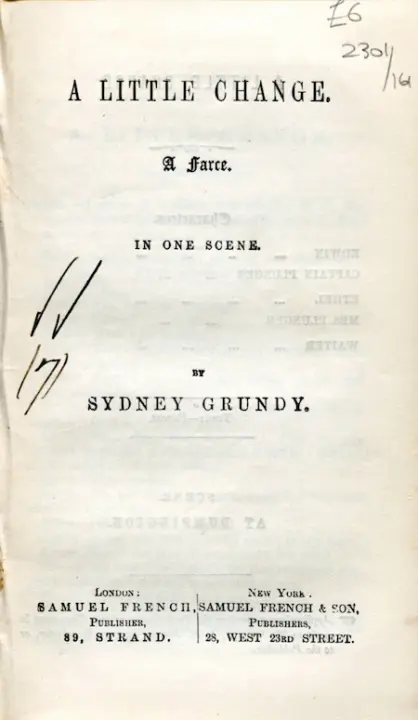
A Little Change: A Farce in One Scene
Sydney Grundy
THE CLASSIC COLLECTION · 1880
"In Honour Bound: An Original Play, in One Act." by Sydney Grundy is a theatrical play written in the late 19th century. This play, primarily a comedy, explores themes of love, promises, and social propriety through the interactions of its characters within a single act. Set within the social context of the Victorian era, it delves into the intricate complications that arise from romantic entanglements and the societal expectations surrounding them. The storyline revolves around Sir George Carlyon, a barrister, and his interactions with Philip Graham, who has just returned from traveling abroad. Philip reveals to Sir George that he is engaged to a lovely girl named Rose Dalrymple, who unexpectedly turns out to be Sir George’s niece. As the characters navigate this revelation, they confront issues of past romantic ties that threaten Philip's future happiness. The tension mounts as secrets and misunderstandings are revealed, culminating in a pivotal moment where responsibilities and emotional attachments are evaluated. Through witty dialogue and the unfolding drama, the play reflects on the burdens of past love and the quest for personal happiness amidst societal norms.
Introduction adapted from the source catalogue; source summaries may be automatically generated.
Free to read · English · 7,325 words · No account needed
MAKE TIME FOR A GOOD BOOK
On by default. Untick to stop anonymous reading totals. Each page counts after 10 seconds in view. How this works.
Anonymous counting is on unless you have switched it off.
SIR G. Had buried his first love when it was dead, he wouldn't have been haunted by its ghost. When passion is burnt out, sweep the hearth clean, and clear away the ash, before you set alight another fire. It is a law of life. Old things give place to new. The loves of yesterday are like these faded flowers, fit only to be cast into the flames. (flings bouquet into fire) That is the moral: and I call it excellent. (sits, C., and looks at PHILIP)
LADY C. (aside) He doesn't speak to me. Am I a faded flower?
(sits, L.)
ROSE. Very good, Uncle George. That ought to get the verdict.
(leaning upon his shoulder)
SIR G. Let us hope it will. (looking at PHILIP)
ROSE. If all your speeches are as nice as that, I must come down to
court and hear you plead.
SIR G. I shall be proud to have so fair an auditor. But we've not told
your aunt the news.
LADY C. What news?
SIR G. Philip informs me, much to my surprise----
PHILIP. (rising) Sir George! I have considered your advice, and have
resolved to act on it. Till I have done so it would perhaps be
better----
SIR G. Not to say anything? I will respect your confidence.
LADY C. You have some private matter to discuss. Shall we go?
(rises)
SIR G. We will go, if you will excuse us. (rises)
LADY C. Certainly.
SIR G. (to PHILIP) Come with me. (Exit, L.)
PHILIP. In case I don't see you again, Miss Dalrymple, good night.
(bows)
ROSE. Good evening, Mr. Graham. (she curtseys ceremoniously)
LADY C. (aside) What can they have to talk about--those two?
(reflectively)
PHILIP comes, L., and stands before LADY CARLYON.
PHILIP. Good night. (puts out his hand)
LADY C. (giving him her hand slowly, which he takes and drops) Good night. (exit PHILIP, quickly, L.) How glad he is to go! (drops down on seat again, L., leaning her head back, pressed between her hands--slight pause--ROSE comes down)
ROSE. Is anything the matter?
LADY C. I beg your pardon, dear. (rises and puts her arm round ROSE and leads her to the lounge) I don't feel very well to-night.
ROSE. Sit down and let me talk to you. A chat will cheer you perhaps.
LADY CARLYON sits upon the lounge before the fire--ROSE kneels beside her, on the further side from audience, so that both their faces are visible.
LADY C. I am so glad to have you with me, Rose. I wish I had you
always. I am very lonely.
ROSE. You have Uncle George!
Your reading position is saved on this browser. Take it to another device with a library code. Reading pages adapt to text, rather than matching a printed edition.
BEHIND THE BOOK
This eBook is for the use of anyone anywhere in the United States and most other parts of the world at no cost and with almost no restrictions whatsoever. You may copy it, give it away or re-use it under the terms of the Project Gutenberg License included with this eBook or online at www.gutenberg.org. If you are not located in the United States, you will have to check the laws of the country where you are located before using this eBook. Read the source licence.
The original source file, including credits and licence, is retained by this library. Request an original-format copy at no charge. Please include the book title and Project Gutenberg identifier #41369.
KEEP YOUR CURIOSITY GOING
Maurice Baring
W. B. (William Butler) Yeats
Edward Martyn

John Brougham & Charlotte Brontë
Marguerite Merington
Leonid Andreyev