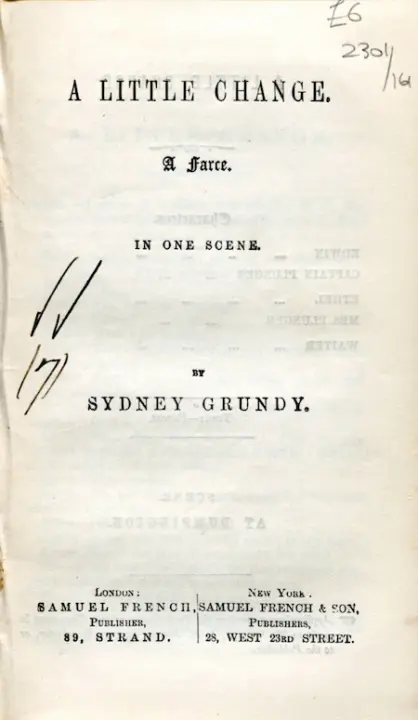
A Little Change: A Farce in One Scene
Sydney Grundy
THE CLASSIC COLLECTION · 1880
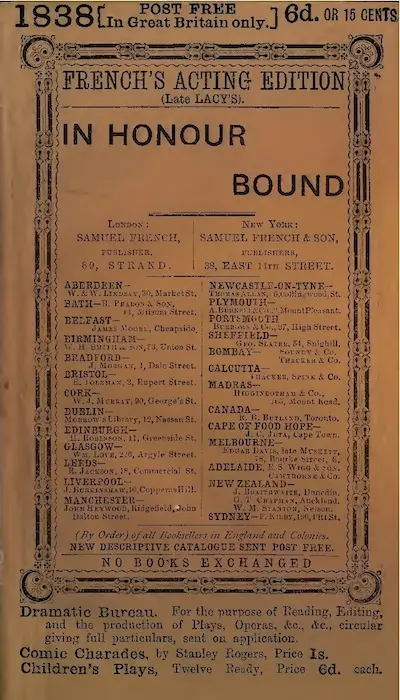
"In Honour Bound: An Original Play, in One Act." by Sydney Grundy is a theatrical play written in the late 19th century. This play, primarily a comedy, explores themes of love, promises, and social propriety through the interactions of its characters within a single act. Set within the social context of the Victorian era, it delves into the intricate complications that arise from romantic entanglements and the societal expectations surrounding them. The storyline revolves around Sir George Carlyon, a barrister, and his interactions with Philip Graham, who has just returned from traveling abroad. Philip reveals to Sir George that he is engaged to a lovely girl named Rose Dalrymple, who unexpectedly turns out to be Sir George’s niece. As the characters navigate this revelation, they confront issues of past romantic ties that threaten Philip's future happiness. The tension mounts as secrets and misunderstandings are revealed, culminating in a pivotal moment where responsibilities and emotional attachments are evaluated. Through witty dialogue and the unfolding drama, the play reflects on the burdens of past love and the quest for personal happiness amidst societal norms.
Introduction adapted from the source catalogue; source summaries may be automatically generated.
Free to read · English · 7,325 words · No account needed
MAKE TIME FOR A GOOD BOOK
On by default. Untick to stop anonymous reading totals. Each page counts after 10 seconds in view. How this works.
Anonymous counting is on unless you have switched it off.
PHILIP. The only girl in the wide world for me.
SIR G. Well, you've been round it, so you ought to know. I hope you will be happy. It's a toss-up, Philip.
PHILIP. I'm afraid your profession makes you cynical.
SIR G. Gad, it would make an angel cynical.
PHILIP. No doubt, you meet with some extraordinary cases.
(turning over briefs)
SIR G. Never. All ordinary. To a man who has had twenty years' experience, no possible case can appear extraordinary. There aren't three there of which I didn't know the end before I turned a page. No wonder we don't always read our briefs, for we know most of them by heart.
(lies back)
PHILIP. Hallo! (smiling)
SIR G. What have you found?
PHILIP. A breach of promise case. This looks amusing.
SIR G. Very amusing for the judge and jury. Very amusing for the public too. Very amusing for the new-made wife to read in all the newspapers her husband's past.
PHILIP. Is the defendant married, then?
SIR G. Of course he is. They always are. And of course he was on with the new love before he was off with the old. They always will be. The old love was no better than she need be, and no more was he. Very amusing for the new love, isn't it?
PHILIP. Of course the letters will be read in court?
SIR G. And published in the papers. "November, 1877--your own loving and devoted Harry. (laughter) November, 1878--Yours most affectionately, Henry. (loud laughter) November, 1879--Yours truly, Henry Horrocks. (roars of laughter)." Oh, it's a most amusing case--for Mrs. Henry Horrocks.
PHILIP. Why don't you settle it? You are for the defendant.
SIR G. We've tried, but it's too late. Take warning by my client.
SIR G. You be in time, if you are not too late already.
PHILIP. Excuse me, mine was quite a different case. Thank heaven, I have no reason to reproach myself. There was no love, at any rate on my side, in the matter you allude to.
SIR G. And yet you fled the country to avoid the lady. (sitting up)
PHILIP. I never said so.
SIR G. No, my boy; you never said that two and two makes four, but it does, doesn't it? (looking at PHILIP through his glasses)
PHILIP. No doubt. I felt that my position was----(hesitates)
SIR G. Equivocal.
PHILIP. That is the word I wanted.
SIR G. Useful word.
PHILIP. And feeling that, I thought the best course was to----
SIR G. Run away.
PHILIP. But as for promises of marriage, there was nothing of that sort. In fact, there couldn't be.
Your reading position is saved on this browser. Take it to another device with a library code. Reading pages adapt to text, rather than matching a printed edition.
BEHIND THE BOOK
This eBook is for the use of anyone anywhere in the United States and most other parts of the world at no cost and with almost no restrictions whatsoever. You may copy it, give it away or re-use it under the terms of the Project Gutenberg License included with this eBook or online at www.gutenberg.org. If you are not located in the United States, you will have to check the laws of the country where you are located before using this eBook. Read the source licence.
The original source file, including credits and licence, is retained by this library. Request an original-format copy at no charge. Please include the book title and Project Gutenberg identifier #41369.
KEEP YOUR CURIOSITY GOING
Maurice Baring
W. B. (William Butler) Yeats
Edward Martyn

John Brougham & Charlotte Brontë
Marguerite Merington
Leonid Andreyev