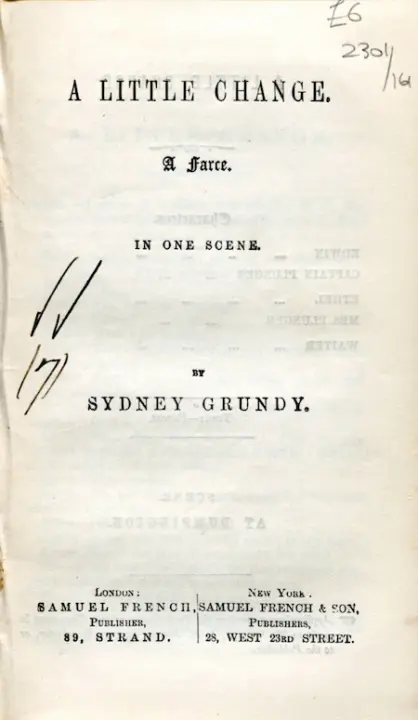
A Little Change: A Farce in One Scene
Sydney Grundy
THE CLASSIC COLLECTION · 1880
"In Honour Bound: An Original Play, in One Act." by Sydney Grundy is a theatrical play written in the late 19th century. This play, primarily a comedy, explores themes of love, promises, and social propriety through the interactions of its characters within a single act. Set within the social context of the Victorian era, it delves into the intricate complications that arise from romantic entanglements and the societal expectations surrounding them. The storyline revolves around Sir George Carlyon, a barrister, and his interactions with Philip Graham, who has just returned from traveling abroad. Philip reveals to Sir George that he is engaged to a lovely girl named Rose Dalrymple, who unexpectedly turns out to be Sir George’s niece. As the characters navigate this revelation, they confront issues of past romantic ties that threaten Philip's future happiness. The tension mounts as secrets and misunderstandings are revealed, culminating in a pivotal moment where responsibilities and emotional attachments are evaluated. Through witty dialogue and the unfolding drama, the play reflects on the burdens of past love and the quest for personal happiness amidst societal norms.
Introduction adapted from the source catalogue; source summaries may be automatically generated.
Free to read · English · 7,325 words · No account needed
MAKE TIME FOR A GOOD BOOK
On by default. Untick to stop anonymous reading totals. Each page counts after 10 seconds in view. How this works.
Anonymous counting is on unless you have switched it off.
LADY C. Surely you will do that?
PHILIP. I can't.
LADY C. Can't! Why? (slight pause)
PHILIP. (drops his head) I have destroyed it.
LADY C. Ah! (turns up and sits at desk) Sit down a moment whilst I write the letter. (writes rapidly)
PHILIP. It would be to no purpose.
LADY C. Oh, I will make it to the purpose. (writing)
PHILIP. Ah, if you only understood my situation!
LADY C. Pray sit down. (continues writing)
PHILIP. (sits on the end of lounge facing the audience--aside) How
shall I tell her who it is requires it? (rises--aloud) Lady
Carlyon----
LADY C. (writing) In one moment.
PHILIP. (sits--aside) How am I to say it? (pause--during which LADY CARLYON finishes and folds up the letter)
LADY C. (rising and advancing) There is the letter. (puts it in his
hand)
PHILIP. It is of no use. (rises)
LADY C. It is signed.
PHILIP. That is the very reason. How can I show your signature----
LADY C. You have my leave. The guardian is a gentleman, I hope.
PHILIP. Undoubtedly.
LADY C. Then he will not betray me.
PHILIP. But you don't know---- (door opens, L.)
LADY C. My husband! hush!
Re-enter SIR GEORGE, L. PHILIP hides behind his back the hand which
holds the letter.
SIR G. Rose has gone up stairs, but I've sent word you want her. Are you no better? You're upset to-night.
PHILIP. It is my fault, Sir George. I've just been telling your wife
of my difficulties.
SIR G. You couldn't have done better. I'm sure she will agree with me, that you should get the signature required. That is the only difficulty in the matter.
PHILIP. But it is insurmountable. If I had the signature, how could I
use it?
SIR G. Not without permission.
PHILIP. No!
LADY C. But you have permission!
(quickly and inadvertently)
SIR G. What?
LADY C. (aside) I've said too much.
SIR G. How did you get it? There's no post at this hour.
PHILIP. (with his disengaged hand produces ROSE'S envelope from his pocket) In the letter which you gave to me----
SIR G. Oh--ah!
PHILIP. And which I have just opened.
SIR G. The letter in the lady's handwriting.
PHILIP. Of her own accord, she releases me----
SIR G. This is a marvellous coincidence.
PHILIP. (shows letter) But here the letter is.
SIR G. How alike you women write! I could almost have sworn that envelope was in my niece's hand.
LADY C. How could that be?
SIR G. Why not?
LADY C. Rose write to Philip, whom she doesn't know!
SIR G. Not know?
LADY C. They never saw each other till to-night.
Your reading position is saved on this browser. Take it to another device with a library code. Reading pages adapt to text, rather than matching a printed edition.
BEHIND THE BOOK
This eBook is for the use of anyone anywhere in the United States and most other parts of the world at no cost and with almost no restrictions whatsoever. You may copy it, give it away or re-use it under the terms of the Project Gutenberg License included with this eBook or online at www.gutenberg.org. If you are not located in the United States, you will have to check the laws of the country where you are located before using this eBook. Read the source licence.
The original source file, including credits and licence, is retained by this library. Request an original-format copy at no charge. Please include the book title and Project Gutenberg identifier #41369.
KEEP YOUR CURIOSITY GOING
Maurice Baring
W. B. (William Butler) Yeats
Edward Martyn

John Brougham & Charlotte Brontë
Marguerite Merington
Leonid Andreyev