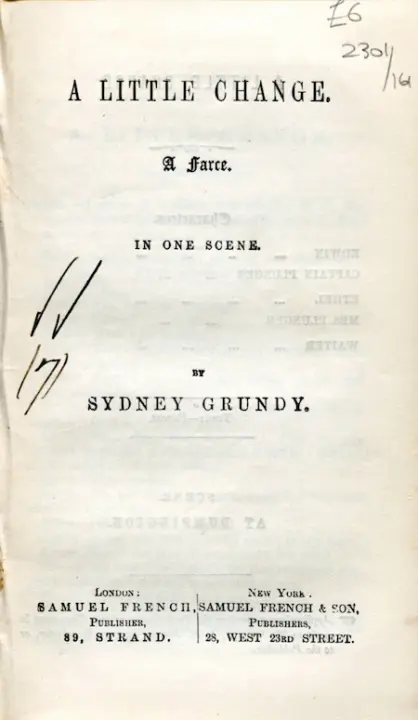
A Little Change: A Farce in One Scene
Sydney Grundy
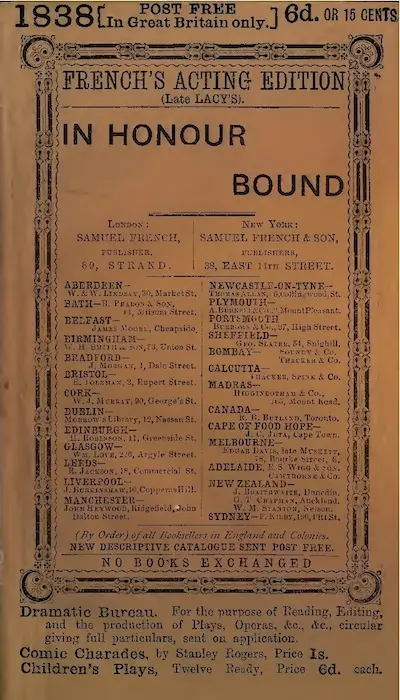
THE CLASSIC COLLECTION · 1880
"In Honour Bound: An Original Play, in One Act." by Sydney Grundy is a theatrical play written in the late 19th century. This play, primarily a comedy, explores themes of love, promises, and social propriety through the interactions of its characters within a single act. Set within the social context of the Victorian era, it delves into the intricate complications that arise from romantic entanglements and the societal expectations surrounding them. The storyline revolves around Sir George Carlyon, a barrister, and his interactions with Philip Graham, who has just returned from traveling abroad. Philip reveals to Sir George that he is engaged to a lovely girl named Rose Dalrymple, who unexpectedly turns out to be Sir George’s niece. As the characters navigate this revelation, they confront issues of past romantic ties that threaten Philip's future happiness. The tension mounts as secrets and misunderstandings are revealed, culminating in a pivotal moment where responsibilities and emotional attachments are evaluated. Through witty dialogue and the unfolding drama, the play reflects on the burdens of past love and the quest for personal happiness amidst societal norms.
Introduction adapted from the source catalogue; source summaries may be automatically generated.
Free to read · English · 7,325 words · No account needed
MAKE TIME FOR A GOOD BOOK
On by default. Untick to stop anonymous reading totals. Each page counts after 10 seconds in view. How this works.
Anonymous counting is on unless you have switched it off.
PHILIP. No doubt, the course you recommend would be the proper course to take, if it were possible; but in the circumstances it is quite impossible.
SIR G. Difficult, perhaps, but not impossible. Have no false delicacy in a case like this. This lady--I presume, whoever she may be, she is a lady--who is fond of you, for that is evident, but of whose friendship you are weary, must be sacrificed. I pity her, but there is no help for it.
PHILIP. None! but a letter is out of the question.
SIR G. Why?
PHILIP. How could I ask her--oh, it is impossible!
SIR G. Then, you do feel for her?
PHILIP. I can't help pitying her.
SIR G. Perhaps still care for her--a little?
PHILIP. Sir George (rises), I give you my assurance as a gentleman, nothing has passed between us but kind words. I never loved her; and when I think of all the trouble she has brought on me--how she has banished me for months abroad--how nearly she has made me a false friend--I hate the very mention of her name!
LADY C. (who has followed his words in an agony, unable to restrain herself) Philip! (remembering herself, drops back upon the lounge, and feigns to be asleep)
PHILIP. (turning, L., quickly) What's that?
SIR G. (rising and turning up the lamp, sees her upon the lounge) My wife! (going round at back of desk to lounge) She is asleep. (moving her) Bell! Isabel! (she pretends to wake, then starts up suddenly)
LADY C. Oh, how you startled me!
SIR G. Nay, how you startled us!
LADY C. How so?
SIR G. By calling out.
LADY C. Forgive me for disturbing you, but I was dreaming.
SIR G. And not a pleasant dream, apparently. Why, you are trembling
all over.
LADY C. (smiling) So I am.
SIR G. And you cried out as though you were in pain.
LADY C. It was in terror. I dreamt that I was walking on the edge of a
high cliff.
SIR G. Pshaw!
LADY C. Philip was with me.
SIR G. You had a safe escort.
LADY C. But the path grew so difficult, we had to separate. I followed him; when suddenly he turned and----
SIR G. And what?
LADY C. Flung me over! I shrieked out, "Philip!"--and awoke.
SIR G. That was what startled us.
LADY C. Forgive me. Mr. Graham, for having even dreamt that you could
be so little chivalrous.
SIR G. You are not well, my dear. It's time you went upstairs. I'll
ring for your maid.
LADY C. She has gone to bed. It doesn't matter. I can go alone.
Your reading position is saved on this browser. Take it to another device with a library code. Reading pages adapt to text, rather than matching a printed edition.
BEHIND THE BOOK
This eBook is for the use of anyone anywhere in the United States and most other parts of the world at no cost and with almost no restrictions whatsoever. You may copy it, give it away or re-use it under the terms of the Project Gutenberg License included with this eBook or online at www.gutenberg.org. If you are not located in the United States, you will have to check the laws of the country where you are located before using this eBook. Read the source licence.
The original source file, including credits and licence, is retained by this library. Request an original-format copy at no charge. Please include the book title and Project Gutenberg identifier #41369.
KEEP YOUR CURIOSITY GOING
Maurice Baring
W. B. (William Butler) Yeats
Edward Martyn

John Brougham & Charlotte Brontë
Marguerite Merington
Leonid Andreyev