THE CLASSIC COLLECTION✦An outlaw’s diary: the CommuneCLASSIC FREE BOOKS
An outlaw’s diary: the Commune
Cécile Tormay
THE CLASSIC COLLECTION · 1904
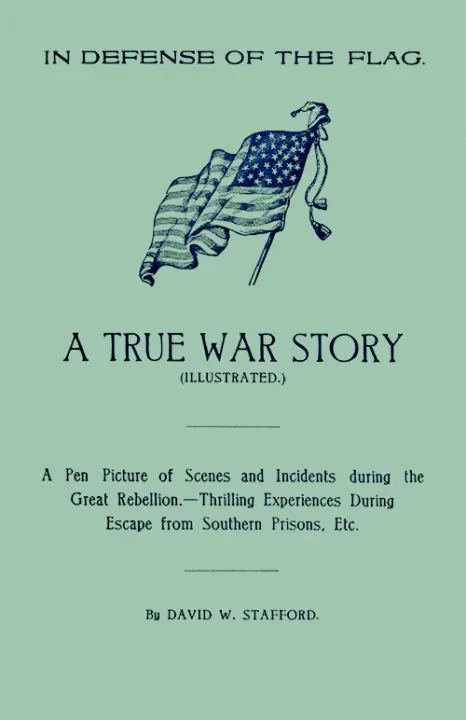
"In Defense of the Flag: A True War Story" by David W. Stafford is a historical account written in the early 20th century. This narrative recounts the true experiences of the author during the American Civil War, focusing on his enlistment, battles, the loss of his brother, and the harrowing details of being captured and imprisoned by the Confederate army. The book gives a personal glimpse into the challenges faced by soldiers of that era, particularly those who endured the intense hardships of war and imprisonment. The beginning of the story paints a vivid picture of Stafford's early life and motivations for joining the army at the tender age of seventeen. It details his initial enlistment in the 83rd Pennsylvania Volunteers, the struggle to keep his younger brother from following in his footsteps, and the profound heartbreak of losing him in battle. The opening sections also convey the chaos of war as Stafford narrates his experiences on the battlefield, his injuries, and the emotional turmoil of receiving tragic news about his brother’s fate while facing the prospect of imprisonment in a Southern prison. This portion sets the stage for a gripping tale of survival, resilience, and the search for freedom amidst the horrors of war.
Introduction adapted from the source catalogue; source summaries may be automatically generated.
Free to read · English · 28,392 words · No account needed
MAKE TIME FOR A GOOD BOOK
On by default. Untick to stop anonymous reading totals. Each page counts after 10 seconds in view. How this works.
Anonymous counting is on unless you have switched it off.
Well I kept on for some length of time, until it had gotten to be nearly night. I finally came to the mountain trail that I had been on when I stopped at the rebel captain’s place. I had in all of this day’s rambles traveled in no direct line, but had put in a good part of the day.
I had not gone far before I came to a log cabin, and here found two women. It had snowed two or three inches the night before, and during the day the sun had come out warm, and in the woods a man could be tracked. It seems that the rebel captain had gone back and got help to pursue my trail, and when I stopped at the log cabin and asked for something to eat they gave me a lunch and told me that the captain’s place was not more than six or seven miles from where I was, and they told me that I had better go to a barn which was back in the lot just a short distance from the house and conceal myself in a large quantity of straw that was in the barn. This barn was built of logs. So I went and crawled down in the northeast corner, clear down to the bottom. Now I had heard of crawling into a hole and drawing the hole in after you, so I tried to fill the hole up after me the best I could, and none too soon either, before there came three mounted men, one the captain. They tried to make these two women tell where I had gone. These women had husbands in our army at Knoxville, Tennessee, and I think these Union women would have died before they would have revealed my whereabouts. Soon these men came to the barn, looked all through it, and it seemed as though they would dig in the corner where I was and find me, but they went away without finding me, and again tried to find out for certain from these women whether they had seen me, for they had tracked me through the timber to the clearing, but when they came to the clearing the snow was gone. These rebels soon went back in the direction that I had come, and I went to the house and again started on my way, it now being dark, to see if I could not succeed in getting across this mountain. It did seem as though this was the hardest part of my journey, for after traveling all night until nearly morning, I lost a good share of the time from the mountain trail. What was my surprise to find myself again in the hands of a rebel guerilla. I had come around in front of a newly constructed log building, and just as I did so I saw a man in full rebel uniform seated on an old box mending a pair of boots. He perceived what a plight I was in for dress, and as he heard me talk he began to ask me a good many questions in regard to where I was from, and he told me about his being in the rebel army and deserting, and about his parents being good Union people. After he had talked for some time I really thought he was a good Union man, and told him of my escape from prison. Then I told him where I was from, and that my birth place was in Erie county, Pennsylvania. After we had talked some little time he wanted to know if I ever worked at shoemaking. I told him that I had, and that my father worked at the trade as long as I could remember. So he had me mend up his boots, which I did, thinking that his wife would soon be home and get something to eat. Now this was one of the worst sights for poverty that I had seen in all my travels, for it did not seem as though this man had five pounds of corn meal in this newly built hut. In one end there was a very rudely constructed fireplace, and I failed to find anything inside of the place to answer for a bed, except some old rags and a little straw in one corner. The day was nearly half gone when I had finished mending his boots, and he seemed to be very well pleased, when I told him that it did not seem as though his wife would be back very soon, of whom he had spoken. He had told me that as soon as she came she would get something for us to eat, but I still insisted on going. So I started to go, and just as soon as I made away he reached behind the door and got out a double-barreled shot gun and brought it to bear on me. He told me to stop or he would have to shoot. I thought how soon my friend had turned to a foe. I found that I was again in the hands of an enemy. As soon as I went back to him he called very loudly for his mother to come up to his place. It seemed that his folks lived about a hundred yards or more away, just across the woods. Soon his poor old mother came running up to the house and asked him what was the matter. He wanted her to stay with the children while he went away with me. Then she looked at me and wanted to know where he was going. He told her that I was a Yankee, right from Pennsylvania and that he was obliged to take me and turn me over to the home guards. He would shoot or hang me without any trial whatever. Then she told him that he had deserted from the Confederate army himself and would be just as liable to arrest as I was, but he didn’t seem to care how much she talked to him. Oh, so selfish was he to accomplish his end! He wanted his mother to stay with the two children while he went away with me. Then his mother wanted to know who I was and I told her all I had done for her son, and how I had waited after mending his boots, and how he was inclined to want to shoot me for the kind act I had shown him. “Well, mother,” he said, “will you stay here with the children until I come back?” “No sir, I will not do it, nor will I ever do anything for you if you do not let this poor starving creature go,” she said. “No, mother, I could not do it, but if you will take the children home with you I will go down and let father see my prisoner, so come along,” and he made me walk right in front of his double-barreled shot gun, and was very careful to tell me if I undertook to run that he would have to shoot me. In this way we went to a corn field, about a half mile from his father’s place, and here we found about eight or ten women and men husking corn. Advancing up to his father this “William,” as they called him, said: “Father, here is a real Yankee, right from Pennsylvania.” “What part of Pennsylvania are you from?” asked the father. I told him from Erie county. “Well,” he said, “my boy here was born in that state, in Crawford county. Well, how do you do? I am very glad to see you. William, what have you got that gun for?” “Why, father, don’t you know that I took a hard oath to serve my country?” “Yes, you took an oath, my poor boy, but deserted the Southern service, knowing that your poor father was a Northern Union man. Yes, yes, you took a wonderful oath, but, William, you must let this man go.” All the talk the poor old man could say to his son was of no avail, and now his kind brother plead with him. This boy was only seventeen years old. He had lost his right arm above the elbow. Then came, last of all, his sisters, and if ever I have heard pleading for one’s life it seemed that these poor souls did it. It seemed that all this man’s aim was to try his firearms on me, for after a long talk with his young brother and sisters, the brother came to me and told me that the only way that William would release me was for me to start off a little distance and then run. He said William would probably shoot at me and that he was afraid it would mean death to me very soon. The brother and his two sisters came back shortly, and the former told me what he had concluded to do. He allowed that he would just get off a short distance and then I must get up and run. Then William would turn and shoot at me, and I must run all the faster. He started and walked off about ten rods and I saw that he did not intend to go any further. So I arose as quickly as possible from a shock of corn I had been husking and started for a very steep bluff which was almost straight down, and it did seem as though I fairly flew down this hill so rapid was my flight. Dear reader, if you was never compelled to flee from a foe with a gun and then to be shot at, you can imagine the plight I was in. Now I want to say right here that in eternity I expect to meet this same man, and I don’t want him to come up before me and say: “You wrote a tale, away back there, against me that you scattered broadcast which was untrue.”
Your reading position is saved on this browser. Take it to another device with a library code. Reading pages adapt to text, rather than matching a printed edition.
BEHIND THE BOOK
This eBook is for the use of anyone anywhere in the United States and most other parts of the world at no cost and with almost no restrictions whatsoever. You may copy it, give it away or re-use it under the terms of the Project Gutenberg License included with this eBook or online at www.gutenberg.org. If you are not located in the United States, you will have to check the laws of the country where you are located before using this eBook. Read the source licence.
The original source file, including credits and licence, is retained by this library. Request an original-format copy at no charge. Please include the book title and Project Gutenberg identifier #49925.
KEEP YOUR CURIOSITY GOING
Cécile Tormay

Moritz Busch
John L. Ransom
Frances Wright
Cécile Tormay

Mabel Potter Daggett