Through the Dark Continent, Vol. 1 (of 2)
Henry M. (Henry Morton) Stanley
THE CLASSIC COLLECTION · 1890
"In Darkest Africa, Vol. 2; or, The Quest, Rescue, and Retreat of Emin, Governor of Equatoria" by Henry M. Stanley is a historical account written in the late 19th century. This work captures the arduous journey and experiences of Stanley and his expedition as they set out to rescue Emin Pasha from Equatoria, detailing the physical challenges and interactions with native tribes. The narrative revolves around various characters, including Stanley himself and members of his expedition, as they navigate the dangers and mysteries of Africa. The opening of the second volume begins with the expedition's preparations for their third journey to the Nyanza. Stanley engages in discussions with Mr. Bonny and the Zanzibaris, who express their grievances about their conditions during the mission. This section delves into the hardships faced by the expedition members, highlighting issues of food scarcity, illness, and the toll that the journey has taken on their morale. A significant focus is placed on the detrimental effects of consuming poorly prepared manioc, leading to illness and death among the Zanzibari carriers. Stanley's leadership and attempts to understand and address the challenges faced by his team set the stage for the trials that will unfold as they continue their quest.
Introduction adapted from the source catalogue; source summaries may be automatically generated.
Free to read · English · 172,568 words · No account needed
MAKE TIME FOR A GOOD BOOK
On by default. Untick to stop anonymous reading totals. Each page counts after 10 seconds in view. How this works.
Anonymous counting is on unless you have switched it off.
The Bavira and Babusessé, separated only by the Ituri, both countries being grass land, speak a dialect remarkably alike. Formerly it was one language; but in two generations the Baviras have become corrupted by using daily the Rukobé, or that of the Wahuma. They migrated from the banks of the Ituri, crossed the Ruki, and dwelt among the Wahuma, who are an exclusive and proud people.
The Rukobé or Wahuma have no single word for thanks, but yo simire-kurungi literally means, “I take it to be good of you,” or “I accept it kindly.”
Wahuma, when children, call their father “baba,” equal to our papa; when
adults, “tata.”
Wahuma, when children, call their mother “mama,” equal to our mamma;
when adults, “man.”
Wahuma, on the other side of the lake, are called Wachwezi.
The number three is the most universally similar. Take from Zanzibar on to the East Coast to Banana on to the West Coast there is but little variation, and through the forest region to Lake Albert, water is almost pretty near alike, especially on the Western half, varying from riba, liba, libu, libo, ibo, rubu.
Chicken = kuku, kokko, ngokko, bukoko.} Spear = ikunga, kunga. } These words seem Goat = me-me. } most popular across Ten = kumi. } Africa. Dog = mbwa, mbua. }
One would imagine a confusion of languages, as for instance:--
Hottentot Babusessé Kumbutti Mandingo. Eye = mu Head = mu Head = mo Man = mo
Wahuma Galla
Milk = mata Head = matta
Danakil Arabic.
Cow = la la = no
Tuarik. Kikongo
Hair = zau Elephant = nzau
Kiyanzi. Bakiokwa.
Friend = koi Eye = koi
Kisawahili. East Manyuema.
Bana or Bwana = Master Bana = four
Kisawahili. Bavira
Kiboko = Hippo Head, hand, finger = Kiboko
Somali. } is in Swahili a vile slang word; and country Boro, mountain } in Niam Niam.
Semmé in Hurrur is sky; in Soudanese Arabic it means good.
Kuba in Bavira is sky; is dog in Adaiel, big in Swahili.
Barra in Adaiel is woman; is continent in Swahili.
Ina in Kiyanzi is four; in Yoruba means fire.
Afi in Babira means road; in Ku-mbutti means river.
A-é in Somali means dog, but means mother in Hurrur; so that son of a female dog in Somali, would in Hurrur be a mother’s son.
Ariho in Wahuma, or, are you here, is sky in Niam Niam.
Happa, here, in Swahili, becomes yes in Monbuttu.
The ibuka of the forest, approaches the ebbugu of Monbuttu (Banana).
The Niam Niam have no words for numerals higher than five; six becomes the second one battisa; seven the second two battiuwi, &c., &c.
The Wabarukuru likewise.
Posyo, meat in Niam Niam, approaches the Posho, rations, Swahili, and
podzio, Russian for hurry.
Your reading position is saved on this browser. Take it to another device with a library code. Reading pages adapt to text, rather than matching a printed edition.
Henry M. (Henry Morton) Stanley
Henry M. (Henry Morton) Stanley
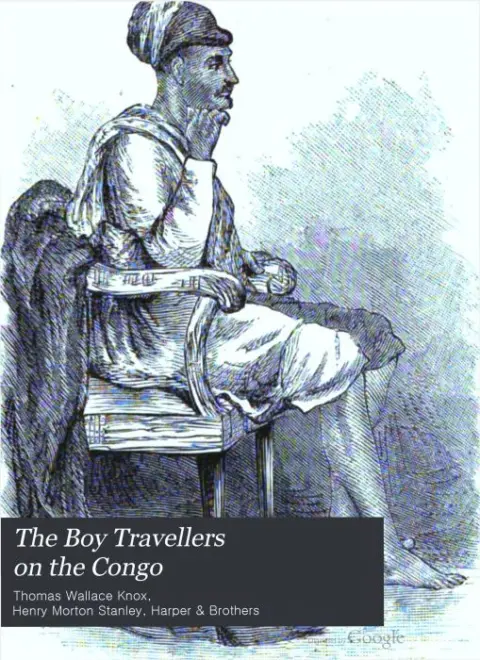
Thomas Wallace Knox & Henry M. (Henry Morton) Stanley
Henry M. (Henry Morton) Stanley
BEHIND THE BOOK
This eBook is for the use of anyone anywhere in the United States and most other parts of the world at no cost and with almost no restrictions whatsoever. You may copy it, give it away or re-use it under the terms of the Project Gutenberg License included with this eBook or online at www.gutenberg.org. If you are not located in the United States, you will have to check the laws of the country where you are located before using this eBook. Read the source licence.
The original source file, including credits and licence, is retained by this library. Request an original-format copy at no charge. Please include the book title and Project Gutenberg identifier #43655.
KEEP YOUR CURIOSITY GOING
Wilfrid Scawen Blunt
Wilfrid Scawen Blunt

E. W. (Edgar Watson) Howe
Cécile Tormay

Moritz Busch
John L. Ransom