Through the Dark Continent, Vol. 1 (of 2)
Henry M. (Henry Morton) Stanley
THE CLASSIC COLLECTION · 1890
"In Darkest Africa, Vol. 1; or, The Quest, Rescue, and Retreat of Emin, Governor…" by Henry M. Stanley is a historical account written in the late 19th century. The book chronicles Stanley's exploration and the relief expedition aimed at rescuing Emin Pasha, who was isolated during a tumultuous period in Sudan. The narrative not only focuses on the perilous journey through Africa but also touches upon the broader political and social contexts that influenced the events surrounding the Soudan. At the start of the narrative, Stanley reflects on the historical calamities associated with British involvement in Egypt and the Soudan, setting the scene for the dire circumstances faced by those like Emin Pasha. He offers insight into the socio-political turmoil that preceded his expedition, including the rise of the Mahdi and the failures of the Egyptian government. Stanley outlines the motivations behind the relief expedition and provides background on Emin Pasha, detailing his loyal governance in Equatoria and the dire straits he faced as communication lines with the outside world were severed. The beginning establishes the urgency and gravity of the mission, as Stanley prepares both himself and his potential audience for the journey and challenges ahead.
Introduction adapted from the source catalogue; source summaries may be automatically generated.
Free to read · English · 179,233 words · No account needed
MAKE TIME FOR A GOOD BOOK
On by default. Untick to stop anonymous reading totals. Each page counts after 10 seconds in view. How this works.
Anonymous counting is on unless you have switched it off.
At the same time the warm dry clay floors began to breed fleas by myriads. Poor "Randy" was most miserable from these vexatious torments. We were in no better plight. While dressing they made our limbs black with their numbers. To suppress this pest we had recourse to keeping the floors constantly damp, and to sweeping the floors twice a day.
The ordinary mosquito netting was no protection against the mosquitoes of the clearing. They sailed through the open work as mice would creep through antelope nets, and the only remedy was to make mosquito curtains out of cotton muslin, which happily succeeded, but half suffocated the sleepers.
Our soap had long ago been exhausted, and as a substitute, though it was not agreeable to the smell, and was an altogether unsaleable article, we manufactured a soft soap out of castor-oil and lye, and, after a few experiments, succeeded in turning out a hard ball-like substance, which had all the desired effect.
Every night, from Yambuya to the plains, we had been troubled by harsh screams from the lemur. It began at a startling loud key, very deliberate, and as it proceeded the sounds became louder, quicker, and higher, in a quick succession of angry, grating, wailing cries. In the darkness and silence of the night, they sounded very weird. Soon, from a distance of perhaps 200 yards, commenced a response in the same strain, from another sexual mate. Sometimes two or three pairs of these would make sleep impossible, if any indisposition had temporarily disturbed the usual rest.
Armies of red ants would sometimes invade the fort from the clearing; their columns were not interrupted by the ditch. In long, thick, unbroken lines, guarded by soldiers on either flank, the innumerable insects would descend the ditch and ascend the opposite sides, over the parapets, through the interstices of the poles, over the banquette, and down into the plaza of the fort, some columns attacking the kitchen, others headquarters, the officers' mess-house, and woe betide any unlucky naked foot treading upon a myriad. Better a flogging with nettles, or cayenne over an excoriated body, or a caustic bath for a ravenous itch, than these biting and venomous thousands climbing up the limbs and body, burying themselves in the hair of the head, and plunging their shining, horny mandibles into the flesh, creating painful pustules with every bite. Every living thing seems disturbed at their coming. Men are screaming, bellowing with pain, dancing, and writhing. There is a general rustle, as of a host of migrant creatures among the crisp dry phrynia leaves overhead. The rats and mice, snakes, beetles, and crickets are moving. From a slung cot I have observed, by candle-light, the avengers advancing over the floor of my house, scaling the walls, searching the recesses of every layer of leaves, skirmishing among the nooks and crannies, mouse-holes, and cracks; heard moaning and crying of little blind mice, and terrified squealing of motherly and paternal rats, and hailed them as a blessing, encouraging them along on their career of destruction, until presently some perverse and undisciplined tribes would drop from the roof on my cot, and convert their well-wisher into a vindictive enemy, who, in his rage, would call aloud for hot glowing embers and roast them alive by thousands, until the air was heavy with the odour of frizzling and frying ants. Bad luck to them!
Your reading position is saved on this browser. Take it to another device with a library code. Reading pages adapt to text, rather than matching a printed edition.
Henry M. (Henry Morton) Stanley
Henry M. (Henry Morton) Stanley
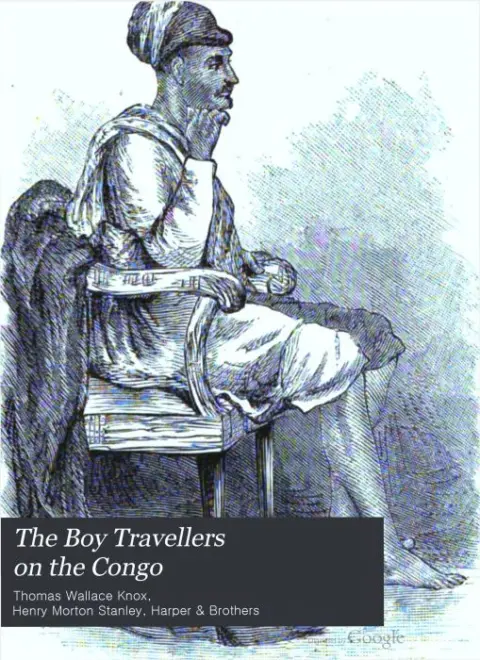
Thomas Wallace Knox & Henry M. (Henry Morton) Stanley
Henry M. (Henry Morton) Stanley
BEHIND THE BOOK
This eBook is for the use of anyone anywhere in the United States and most other parts of the world at no cost and with almost no restrictions whatsoever. You may copy it, give it away or re-use it under the terms of the Project Gutenberg License included with this eBook or online at www.gutenberg.org. If you are not located in the United States, you will have to check the laws of the country where you are located before using this eBook. Read the source licence.
The original source file, including credits and licence, is retained by this library. Request an original-format copy at no charge. Please include the book title and Project Gutenberg identifier #43654.
KEEP YOUR CURIOSITY GOING
Wilfrid Scawen Blunt
Wilfrid Scawen Blunt

E. W. (Edgar Watson) Howe
Cécile Tormay

Moritz Busch
John L. Ransom