THE CLASSIC COLLECTION✦PoemsCLASSIC FREE BOOKS
Poems
Katherine Mansfield
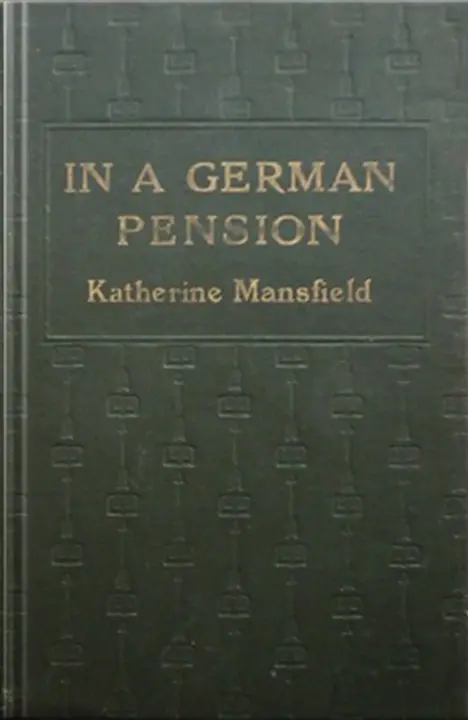
THE CLASSIC COLLECTION · 1911
"In a German Pension" by Katherine Mansfield is a collection of short stories written during the early 20th century. The book presents a series of vignettes that explore the lives, conversations, and interactions of a diverse group of guests at a German pension, often delving into themes of culture, societal norms, and the complexities of human relationships. The opening of the book introduces the reader to a lively dining scene in a pension, where the main character engages with various individuals at their mealtime. Through witty dialogue, readers get glimpses of characters like Herr Rat, who boasts about his cooking skills and breakfast habits, and the curious Widow, who questions the protagonist about her marriage and dietary choices. Amidst discussions of food, health, and personal experiences, the protagonist grapples with her identity and the cultural differences that set her apart from her German companions. This initial chapter sets the tone for the collection, hinting at the mix of humor and introspection that characterizes Mansfield's exploration of shared lives within the confines of the pension.
Introduction adapted from the source catalogue; source summaries may be automatically generated.
Free to read · English · 31,401 words · No account needed
MAKE TIME FOR A GOOD BOOK
On by default. Untick to stop anonymous reading totals. Each page counts after 10 seconds in view. How this works.
Anonymous counting is on unless you have switched it off.
“I really never asked him; he is not at all particular about his food.”
A pause. They all looked at me, shaking their heads, their mouths full
of cherry stones.
“No wonder there is a repetition in England of that dreadful state of things in Paris,” said the Widow, folding her dinner napkin. “How can a woman expect to keep her husband if she does not know his favourite food after three years?”
“Mahlzeit!”
“Mahlzeit!”
I closed the door after me.
“Who is he?” I said. “And why does he sit always alone, with his back
to us, too?”
“Ah!” whispered the Frau Oberregierungsrat, “he is a Baron.”
She looked at me very solemnly, and yet with the slightest possible contempt—a “fancy-not-recognising-that-at-the-first-glance” expression.
“But, poor soul, he cannot help it,” I said. “Surely that unfortunate fact ought not to debar him from the pleasures of intellectual intercourse.”
If it had not been for her fork I think she would have crossed herself.
“Surely you cannot understand. He is one of the First Barons.”
More than a little unnerved, she turned and spoke to the Frau Doktor on
her left.
“My omelette is empty—empty,” she protested, “and this is the third I
have tried!”
I looked at the First of the Barons. He was eating salad—taking a whole lettuce leaf on his fork and absorbing it slowly, rabbit-wise—a fascinating process to watch.
Small and slight, with scanty black hair and beard and yellow-toned complexion, he invariably wore black serge clothes, a rough linen shirt, black sandals, and the largest black-rimmed spectacles that I had ever seen.
The Herr Oberlehrer, who sat opposite me, smiled benignantly.
“It must be very interesting for you, gnädige Frau, to be able to watch... of course this is a very fine house. There was a lady from the Spanish Court here in the summer; she had a liver. We often spoke together.”
I looked gratified and humble.
“Now, in England, in your ‘boarding ’ouse’, one does not find the First Class, as in Germany.”
“No, indeed,” I replied, still hypnotised by the Baron, who looked like a little yellow silkworm.
“The Baron comes every year,” went on the Herr Oberlehrer, “for his nerves. He has never spoken to any of the guests—yet.” A smile crossed his face. I seemed to see his visions of some splendid upheaval of that silence—a dazzling exchange of courtesies in a dim future, a splendid sacrifice of a newspaper to this Exalted One, a “danke schön” to be handed down to future generations.
Your reading position is saved on this browser. Take it to another device with a library code. Reading pages adapt to text, rather than matching a printed edition.
Katherine Mansfield
Katherine Mansfield
Katherine Mansfield
BEHIND THE BOOK
This eBook is for the use of anyone anywhere in the United States and most other parts of the world at no cost and with almost no restrictions whatsoever. You may copy it, give it away or re-use it under the terms of the Project Gutenberg License included with this eBook or online at www.gutenberg.org. If you are not located in the United States, you will have to check the laws of the country where you are located before using this eBook. Read the source licence.
The original source file, including credits and licence, is retained by this library. Request an original-format copy at no charge. Please include the book title and Project Gutenberg identifier #1472.
KEEP YOUR CURIOSITY GOING
Coulson Kernahan

Maurice Baring
Frances Wright
Cécile Tormay

Frederic Jesup Stimson

W. H. P. (William Henry Pope) Jarvis