
The World of Chance
William Dean Howells
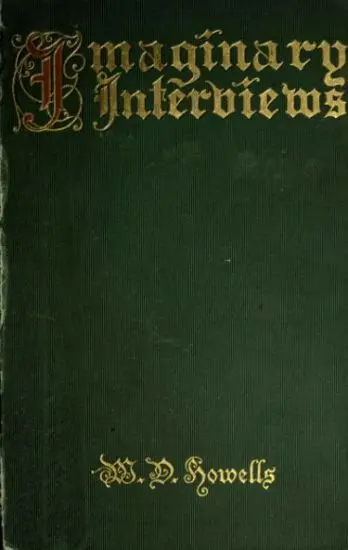
THE CLASSIC COLLECTION · 1910
"Imaginary Interviews" by William Dean Howells is a collection of satirical essays written during the early 20th century. The work is notable for its playful and imaginative dialogue, encapsulating a variety of themes related to literature, society, and human experiences through whimsical conversations with fictional characters. The opening chapter introduces the concept of an "Easy Chair," a symbolic space where discussions on contemporary issues unfold, paving the way for a rich exploration of cultural and moral reflections. At the start of the book, the reader is introduced to the concept of the Easy Chair, reflecting Howells' trademark wit and social commentary. The dialogue begins with a whimsical recounting of the chair's storied past and its significance in the context of the magazine "Harper's." The discussion revolves around the legacy of previous editors and the challenges faced by their successors in capturing the essence of contemporary social dynamics, particularly in relation to themes like the commercialization of Christmas and cultural expectations. The engaging exchange between the Easy Chair and its occupant sets a compelling tone for the rest of the collection, promising further explorations of societal values and the human condition.
Introduction adapted from the source catalogue; source summaries may be automatically generated.
Free to read · English · 105,504 words · No account needed
MAKE TIME FOR A GOOD BOOK
On by default. Untick to stop anonymous reading totals. Each page counts after 10 seconds in view. How this works.
Anonymous counting is on unless you have switched it off.
"This question would bring us to the pass where we should more or less drop the mocking mask. We should picture a state of things in which we had actually arrived at a monarchy of our own, with a real sovereign and a nobility and a court, and the rest of the tradition. With a sudden severity we should ask where, since they could not all be of the highest rank, our women would consent to strike the procession of precedence? How, with their inborn and inbred notions of the deference due their sex, with that pride of womanhood which our republican chivalry has cherished in them, they would like, when they went to court, to stand, for hours perhaps, while a strong young man, or a fat old man, or a robust man in the prime of life, remained seated in the midst of them? Would it flatter their hopes of distinction to find the worst scenes of trolley-car or subway transit repeated at the highest social function in the land, with not even a hanging-strap to support their weariness, their weakness, or, if we must say it, their declining years? Would the glory of being part of a spectacle testifying in our time to the meanness and rudeness of the past be a compensation for the aching legs and breaking backs under the trailing robes and the nodding plumes of a court dress?"
"That would be a telling stroke," our visitor said, "but wouldn't it be a stroke retold? It doesn't seem to me very new."
"No matter," we said. "The question is not what a thing is, but how it is done. You asked how we should treat a given subject, and we have answered."
"And is that all you could make of it?"
"By no means. As subjects are never exhausted, so no subject is ever exhausted. We could go on with this indefinitely. We could point out that the trouble was, with us, not too much democracy, but too little; that women's civic equality with men was perhaps the next step, and not the social inequality among persons of both sexes. Without feeling that it affected our position, we would acknowledge that there was now greater justice for women in a monarchy like Great Britain than in a republic like the United States; with shame we would acknowledge it; but we would never admit that it was so because of the monarchism of the first or the republicanism of the last. We should finally be very earnest with this phase of our subject, and we should urge our fair readers to realize that citizenship was a duty as well as a right. We should ask them before accepting the suffrage to consider its responsibilities and to study them in the self-sacrificing attitude of their husbands and fathers, or the brothers of one another, toward the state. We should make them observe that the actual citizen was not immediately concerned with the pomps and glories of public life; that parties and constituencies were not made up of one's fellow-aristocrats, but were mostly composed of plebeians very jealous of any show of distinction, and that, in spite of the displeasures of political association with them, there was no present disposition in American men to escape to monarchy from them. We cannot, we should remind them, all be of good family; that takes time, or has taken it; and without good family the chances of social eminence, or even prominence, are small at courts. Distinction is more evenly distributed in a democracy like ours; everybody has a chance at it. To be sure, it is not the shining honor bestowed by kings, but when we remember how often the royal hand needs washing we must feel that the honor from it may have the shimmer of putrescence. This is, of course, the extreme view of the case; and the condition of the royal hand is seldom scrutinized by those who receive or those who witness the honor bestowed. But the honor won from one's fellow-citizens is something worth having, though it is not expressed in a ribbon or a title. Such honor, it seems probable, will soon be the reward of civic virtue in women as well as men, and we hope women will not misprize it. The great end to be achieved for them by the suffrage is self-government, but with this goes the government of others, and that is very pleasant. The head of our state may be a woman, chosen at no far-distant election; and though it now seems droll to think of a woman being president, it will come in due time to seem no more so than for a woman to be a queen or an empress. At any rate, we must habituate our minds to the idea; we must realize it with the hope it implies that no woman will then care socially to outshine her sister; at the most she will be emulous of her in civic virtue, the peculiar grace and glory of republics. We understand that this is already the case in New Zealand and Colorado and Wyoming. It is too soon, perhaps, to look for the effect of suffrage on the female character in Denmark; it may be mixed, because there the case is complicated by the existence of a king, which may contaminate that civic virtue by the honor which is the moving principle in a monarchy. And now," we turned lightly to our visitor, "what is the topic you wish us to treat?"
Your reading position is saved on this browser. Take it to another device with a library code. Reading pages adapt to text, rather than matching a printed edition.
William Dean Howells
William Dean Howells

William Dean Howells

William Dean Howells
BEHIND THE BOOK
This eBook is for the use of anyone anywhere in the United States and most other parts of the world at no cost and with almost no restrictions whatsoever. You may copy it, give it away or re-use it under the terms of the Project Gutenberg License included with this eBook or online at www.gutenberg.org. If you are not located in the United States, you will have to check the laws of the country where you are located before using this eBook. Read the source licence.
The original source file, including credits and licence, is retained by this library. Request an original-format copy at no charge. Please include the book title and Project Gutenberg identifier #28763.
KEEP YOUR CURIOSITY GOING

David Patterson (Spirit) Hatch

David Patterson (Spirit) Hatch

David Patterson (Spirit) Hatch
Coulson Kernahan

Ralph Waldo Emerson

Maurice Baring