THE CLASSIC COLLECTION✦An outlaw’s diary: the CommuneCLASSIC FREE BOOKS
An outlaw’s diary: the Commune
Cécile Tormay
THE CLASSIC COLLECTION · 1905
"Illuminated Manuscripts" by John William Bradley is a historical account written in the early 20th century. The book serves as a comprehensive exploration of the art of illumination, detailing its techniques, influences, and significance throughout various periods, as well as the different cultures that contributed to its development. It likely covers topics such as the materials used, various styles and the evolution of methods in manuscript decoration across the ages. The opening of the book introduces readers to the foundational concepts of art and illumination, distinguishing the aims and processes of illumination from those of miniature painting. Bradley elaborates on the origins of specific terms like 'illumination' and 'miniature,' setting the stage for a deeper understanding of the subject. He emphasizes that the art of illumination is about more than mere aesthetics; it seeks to enrich the experience of engaging with text. Additionally, the early chapters outline the materials, such as vellum and parchment, used in creating illuminated manuscripts, establishing a historical context for the subsequent discussions on various artistic styles and their cultural significance.
Introduction adapted from the source catalogue; source summaries may be automatically generated.
Free to read · English · 64,895 words · No account needed
MAKE TIME FOR A GOOD BOOK
On by default. Untick to stop anonymous reading totals. Each page counts after 10 seconds in view. How this works.
Anonymous counting is on unless you have switched it off.
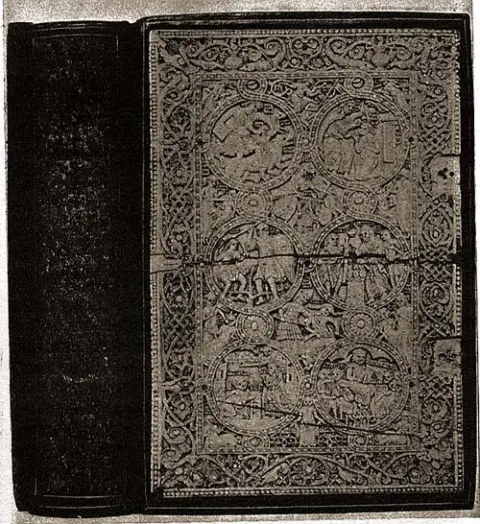
As for the texts or inscriptions, they would require a commentary to themselves--not to speak of translations and remarks upon the calligraphy. One of these remarkable miniatures may be described, as it depicts the presentation of the volume to the Madonna. Our Lady in the centre of the design is seated on a Byzantine sedile with the infant Jesus on her knees. She is crowned, and has the nimbus, and appears as if intended to represent the glory of the Church. Her hand is raised as in the act of teaching. Christ, also, has the nimbus, but with the cross upon it, and raises his hand in the attitude of benediction. In the tympanum of the semicircle over the Madonna, written in letters of gold on purple, surrounded by the word "Sancta" in ordinary ink, is the monogram of Maria, having a small sun and moon above it, and other inscriptions, partly Latin, partly Greek. Below the Madonna, on the left, stands the abbess, her knees slightly bent, holding up her book, and clothed in the costume of her Order, but coloured, no doubt, simply for artistic reasons. Thus she wears a blue veil and a claret-coloured robe. In the reversed semicircle before her is another monogram, Uota or Tuota, a name which perhaps may be translated Uta, Utta, Ida, etc. It has been said already who she is likely to have been. It does not follow, of course, that she herself wrote or illuminated the book she is presenting, but judging from similar instances, as e.g. Herrade of Landsberg and Hrosvita of Gandersheim, she may have done so.
Still the work looks technically too masterly for anyone not a trained artist to have done. In the corners are small quadretti, containing busts of the four cardinal virtues:--Prudence, Justice, Temperance, and Fortitude; and in circlets in the centre of each border are Faith, Hope, and Charity, the latter twice, at top and bottom. A number of extraordinary beasts fill up little niches in the design, which may possibly be also symbolical, but possibly also nothing but artistic fancies. The other miniatures we must pass over. Nevertheless those representing the four evangelists are worth examination;[31] the ornamentation being especially rich and elaborate. Let us now turn our attention to a new element--a new spirit we might term it--which was manifesting itself in Italy and France. We cannot too strongly insist upon the fact that whatever appears in illumination has appeared first in architecture and its auxilliary arts. Now we have to see how this fact begins to change almost entirely the character of the ornamentation of books. During the latter part of the twelfth century, when precisely we cannot say, nor where, a new form of architecture began to show itself. This new style, laying aside both the classic cornice and the Romanesque arch, makes use of a new vertical principle of construction, called in French the ogive or arch, composed of two sections only, instead of the whole semicircle. By some fatality, of which no exact explanation can be given, English writers have given this new style the name of Gothic. Scores of cathedrals throughout Europe are called Gothic cathedrals, whereas in all probability, if we exclude Sweden, there is only one really Gothic building in the world, that is the Tomb of Theodoric at Ravenna, and none of the so-called Gothic cathedrals are in the least like it. As to the invention itself, it has been claimed by almost every nationality in Europe. There can be no doubt that accidentally, or otherwise, the pointed arch had been used often enough without any idea of its adoption as a principle of construction even in ancient buildings. The famous gate at Mycoene is one instance. This is not the place to discuss the question, so we let it pass. We could point out long and elaborate arguments intended to prove that it originated in England--that it originated in France--in Germany.[32] Possibly they may all be right in a sense, for most probably the origin was not in any particular locality, but in the religious spirit of the time. It was a general revival of the Church itself that was its cause. If any special locality has more reason on its side than another, it is probably France, but as we say, that is not an essential point. It must suffice us here that it arose, and that by the end of the twelfth century it was a fact. And the remarkable part about it is that it was by the influence of lay artists and especially of the freemasons that it became the accepted architecture of Christendom.
Your reading position is saved on this browser. Take it to another device with a library code. Reading pages adapt to text, rather than matching a printed edition.
BEHIND THE BOOK
This eBook is for the use of anyone anywhere in the United States and most other parts of the world at no cost and with almost no restrictions whatsoever. You may copy it, give it away or re-use it under the terms of the Project Gutenberg License included with this eBook or online at www.gutenberg.org. If you are not located in the United States, you will have to check the laws of the country where you are located before using this eBook. Read the source licence.
The original source file, including credits and licence, is retained by this library. Request an original-format copy at no charge. Please include the book title and Project Gutenberg identifier #19870.
KEEP YOUR CURIOSITY GOING
Cécile Tormay

Moritz Busch
John L. Ransom
Frances Wright
Cécile Tormay

Mabel Potter Daggett