THE CLASSIC COLLECTION✦An outlaw’s diary: the CommuneCLASSIC FREE BOOKS
An outlaw’s diary: the Commune
Cécile Tormay
THE CLASSIC COLLECTION · 1905
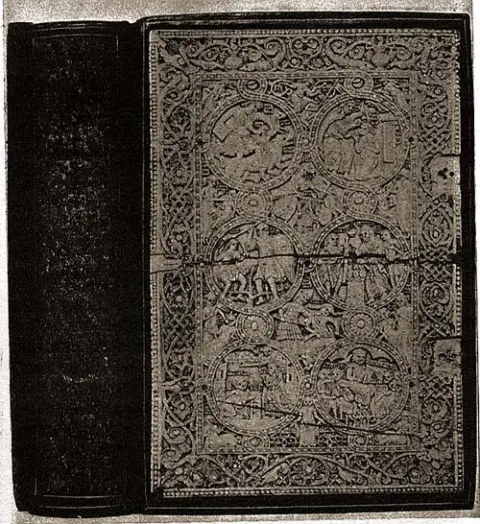
"Illuminated Manuscripts" by John William Bradley is a historical account written in the early 20th century. The book serves as a comprehensive exploration of the art of illumination, detailing its techniques, influences, and significance throughout various periods, as well as the different cultures that contributed to its development. It likely covers topics such as the materials used, various styles and the evolution of methods in manuscript decoration across the ages. The opening of the book introduces readers to the foundational concepts of art and illumination, distinguishing the aims and processes of illumination from those of miniature painting. Bradley elaborates on the origins of specific terms like 'illumination' and 'miniature,' setting the stage for a deeper understanding of the subject. He emphasizes that the art of illumination is about more than mere aesthetics; it seeks to enrich the experience of engaging with text. Additionally, the early chapters outline the materials, such as vellum and parchment, used in creating illuminated manuscripts, establishing a historical context for the subsequent discussions on various artistic styles and their cultural significance.
Introduction adapted from the source catalogue; source summaries may be automatically generated.
Free to read · English · 64,895 words · No account needed
MAKE TIME FOR A GOOD BOOK
On by default. Untick to stop anonymous reading totals. Each page counts after 10 seconds in view. How this works.
Anonymous counting is on unless you have switched it off.
[60] La Renaissance en Italie, etc., 547-8.
An illuminator of the name of Jehan Poyet is said to have assisted in the "Hours," thus while Bourdichon painted the miniatures, Poyet put in the flowers and fruit, etc.; but this share of work is by some believed to belong to a smaller Book of Hours executed for the Queen. Flowers and fruit are said to have been Poyet's speciality, and it is quite possible that he may have had the painting of the borders of the "Grandes Heures," while Bourdichon did the rest. The writer of the MS. was another native of Tours, named Jehan Riveron. During the reign of Francis I. the school of Tours was removed to Paris because the Court had settled there. Louis XII. had died in the Hôtel des Tournelles, and Francis, though full of plans for plaisances elsewhere, lived mostly in Paris. Fontainebleau is the dream of the near future. Il Rosso, the Italian architect, painter, poet, and musician, was busy there amid a crowd of other artists from Florence and Rome--the refuse of a once brilliant sodality. It was the frivolous, pretty, graceful side of Italian art that came northward in that great migration--the graver and more dignified elements were left behind. To see what Italian art became in France, we have only to enter the Grand Gallery at Fontainebleau, and we see it at its best in architecture, sculpture, and painting. And we cannot help admiring it, for it is amazingly beautiful. Yet it is not Italian--the Italian of the Medici and Farnese palaces. Il Rosso was neither a Michelangelo nor a Carracci; but he set a fashion. He changed the face of art for France. Nor was it in painting and sculpture only. The Italian passion for devises, anagrams, emblems, and mottoes became the rage in Paris. It first came in with the return of Charles VIII. from his Neapolitan campaign. Louis XII. adopted the hedgehog or porcupine, with the motto "Cominus et eminus." His Queen Claude's motto was "Candida candidis." The Princess Marguerite's emblem was a marigold or heliotrope; others assigned her the daisy. Her motto: "Non inferiora secutus." The well-known emblem of Francis was a salamander--why, is a mystery--with the motto, "Nutrisco et extinguo." All this entered into the taste of the illuminator, and elegant cartouche frames--probably of Dutch origin, as we see in the old map-books of Ortelius Cluverius and Bleau, imported by Ortelius and his friends into Italy, and made use of by Clovis, and thence transferred to France--were made into border-frames for miniatures, varied with altar-forms, doorways, and other fanciful frameworks from the new architecture decorated with flowers, ribbons, panels, mottoes. Another new thing, too, no doubt afforded plenty of suggestion to the illuminator. This was stained glass. Jean Cousin was in his glory in glass-painting; Robert Pinagrier also. But it was Cousin who adopted the new Italian ideas, and whose works were models for the illuminator. In the backgrounds and details of his glass-paintings at Sens, Fleurigny, Paris, and elsewhere, we may trace his progress; and an excellent model, too, was Jean Cousin. He has other claims to remembrance in sculpture, engraving, authorship, but it is as the glass-painter that his influence is seen in illumination. Indeed, Mr. A.F. Didot strongly urged the probability that Cousin was himself the illuminator of the splendid Breviary or Hours of Claude Gouffier.[61] The drawing is in his best manner, the frame-border of caryatides in camaieu is of a richness of ornamentation in keeping with the rest of the volume. The arms and motto of Gouffier are painted in it. It is objected that Cousin's name does not appear in the Gouffier account-books, while those of other artists are given. But only a portion of the accounts is extant. Cousin may, perhaps, only have designed the book, and the other miniaturists carried out his designs. At any rate, the accounts give us the names of three miniaturists which we may here record--Jean Lemaire, of Paris (1555), Charles Jourdain, and Geoffroy Ballin (1359). These "enlumineurs" are stated to have decorated two Books of Hours for Gouffier's wedding. As a good example of the style employed in the decoration of title-pages, we may quote the chimney-piece of the Château d'Anet, executed for Diane de Poitiers, where a sculptured marble frame surrounds a painted landscape. Many of the books of the time of Francis I. and Henry II. are ornamented in this style.
Your reading position is saved on this browser. Take it to another device with a library code. Reading pages adapt to text, rather than matching a printed edition.
BEHIND THE BOOK
This eBook is for the use of anyone anywhere in the United States and most other parts of the world at no cost and with almost no restrictions whatsoever. You may copy it, give it away or re-use it under the terms of the Project Gutenberg License included with this eBook or online at www.gutenberg.org. If you are not located in the United States, you will have to check the laws of the country where you are located before using this eBook. Read the source licence.
The original source file, including credits and licence, is retained by this library. Request an original-format copy at no charge. Please include the book title and Project Gutenberg identifier #19870.
KEEP YOUR CURIOSITY GOING
Cécile Tormay

Moritz Busch
John L. Ransom
Frances Wright
Cécile Tormay

Mabel Potter Daggett