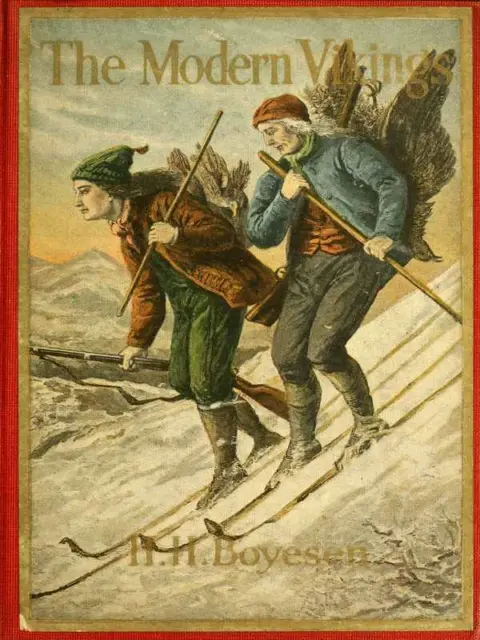
The Modern Vikings: Stories of Life and Sport in the Norseland
Hjalmar Hjorth Boyesen
THE CLASSIC COLLECTION · 1881
"Ilka on the Hill-Top and Other Stories" by Hjalmar Hjorth Boyesen is a collection of narratives likely written during the late 19th century. The central story follows Jelka, a young girl residing in the Tyrol, and her encounters with the inhabitants of a village, including Mr. Julius Hahn, a middle-class concert garden proprietor from Berlin, and his son, Fritz. The collection explores themes of ambition, love, and the contrast between rural simplicity and urban sophistication. The opening of "Ilka on the Hill-Top" introduces Mr. Hahn and his son Fritz, who embark on a summer journey through the picturesque Tyrol region. Their journey is marked by Mr. Hahn's grumbling about the rigors of travel, contrasting with Fritz's admiration for the scenery. Their trip leads them to hear enchanting yodeling voices from the mountains, teasing the theme of artistic aspiration as they learn about Ilka, a local singer, and her love for Hansel, a hunter from the valley. The dynamics between Mr. Hahn, inspired by his daughter's singing potential, and the village's down-to-earth characters set the stage for deeper explorations of social class and personal ambition in the stories that follow.
Introduction adapted from the source catalogue; source summaries may be automatically generated.
Free to read · English · 54,504 words · No account needed
MAKE TIME FOR A GOOD BOOK
On by default. Untick to stop anonymous reading totals. Each page counts after 10 seconds in view. How this works.
Anonymous counting is on unless you have switched it off.
"Ilka, light the candles," said Mother Uberta, sullenly. "And you," she continued, turning again to Mr. Hahn, "find yourself a seat, until we can see what you look like."
"What a vixen of an old woman!" whispered the proprietor of the "Haute Noblesse" to his son, as they seated themselves on the hard wooden bench near the window.
"Small chance for the 'Haute Noblesse,' I fear," responded Fritz, flinging his travelling cap on the clean-scoured deal table.
Ilka, who in the meanwhile had obeyed her mother's injunction, now came forward with two lighted tallow dips, stuck in shining brass candle-sticks, and placed them on the table before the travellers. She made a neat little courtesy before each of them, to which they responded with patronizing nods.
"Parbleu! Elle est charmante!" exclaimed Fritz, fixing a bold stare on the girl's blushing face.
"Bien charmante," replied Mr. Hahn, who took a great pride in the
little French he had picked up when he carried a napkin over his
shoulder.
And indeed, Ilka was charmante as she stood there in the dim candle-light, her great innocent eyes dilated with child-like wonder, her thick blond braids hanging over her shoulders, and the picturesque Tyrolese costume--a black embroidered velvet waist, blue apron, and short black skirt--setting off her fine figure to admirable advantage. She was a tall, fresh-looking girl, of stately build, without being stout, with a healthy blooming countenance and an open, guileless expression. Most people would have pronounced her beautiful, but her beauty was of that rudimentary, unindividualized kind which is found so frequently among the peasantry of all nations. To Fritz Hahn, however who was not a philosophical observer, she seemed the most transcendent phenomenon his eyes had ever beheld.
"To make a long story short, madam," began Mr. Hahn after a pause, during which Mother Uberta had been bristling silently while firing defiant glances at the two strangers, "I am the proprietor of a great establishment in Berlin--the 'Haute Noblesse'--you may have heard of it."
"No, I never heard of it," responded Mother Uberta, emphatically, as if anxious to express her disapproval, on general principles, of whatever statements Mr. Hahn might choose to make.
"Well, well, madam," resumed the latter, a trifle disconcerted, "it makes very little difference whether you have heard of it or not. I see, however, that you are a woman of excellent common sense, and I will therefore be as brief as possible--avoid circumlocutions, so to speak."
"Yes, exactly," said Mother Uberta, nodding impatiently, as if eager
to help him on.
"Madame Uberta,--for that, as I understand, is your honored name,--would you like to get one thousand florins?"
Your reading position is saved on this browser. Take it to another device with a library code. Reading pages adapt to text, rather than matching a printed edition.
Hjalmar Hjorth Boyesen
Hjalmar Hjorth Boyesen
Hjalmar Hjorth Boyesen
Hjalmar Hjorth Boyesen
BEHIND THE BOOK
This eBook is for the use of anyone anywhere in the United States and most other parts of the world at no cost and with almost no restrictions whatsoever. You may copy it, give it away or re-use it under the terms of the Project Gutenberg License included with this eBook or online at www.gutenberg.org. If you are not located in the United States, you will have to check the laws of the country where you are located before using this eBook. Read the source licence.
The original source file, including credits and licence, is retained by this library. Request an original-format copy at no charge. Please include the book title and Project Gutenberg identifier #13929.
KEEP YOUR CURIOSITY GOING

Charles G. (Charles Griffith) Ross
Hannah Webster Foster

Emily Lawless
Edwin Hamlin Carr

Charles De Lano Hine
Andrew Ure