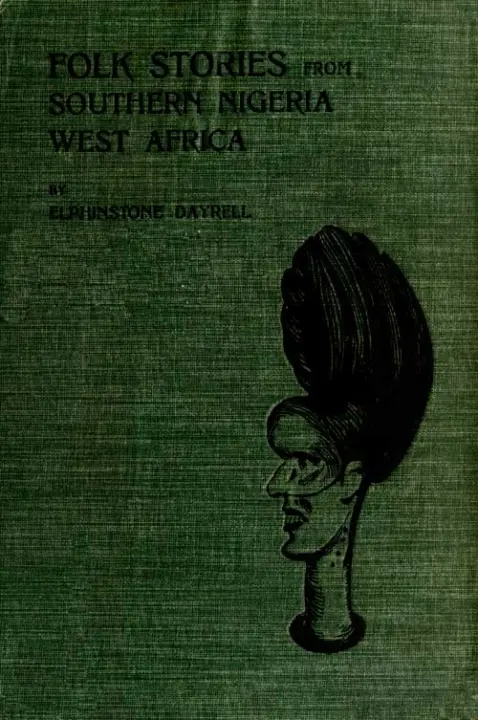
Folk Stories from Southern Nigeria, West Africa
Elphinstone Dayrell
THE CLASSIC COLLECTION · 1913
"Ikom Folk Stories from Southern Nigeria" by Elphinstone Dayrell is a collection of folktales written in the early 20th century. The volume presents a rich tapestry of cultural narratives from the Ikom district, encapsulating various aspects of local traditions, marriage customs, and moral lessons delivered through engaging stories. These tales often revolve around characters like animals, humans, and supernatural beings, each conveying deeper societal values and norms. The opening of this collection sets the stage for a journey into the oral tradition of the Ikom people. Dayrell, drawing upon his experiences and interactions with the locals as a district commissioner, introduces a range of characters, starting with Awu, a woman who abandons one of her newborn twins in the forest out of shame. The story unfolds as the abandoned twin, Agbor, is miraculously saved by a hawk, leading to themes of maternal regret and the connection between animals and humans in their cultural storytelling. This poignant beginning hints at the narratives that blend humor, drama, and moral lessons that are characteristic of folklore, inviting readers to explore the vibrant world of Ikom and its traditions.
Introduction adapted from the source catalogue; source summaries may be automatically generated.
Free to read · English · 63,141 words · No account needed
MAKE TIME FOR A GOOD BOOK
On by default. Untick to stop anonymous reading totals. Each page counts after 10 seconds in view. How this works.
Anonymous counting is on unless you have switched it off.
The chiefs then made a law that, for the future, whenever a man killed another by accident, he should pay two slaves to the father of the dead man, but he should not be killed as he would have been if he had killed the man on purpose.
Told by Ennenni of Okuni.--[E.D., 19.6.10.]
XVI.--HOW OGHABI POISONED HIS FRIEND OKPA AND FAMILY, OR WHY A HOST SHOULD ALWAYS EAT FIRST FROM THE FOOD WHICH HE GIVES TO HIS GUESTS.
Oghabi and Okpa both lived at Inkum. They had always been great friends since they were boys, and when they grew up they made farms in the same place and used to feed together. As they became richer they bought slaves and canoes and lived in separate houses, each man having one wife. At last Oghabi became tired of the farming work and told his friend that he was going to be a hunter. He said that by his hunting he hoped to grow richer, as he intended to go from town to town and sell the meat of the animals he killed while Okpa could be looking after the farm.
For some time all went well with Oghabi, and he made a lot of money by selling his dried meat, but one day he went into the forest with two of his slaves and met with misfortune. He had hunted all day, and killed several buck, and when the evening came he skinned the animals, and having cut them in half placed the meat over the fire to dry in the smoke. He then went to sleep with the two slaves.
During the night a large python came and took one of Oghabi’s legs in his mouth and swallowed it up to the thigh.
Okhabi woke up in great fear and yelled for help, he tried to stand up but could not do so, as his leg was down the snake’s throat. He then called for his hunting knife which one of the slaves gave him, the other slave called Odo snatched a burning stick from the fire and ran off to call Okpa to come and help. But before Okpa arrived Oghabi had cut the snake’s mouth and body right down with his hunting knife and released his leg. The leg was so swollen and inflamed that he could not walk. Okpa arrived shortly afterwards with his wife and together with the help of the slaves they carried Oghabi and the meat he had killed back to his house. Okpa then went home with his wife, but the next morning he went to enquire after his friend, and having stayed a short time he went home again. Later in the day Okpa’s wife came to see Oghabi and had a conversation with his wife. She said she thought there must be something wrong about what had happened the night before as it was not usual for a snake to try and swallow a man, she therefore advised Oghabi’s wife to consult a ju-ju man upon the matter. After she had gone home Oghabi’s wife told her husband what Okpa’s wife had said, and Oghabi agreed and sent off for the ju-ju man at once. When the man came he consulted his skull and then said: “It was your best friend who sent the snake to kill you but I will not mention his name unless you promise to revenge yourself upon him.” As Oghabi only had one good friend he did not want to promise what the ju-ju man asked, but his wife, who had great faith in the ju-ju man, at last persuaded him to pass his word. The ju-ju man then said, “It was your friend Okpa who sent the big snake to swallow you as he is envious of your being a hunter and making more money than him.” Oghabi would not believe this at first, but his wife convinced him after much argument that what the ju-ju man had said was true. From that day Oghabi grew to hate his friend, and when he recovered from the injuries he had received from the snake he began to plot as to how he should revenge himself upon Okpa and his wife. At last he decided to poison them as he did not wish to kill them openly with a matchet. Having got some strong poison from the ju-ju man he told his wife to prepare palm oil chop for Okpa and his family. While she was getting the food ready Oghabi went out and made some tombo, and when he returned he divided the tombo into two calabashes, one large and one small. Into the large calabash he placed some of the poison, and the remainder he put in the palm oil chop. He then got ready and went with his wife to Okpa’s house taking the two calabashes of tombo and the palm oil chop with him. When they arrived Okpa received them gladly and ordered food to be prepared at once. When the food was ready Okpa and his wife sat down and eat it and drank the tombo from the small calabash. Oghabi then told Okpa and his wife that they could eat the food which they had brought for them, and when they had finished they could drink the tombo in the big calabash. Okpa and his wife then called their children together and sat down and eat the poisoned food and drank the tombo, but Okpa’s youngest son would not eat or drink anything.
Your reading position is saved on this browser. Take it to another device with a library code. Reading pages adapt to text, rather than matching a printed edition.
Elphinstone Dayrell
BEHIND THE BOOK
This eBook is for the use of anyone anywhere in the United States and most other parts of the world at no cost and with almost no restrictions whatsoever. You may copy it, give it away or re-use it under the terms of the Project Gutenberg License included with this eBook or online at www.gutenberg.org. If you are not located in the United States, you will have to check the laws of the country where you are located before using this eBook. Read the source licence.
The original source file, including credits and licence, is retained by this library. Request an original-format copy at no charge. Please include the book title and Project Gutenberg identifier #70959.
KEEP YOUR CURIOSITY GOING

Maurice Baring
Francis Greenleaf Allinson & Anne C. E. (Anne Crosby Emery) Allinson
Stuart Dodgson Collingwood
Percy Keese Fitzhugh
Mary Macleod & Edmund Spenser

Cooke Don-Carlos