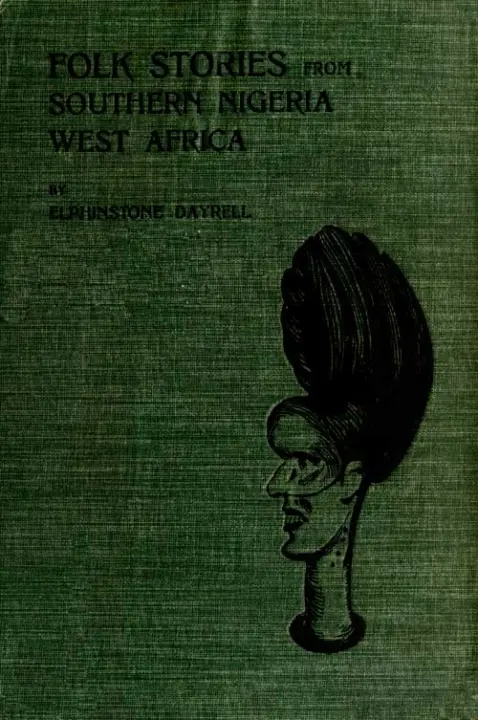
Folk Stories from Southern Nigeria, West Africa
Elphinstone Dayrell
THE CLASSIC COLLECTION · 1913
"Ikom Folk Stories from Southern Nigeria" by Elphinstone Dayrell is a collection of folktales written in the early 20th century. The volume presents a rich tapestry of cultural narratives from the Ikom district, encapsulating various aspects of local traditions, marriage customs, and moral lessons delivered through engaging stories. These tales often revolve around characters like animals, humans, and supernatural beings, each conveying deeper societal values and norms. The opening of this collection sets the stage for a journey into the oral tradition of the Ikom people. Dayrell, drawing upon his experiences and interactions with the locals as a district commissioner, introduces a range of characters, starting with Awu, a woman who abandons one of her newborn twins in the forest out of shame. The story unfolds as the abandoned twin, Agbor, is miraculously saved by a hawk, leading to themes of maternal regret and the connection between animals and humans in their cultural storytelling. This poignant beginning hints at the narratives that blend humor, drama, and moral lessons that are characteristic of folklore, inviting readers to explore the vibrant world of Ikom and its traditions.
Introduction adapted from the source catalogue; source summaries may be automatically generated.
Free to read · English · 63,141 words · No account needed
MAKE TIME FOR A GOOD BOOK
On by default. Untick to stop anonymous reading totals. Each page counts after 10 seconds in view. How this works.
Anonymous counting is on unless you have switched it off.
The chief then called a play for all the young men and young women of the town, and told them what had happened. He also gave them plenty to eat and drink so that they might rejoice with him in his good fortune. Chief ’Ndabu then went to the ju-ju man, taking many presents with him, and having thanked him for his good advice which had turned out so well, he then asked how many children he would have by his wife; and when the ju-ju man said he would have twenty-one children, he was very glad and went home, but he did not tell his wife. The chief then sent his slaves off to the farm to make it larger, as in the future he would have to make provision for a larger household. From the time Iya Agagim conceived, the chief kept her in the house, as he was afraid that if she met any of his former wives they might be jealous, and try to do her some injury.
In due course, the woman gave birth to a boy baby, and the chief held another big play which lasted for three days and nights, and much tombo was drunk. Then the chief went again to the ju-ju man, and having given him a big “dash,” asked whether the boy would live. The ju-ju man said that he would live, and that some day one of his sons would discover something which the Okuni people had never heard of or known before. Then the chief went home. Altogether Iya Agagim gave birth to twenty-one children, and the last boy who was born was called Amoru. The chief then knew that his wife would not bear any more children. As they grew up, whenever he went to his farm, Chief ’Ndabu used to take all his children with him, and there were many people in the town who were very jealous of him on account of his large family. At last, some of the townspeople met together and decided to get rid of the chief and all his family. One of the Okuni chiefs, called Elullo, who was a witch, said that he was willing to go to Chief ’Ndabu’s house at night and see what he could do, but he was afraid of the ju-ju which the chief kept in a corner of the house, as it was very powerful against witches and might kill him. At last, he thought of a plan, so he went to one of Chief ’Ndabu’s former wives, who was called Elilli, and asked her what sort of ju-ju her former husband had to protect him against witches. Elilli then asked him why he wanted to know, so the chief told her that they were tired of Chief ’Ndabu and all his family, and wanted to kill them, but that they were afraid of his ju-ju. Elilli said that she was also very jealous of Iya Agagim having so many children, and that as she was a witch herself she would like to join with Chief Elullo and kill the whole family. Elilli said that the safest way to dispose of them all was to put a witch into Amoru the last born, and that he would take them to his father’s house so that they would not then do anything contrary to the chief’s protecting ju-ju. Chief Elullo then invited Chief ’Ndabu to dine with him, and asked him to bring his wife and all his children. The chief gladly accepted the invitation and Elullo prepared large quantities of palm oil chop and tombo for his guests. One portion of the food he set aside for the boy Amoru, and this portion was bewitched. In the evening Chief ’Ndabu came with his family, and they all enjoyed their dinner. But the prepared food had been given to Amoru who eat it. After they had dined, they all went home and, shortly afterwards, went to bed. During the night, Chief Elullo turned himself into a witch-bird (the owl) and went to ’Ndabu’s house, where he called the boy whom he had witched. By this time a lot of witches had arrived, and when Amoru came out he was surprised to see so many people. Chief Elullo then cautioned the boy never to tell anyone what he saw, and then took him to the place where they cooked human food, and gave him a piece of flesh and some yam to eat. Amoru eat the yam, but took the flesh home and hid it. He hid the meat inside his mother’s fire-place, and covered it over with pots. Although he never spoke about what he had seen, he could not help wondering how it was that he could go in and out of the house when all the doors were fastened. The next night when he heard the witches play in the town, he was compelled by the witch inside him to go and join them, and found when he got to the cooking place that a man had been killed and hung up to the branch of a tree by his neck. Chief Elullo told the boy that they were going to eat the dead man as they had eaten the man the previous night, and that he should have his share as before. Amoru was very frightened when he saw what was done, but dared not say anything. The dead man was then cut up and cooked with yams. When the food was sufficiently cooked it was divided amongst the witches who sat down and eat it, but Amoru only eat the yam and took the meat home and hid it in the same place. Every night for a month and a half the boy attended the feast of the witches, and either a man or a woman was always killed and eaten; but Amoru always took his piece of flesh home and placed it with the other meat. All this time Chief ’Ndabu had been making sacrifices to his ju-ju to protect him against witchcraft, and he used to call all his sons together to sit round the ju-ju while the sacrifices were being made, but Amoru sat outside as he was afraid to go near his father’s ju-ju on account of the witch in him.
Your reading position is saved on this browser. Take it to another device with a library code. Reading pages adapt to text, rather than matching a printed edition.
Elphinstone Dayrell
BEHIND THE BOOK
This eBook is for the use of anyone anywhere in the United States and most other parts of the world at no cost and with almost no restrictions whatsoever. You may copy it, give it away or re-use it under the terms of the Project Gutenberg License included with this eBook or online at www.gutenberg.org. If you are not located in the United States, you will have to check the laws of the country where you are located before using this eBook. Read the source licence.
The original source file, including credits and licence, is retained by this library. Request an original-format copy at no charge. Please include the book title and Project Gutenberg identifier #70959.
KEEP YOUR CURIOSITY GOING

Maurice Baring
Francis Greenleaf Allinson & Anne C. E. (Anne Crosby Emery) Allinson
Stuart Dodgson Collingwood
Percy Keese Fitzhugh
Mary Macleod & Edmund Spenser

Cooke Don-Carlos