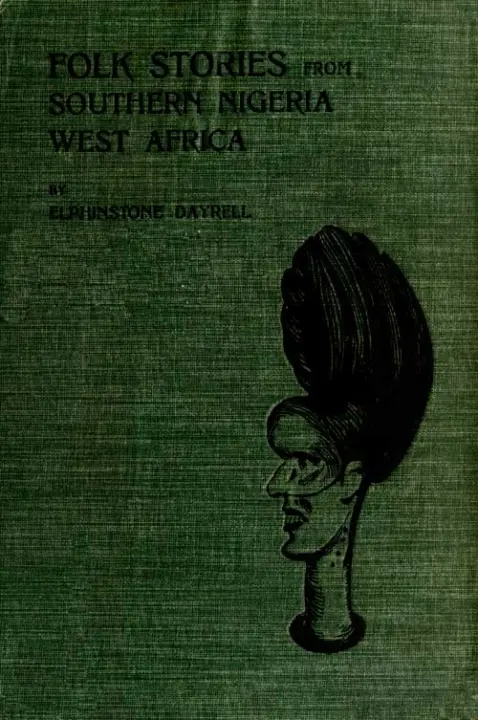
Folk Stories from Southern Nigeria, West Africa
Elphinstone Dayrell
THE CLASSIC COLLECTION · 1913
"Ikom Folk Stories from Southern Nigeria" by Elphinstone Dayrell is a collection of folktales written in the early 20th century. The volume presents a rich tapestry of cultural narratives from the Ikom district, encapsulating various aspects of local traditions, marriage customs, and moral lessons delivered through engaging stories. These tales often revolve around characters like animals, humans, and supernatural beings, each conveying deeper societal values and norms. The opening of this collection sets the stage for a journey into the oral tradition of the Ikom people. Dayrell, drawing upon his experiences and interactions with the locals as a district commissioner, introduces a range of characters, starting with Awu, a woman who abandons one of her newborn twins in the forest out of shame. The story unfolds as the abandoned twin, Agbor, is miraculously saved by a hawk, leading to themes of maternal regret and the connection between animals and humans in their cultural storytelling. This poignant beginning hints at the narratives that blend humor, drama, and moral lessons that are characteristic of folklore, inviting readers to explore the vibrant world of Ikom and its traditions.
Introduction adapted from the source catalogue; source summaries may be automatically generated.
Free to read · English · 63,141 words · No account needed
MAKE TIME FOR A GOOD BOOK
On by default. Untick to stop anonymous reading totals. Each page counts after 10 seconds in view. How this works.
Anonymous counting is on unless you have switched it off.
It is noteworthy that when you get over the watershed between the Cross River and the Katsena (Niger), and into the Munchi country, ju-ju does not seem to exist in the same way as it does further south. In the year 1909, while I was Political Officer on the Anglo-German Boundary Commission, I marched up through the Munchi country into Northern Nigeria, and back again, being absent from my district altogether about six months. During the whole of that time there was not a single death in any of the Munchi or Domi towns where I stayed. It was so noticeable that even the soldiers and carriers remarked upon the absence of deaths, and could not understand the reason. It may have been that the country was more healthy, and we may have been very fortunate, but the fact remains that where there was no ju-ju there were no deaths, and when we returned to the country of ju-ju deaths were of frequent occurrence.
It has been suggested in one of the criticisms on my Folk Stories from Southern Nigeria that the native words should be given on one side of the page, and a fairly literal translation on the other. This would, however, involve a larger expenditure of time than I have at my disposal. There are ten different languages spoken in this district, and it would be extremely difficult to give exact translations of the stories, particularly as some of them as told would be quite unfit for publication. The stories have, however, been set down as nearly as possible in the way they were related to me, the only alterations made being those necessary to render the tales into simple English, as bush English would not be understood, and certain passages containing objectionable matter have been omitted.
In some of the stories it may be noticed that articles such as plates, glasses, bottles of gin, brass pans, and pots have been mentioned, also the use of locks and keys has been introduced into at least one of the tales, although it is quite obvious that the above-mentioned articles could not have existed in this country when the majority of the stories were first related, I have written them down when they were so translated by the interpreter. It is not difficult to understand how some of the things crept into the stories. For example, demijons (which are brought up river from Calabar filled with rum) are used every day in most of the towns for tombo, and glass tumblers are also quite common, and it is easily conceivable that a native, who is accustomed to using these articles, in relating a story might say in his language the equivalent for “The pourer-out then took the demijon of tombo and poured some into a glass which he gave to the chief,” instead of saying, “The pourer-out then poured some tombo from the calabash into the drinking-horn which he handed to the chief.” The latter translation would probably be far nearer to the original version. It is also extremely doubtful whether brass rods, which are mentioned so frequently, existed at the date of many of the stories. The approximate date of the importation of rods into this country is probably known, and cannot be more than about sixty years ago, and most likely considerably less. The author is of the opinion that in the early days there was no form of native currency in the Ikom district. At the present time, rods are not used further north-east from Ikom than Umbaji, and in 1909, whilst on the Anglo-German Boundary Commission, he found that there was no form of native currency at Bassankwala, and no substitute therefore, with the possible exception of a few native forged iron hoes which found their way down from the north-west, and had a fixed marketable value. But the use of these implements is doubtless of a comparatively recent date, as nearly all the natives in that part use wooden hoes lashed on to the bent handles with tie-tie. In the country mentioned, all trade was and is still done by a system of barter and exchange. The Umbaji people exchanging salt and house rats (which form an article of diet for the Bassankwala people, who are cannibals) for palm oil and yams. The Bassankwala people admitted to the author that they ate human beings, and had always done so, but they asserted vehemently that they did not eat their own dead--these they passed on to the next town, who sent them theirs in exchange. Prisoners taken in fighting or people killed were also eaten, and, from what the adjoining countries told the author, natives straying into their bush were similarly treated. These people, however, all promised, and were apparently perfectly sincere, at once to stop this abominable practice, at the same time saying that they were unaware they had been doing wrong, as they had never heard the white man’s laws before.
Your reading position is saved on this browser. Take it to another device with a library code. Reading pages adapt to text, rather than matching a printed edition.
Elphinstone Dayrell
BEHIND THE BOOK
This eBook is for the use of anyone anywhere in the United States and most other parts of the world at no cost and with almost no restrictions whatsoever. You may copy it, give it away or re-use it under the terms of the Project Gutenberg License included with this eBook or online at www.gutenberg.org. If you are not located in the United States, you will have to check the laws of the country where you are located before using this eBook. Read the source licence.
The original source file, including credits and licence, is retained by this library. Request an original-format copy at no charge. Please include the book title and Project Gutenberg identifier #70959.
KEEP YOUR CURIOSITY GOING

Maurice Baring
Francis Greenleaf Allinson & Anne C. E. (Anne Crosby Emery) Allinson
Stuart Dodgson Collingwood
Percy Keese Fitzhugh
Mary Macleod & Edmund Spenser

Cooke Don-Carlos