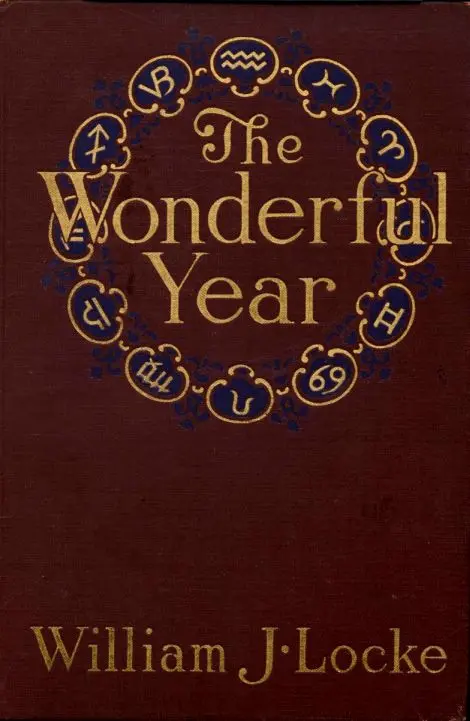
The Wonderful Year
William John Locke
THE CLASSIC COLLECTION · 1905
"Idols" by William John Locke is a novel written in the late 19th century. The story revolves around the complex relationships between three main characters: Irene Merriam, her husband Gerard, and his close friend Hugh Colman. As the narrative begins, it explores themes of love, loyalty, jealousy, and the societal pressures that accompany personal choices. At the start of the novel, two men commit a crime that sets off a chain of events affecting four seemingly unrelated lives. We are introduced to Irene Merriam, a content woman reflecting on her happy life with Gerard and Hugh, both of whom share a deep connection with her. As they engage in conversation and display their differing natures, tensions begin to emerge, particularly with Irene's compassionate concern for a Jewish girl named Minna Hart, who quickly becomes tied to them as her character unfolds. The early chapters lay the groundwork for dramatic developments and moral conflicts rooted in love, friendship, and societal constraints, hinting at deeper struggles to come.
Introduction adapted from the source catalogue; source summaries may be automatically generated.
Free to read · English · 80,379 words · No account needed
MAKE TIME FOR A GOOD BOOK
On by default. Untick to stop anonymous reading totals. Each page counts after 10 seconds in view. How this works.
Anonymous counting is on unless you have switched it off.
“It is devilish hard lines on me, Colman, you know. When I advanced you that money, I thought your inheritance was as safe as a mortgage. You are aware it is not my usual way of doing business. This is not an actual reversion; it’s only a convenient term. But I liked you, and somehow it’s pleasant now and then to do a friend a good turn.”
“I am deeply aware of all that,” said Hugh.
“And, as I mentioned, I considered the security safe.”
“So did I. You can scarcely blame me.”
“I believe you,” said the old man, cordially. “You meant to play square, I know. Otherwise you wouldn’t be here, would you? But, all the same, if your uncle were to die to-morrow, I should be done out of £5,000. I don’t pretend to say that £5,000 would break me. Thank God I can run to six figures with something bigger than a ‘1’ in front any day, when all is called in. But money is money. Now, as a gentleman, would you feel morally justified in abiding by your legal rights?”
“No,” said Hugh, “I wouldn’t. But circumstances----”
“I know,” interrupted the money-lender, with upraised hand. “They aren’t quite yet what they ought to be. But you are going to be a successful man. They will alter. Now I have a friendly proposal to make to you.”
“And I am coming with one to you, Mr. Hart,” said Hugh, with a smile. “And I think you had better hear mine first. You consider me an honest man?”
“I do.”
“And you don’t disapprove of me personally?”
“On the contrary, I’m very pleased and proud to call you a friend of mine. You wouldn’t have had my money otherwise.”
“Then, Mr. Hart, you make easier what I have to say. It concerns your
daughter, Miss Hart.”
“What? Minna--my daughter?” said the old man, with a sharp change of
tone.
“I have the honour to ask you for her hand in marriage.”
“You!”
An indescribable change came over the old man’s face. Instantly it lost the sleek and coarse materialism of the money-getter, the half-sensual content of the easy-going man who has well dined, the patronising geniality of the prosperous host. A fire glowed in his eyes. His Jewish features seemed to grow more prominent. The grey beard framed a strange, patriarchal dignity. The Jew, proud and unconquered through centuries of oppression, overwhelming all other accidents of life in the eternal arrogance of race, was regarding, with angry and incredulous scorn, the Gentile, the hybrid child of yesterday.
“You!” he repeated, almost insultingly.
Your reading position is saved on this browser. Take it to another device with a library code. Reading pages adapt to text, rather than matching a printed edition.
William John Locke
William John Locke
William John Locke
William John Locke
BEHIND THE BOOK
This eBook is for the use of anyone anywhere in the United States and most other parts of the world at no cost and with almost no restrictions whatsoever. You may copy it, give it away or re-use it under the terms of the Project Gutenberg License included with this eBook or online at www.gutenberg.org. If you are not located in the United States, you will have to check the laws of the country where you are located before using this eBook. Read the source licence.
The original source file, including credits and licence, is retained by this library. Request an original-format copy at no charge. Please include the book title and Project Gutenberg identifier #56015.
KEEP YOUR CURIOSITY GOING
Coulson Kernahan

Maurice Baring
Frances Wright
Cécile Tormay

Frederic Jesup Stimson

W. H. P. (William Henry Pope) Jarvis